The acquisition of @ takes one more step. It relies on the assumption that physical possession of an object as a requirement for an acquisition is no longer necessary, and therefore it sets curators free to tag the world and acknowledge things that “cannot be had” – because they are too big (buildings, Boeing 747’s, satellites), or because they are in the air and belong to everybody and to no one, like the @ – as art objects befitting MoMA’s collection. The same criteria of quality, relevance, and overall excellence shared by all objects in MoMA’s collection also apply to these entities.
Which is all lovely and conceptual and quasi-Dadaist and I’m sure it will annoy Brian Sewell, but it does open up a new can of Vermeers. I mean, if acquisition is not dependent on ownership, could MoMA announce that they’ve just acquired the Mona Lisa? And if the principle extends to buildings, could Tate Modern announce that they’ve just acquired MoMA?
Oh dear, it’s all gone a bit death-y, hasn’t it? Yesterday we got the sad news that both Charlie Gillett (we can forgive the Dire Straits business, because he gave us Ian Dury, Lene Lovich and The Sound of the City, one of the first books that persuaded me that writing about pop music might not be an utter waste of time) and Alex Chilton (am I the only person prepared to admit to preferring the Box Tops to Big Star?) had checked out, and this morning I found that Fess Parker, the man in the coonskin cap, had gone the same way.
Amidst the carnage, I almost missed the fact that Pierrot Bidon had also died. He was the man behind the extraordinary circus collective Archaos; by combining athleticism, nihilism and a smart eye for a bit of publicity, it added a bit of danger to the Edinburgh Fringe in the days before that venerable institution effectively turned into an open audition for people who aspire to be on Mock The Week. With its rough edges sanded down a bit, the Archaos meme was tweaked into the success of Cirque du Soleil, Stomp, the Blue Man Group and those strange people who dangled from ribbons at the Millennium Dome.
I was lucky enough to see Archaos in 1989, which was (I think) their first time in Edinburgh. Buzzes were still created by word of mouth in those days, and all of a sudden the only buzz going was about these stinky French crusties who’d been doing motorcycle stunts during the afternoon rush hour on Princes Street. Unusually for the Fringe, the show itself lived up to the hype, all fire-breathing punks, juggling chainsaws and topless trapeze artists. It was the sort of show where the audience leaves quietly, not because they are underwhelmed, but because there is nothing left to say, not at least until you bump into someone who hasn’t seen it yet.
They showed it on TV that Christmas. It was good, but there was something missing; the smell. For two decades, I’ve been telling people it was “the smell of cordite” but as I came to write this, I realised I wasn’t entirely sure what cordite was, beyond something a bit explosive, not to mention smelly. It turns out that cordite has been obsolete for decades; now I don’t know what smell it was that the TV show lacked, but it was important. And now Pierrot isn’t around to tell me.
PS: Mark Borkowski eulogises Bidon at greater and more informed length, starting here.
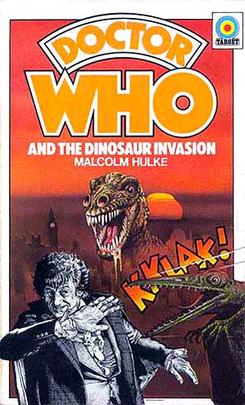
Back in the olden days, when we were all analogue, I was rather fond of Doctor Who. But this wasn’t just about the sacrosanct ritual of Saturday evenings (did anyone actually try to hide behind their sofas, most of which were surely flush against the wall?) but also about the books. In those pre-video days, the Target novelisations were pretty much the only way you could relive your favourite stories, or discover the ones that had been shown before you were sentient.
The thing is, the books were a sort of parallel universe to DW as seen on TV, essentially similar, but with additions and subtractions, especially when the author was someone other than the original scriptwriter. Subplots, back stories, peculiar Biblical allusions would be thrown in to replace something that wouldn’t work so well in the new medium, to pad out the word count, or just to allow the writer to indulge his personal obsessions.
Moreover, although the books ultimately derived from the scripts, there was little explicit connections with the broadcast programmes. Opposite the title page in each volume was a sentence headed “THE CHANGING FACE OF DOCTOR WHO”, which would put the relevant incarnation of the Time Lord into contex. For example: “The cover illustration of this book portrays the third Doctor Who whose physical appearance was altered by the Time Lords when they banished him to planet Earth in the Twentieth Century.” But there was no reference to the actor who played the Doctor (in this case, Jon Pertwee), nor were any stills from the show included in the books. Instead, we had to make do with line drawings (eventually phased out) and cover art that was of distinctly variable quality, but still hangs around in the memory many decades after I got rid of my collection, about the time of the second Romana.
I’ve been reading a piece about the veteran film critic Roger Ebert, who as a result of cancer, or more specifically the attendant surgeries and complications, has had most of his lower jaw removed. Now he can’t eat, drink or speak, which would strike most observers as a horrible state of affairs. But it’s this passage that really struck home:
...because he’s missing sections of his jaw, and because he’s lost some of the engineering behind his face, Ebert can’t really do anything but smile. It really does take more muscles to frown, and he doesn't have those muscles anymore. His eyes will water and his face will go red — but if he opens his mouth, his bottom lip will sink most deeply in the middle, pulled down by the weight of his empty chin, and the corners of his upper lip will stay raised, frozen in place. Even when he’s really angry, his open smile mutes it: The top half of his face won’t match the bottom half, but his smile is what most people will see first, and by instinct they will smile back. The only way Ebert can show someone he’s mad is by writing in all caps on a Post-it note or turning up the volume on his speakers. Anger isn’t as easy for him as it used to be. Now his anger rarely lasts long enough for him to write it down.
This does make Ebert sound a bit like Canio in Pagliacci or, according to one’s inclinations, James Stewart in The Greatest Show On Earth or Marcel Marceau’s The Maskmaker; the clown who needs/is forced to keep a happy face for the world, whatever might be happening inside. And the fact that Ebert’s fans still expect him to make his trademark thumbs-up gesture 2,078 times a day just adds to the impression of compulsory jollity.
I tend to have the opposite problem. Even if I’m in a relatively jolly mood, my default setting is one of moderate disgruntlement. I’m the sort of person to whom perfect strangers feel able to chirrup that indicator of gittishness, “Cheer up, it may never happen.” Which makes me wonder whether there’s an equivalent that can be directed towards the permanently cheerful? Maybe we should just walk up to them, stare directly into those vast, shiny, 24-hour grins and whisper: “You do realise it’s happened?”
I think next time somebody asks me to explain Baudrillard or McLuhan or Ballard or, I dunno, Gary Numan, I’ll just show them this image. Does the fact that it’s actually a T-shirt add or detract? From Concrete Rocket, via Culturepopped.
PS: And on similar lines, read this story from Korea, if you can bear it.
Every year I succumb to the same bout of irrational anxiety at the supreme wrongness of the decisions taken – even the decisions that have yet to be taken – by the Academy, and now is no exception. How could anybody, I rant like a student, watch both Avatar and The Hurt Locker and come out of the experience thinking that Avatar is better? Surely this a distinction that leaps beyond mere opinion, and becomes an objective fact? Informed word (well, what Mark Kermode reckons) is that Cameron's pretty-yet-elephantine parable of ecology and colonialism and stuff is due for the top Oscar, although Kathryn Bigelow will be the first laydee to get the Director gong.
What’s odder still is that the standard medium through which studios plug their products to potential voters is still the DVD, which should in theory put Avatar at a disadvantage. It’s a film that screams for scope and grandeur, which is one of the reasons it left me a bit cold; it’s as if Cameron looked at the technology first, the 3D and the CGI and the IMAX, and then made a film to fit. Anything other than a six-storey screen will diminish its blue-hued grandeur. Whereas The Hurt Locker, although I’m sure there’s plenty of clever technical stuff going on there, benefits from its very modesty. It’s a war film, but a modern one, about bombs and snipers and skirmishes and damaged men, rather than swarms of extras sweeping over the plains.
In fact, only last night I saw The Hurt Locker in its ideal environment; in a crowded minibus, on a dodgy disc picked up for 20 baht (about 40p) on the Thailand-Laos border. The claustrophobia, heat and bumpy roads all added to the deliciously uneasy atmosphere; as did the policeman who flagged us down, told us all to get off the bus, looked grumpy for about five minutes and then let us carry on.
The English subtitles made the whole thing weirder yet. Rather than being transcribed from the original soundtrack (a practice that has its own drawbacks, as one might imagine), these seemed to be the result of transcribing the Thai soundtrack and then feeding the resulting text through some kind of translation engine. And inevitably we couldn’t turn the bloody things off.
Highlights: the protagonist’s name being rendered as “vegetarian food”; all expletives, of which there are many, becoming “mad hey!”; and the regular on-screen reminder of how many days the grunts have left in Iraq (which surely didn’t need to be translated into English text in the first place, since they’re up there in English even in the Thai version) morphing into “intractable fungus budget”.
PS: Ah. Recent events have conspired to make the above post rather redundant. Just ignore me, I would.
 The acquisition of @ takes one more step. It relies on the assumption that physical possession of an object as a requirement for an acquisition is no longer necessary, and therefore it sets curators free to tag the world and acknowledge things that “cannot be had” – because they are too big (buildings, Boeing 747’s, satellites), or because they are in the air and belong to everybody and to no one, like the @ – as art objects befitting MoMA’s collection. The same criteria of quality, relevance, and overall excellence shared by all objects in MoMA’s collection also apply to these entities.