Showing posts with label writing. Show all posts

Tuesday, January 13, 2026

About Murakami and resolutions


The title of this blog comes from a line in Haruki Murakami’s novel Dance Dance Dance and if you’d asked me in 2005, when I started this thing, I would probably have said that Murakami was my favourite living writer. He was certainly the only one whose books I’d automatically buy as soon as they appeared, in hardback, without reference to the reviews. I was a completist, hoovering up his hard-to-find early books, his non-fiction, the various critical works (at one point I considered a name change to Cultural Scentlessness) and then, and then... I’m not sure if I changed or he did, but I realised the hardback of Killing Commendatore had sat on my shelf unread all the way through lockdown and poor old Nobel bridesmaid Haruki-san became one of his own passive anti-heroes, dumped and left alone with his spaghetti and jazz records and cat.

But then, just before Christmas, I needed to buy a last-minute Secret Santa gift and the only useful shop in the vicinity was a branch of Waterstone’s and the gift I chose wasn’t a book and I always feel awkward if I go into a bookshop and buy only non-book things (and if you’re reading this, I suspect you’re the same) and I chanced upon a Murakami I hadn’t noticed before, his non-fiction anthology Novelist As A Vocation. So I bought it. And now I’ve read it.

Two takeaways. One is a quotation:

People who absolutely love school, and feel sad when they can’t go, probably won’t become novelists.

And the other is an anecdote from Murakami’s early writing life (and not that one about the revelation at the baseball game). When he was grappling with his first book, Hear The Wind Sing, he translated it into his decent but imperfect English, thus simplifying the style and sentence structure, and then put it back into Japanese.

Which ties nicely into my two resolutions for the coming year. First, to rationalise all the half-formed story ideas on my hard drive, and prompted by the fact that great many of my friends (here and here and here and here and here) have got their authorial arses in gear in recent months, I’m going to knuckle down and actually write another bloody book. (I mean, Julian Barnes has retired so I guess there’s a vacancy.) And because I’m frequently shamed by the hard grind that my students put in to perfect their English language skills, I need to get my own grasp of French back to some semblance of adequacy. So, let’s begin. From a novel that’s been simmering for the past few years:

La dernière chose que j’ai goûtée, c’était un pigeon.

Let’s see where that takes us. 

PS: Also from the book, the normally apolitical Murakami dips a toe into the murky waters of identity:

I might, at one time, become a twenty-year-old lesbian. Another time I’ll be a thirty-year-old unemployed househusband. I put my feet into the shoes I’m given then, and make my foot size fit those shoes, and then start to act... Basically I just go with the flow. And as long as I’m following that flow I can freely do all sorts of things that are hardly possible. This is indeed one of the main joys of writing novels.

And, possibly a touch of that cultural scentlessness:

...I get the sense that in Japan and Asian countries the “modern” that necessarily precedes the “postmodern” did not, in a precise sense, exist.

Sunday, November 02, 2025

About books about books

Recent reading has got a wee bit meta. First, Tim Parks in Where I’m Reading From (compiled from his articles in the New York Review of Books) about the effect that publication, or the absence thereof, has on writers, in particular those who inhabit creative writing courses:

Why do we have this uncritical reverence for the published writer? Why does the simple fact of publication suddenly make a person, hitherto almost derided, now a proper object of our admiration, a repository of special and important knowledge about the human condition?

And from Robin Ince’s Bibliomaniac, this snippet about things that fall out of the books of the dead (in this case the departed being Ince’s own father):

Within two days I had collected 74 bookmarks and there will be many more to find, some leather ones with fading cathedrals embossed upon them...

...and I wonder whether, had this been submitted to one of the tutors described by Parks, she or he might have red-penned the ambiguity: is it the cathedrals that are fading, or their embossed representations? But I rather like it.

Sunday, August 17, 2025

About writing a screenplay

From Then We Came To The End, by Joshua Ferris. How many of us can identify, however uncomfortably, with this?

He had another screenplay about a disaffected and cynical copywriter suffering ennui in the office setting while dreaming of becoming a famous screenwriter, which he claimed was not autobiographical.

Thursday, March 20, 2025

About LibGen

Every time someone reveals a massive cache of copyrighted material that’s being used as raw material for AI training, without any thought of compensation to the authors, I join in with the performative outrage, while at the same time being slightly miffed that nothing from my oeuvre was thought worthy of ripping off. I suppose it’s like having a phone or a bike that’s just too old and/or crap to nick. But now I look through LibGen, the vast database of samizdat that Meta has used for its own murky ends, and three whole works of mine are there. At last I can meld my righteous indignation with the warm glow of smugness.

Sunday, March 16, 2025

About literary fiction

Back in the olden days I started a blog about The Da Vinci Code, attempting to deconstruct exactly what Dan Brown was doing right/wrong, attracting millions of readers while at the same time breaking pretty much every rule of half-decent writing (including those followed by other writers of popular, non-literary fiction). I gave up, of course, but I was never dissuaded from my initial premise that the book is badly written. What might have shifted is whether, in a post-literate era, that matters any more.

And now, after all these years, in The Spectator of all places, one Sean Thomas reads the last rites to what may once have been identified as good books, the ones that dominated the cultural agenda in the 80s and 90s. Except, he’s quite glad to see the genre go, even though he (like me) was a bit of an Amis fanboy back in the day. And what was it turned his head around? Why, The Da Vinci Code, of course, because it privileged plot over navel-gazing. But what about the writing, the thing that made critics’ teeth hurt just from thinking about it? Thomas describes that as “all quite workmanlike”.

It’s not though, is it? It’s crap. Go back to my blog for myriad examples. I can only infer that Mr Thomas has had some unfortunate run-ins with workmen.

PS: Just before posting, I Googled Sean Thomas and discovered that he’s the son of DM Thomas, whose novel The White Hotel was pipped to the Booker Prize by Midnight’s Children. From which I won’t draw any conclusions. I’ll just leave it there.

Friday, May 03, 2024

About teaching and crying

Zadie Smith on teaching creative writing in New York (spotted by Padraig Reidy):

They said workshop, so I took a story of mine that I’d written when I was young and was bad, and marked it up in front of the class. And I took a story of theirs and did it on a lightbox. And the student started crying. NYU explained to me that that is not what they meant. So I went down several gears.

Tuesday, January 23, 2024

About Barthes

Stolen from someone. Can’t remember who, which is grimly appropriate, I guess. Not for the first time, I think how much Barthes would have relished social media.


Also, from John Lanchester’s The Debt to Pleasure
Roland Barthes observes somewhere that the meaning of any list of likes and dislikes is to be found in its assertion of the fact that each of us has a body, and that this body is different from everybody else’s. This is tosh. The real meaning of our dislikes is that they define us by separating us from what is outside us; they separate the self from the world that mere banal liking cannot do.

Monday, January 15, 2024

About Ballard

In 1974, JG Ballard gave an interview to an 18-year-old admirer, Akihiko Kokuryo, and offered a message to readers of the speculative fiction magazine in which it was published. Translated into Japanese and then back into English it feels like a pretty good way of coping with the modern world that he predicted so well, so often: 

I hope that you will always be skeptical, passionate, analytic, revolutionary, idealistic, dream-like, serene and hallucinated.

And in searching for an image, I find this clipping. We all have those mammoth novels deep inside, don’t we?

Wednesday, December 27, 2023

About adaptation


By Siân Ejwunmi-Le Berre, whose TV adaptation of Agatha Christie’s Murder is Easy starts tonight, and will probably annoy a) people who’ve read it and have a particular idea in their heads of how it should be be, which is fair enough, and b) people who haven’t read it but aargh, there’s a black man in it.

I’ve come to think of adaptation as a conversation between two writers, colliding at a specific moment in time like strangers at a dinner party... But the scriptwriter shouldn’t dive too deeply into the author’s opinions and beliefs – it’s a party after all, not an interrogation. Adaptation is not some kind of biography. How rude would that be? Like Googling your fellow guests under the dinner table... As an adaptor, there’s no need to become an expert in the writer behind The Book. I take them at their word, in the moment of writing, as expressed on the page alone. Their past, their future, are none of my concern.

PS: Unfortunately, it wasn’t very good. 

Friday, December 15, 2023

About reading

A study at the University of Valencia has cheered up grumpy Luddites everywhere by concluding that reading printed texts improves comprehension more than reading digital matter does. But they’re not entirely sure why. One theory is that the “linguistic quality of digital texts tends to be lower than that traditionally found in printed texts.” In other words, to mangle McLuhan, it may be about the message rather than the medium; if I print out this blog post, it doesn’t miraculously get better. Or, as techies have asserted since the days of Babbage, garbage in, garbage out.

Saturday, March 04, 2023

About bad writing

Alan Moore
Read terrible books, because they can be more inspiring than good books. If you’re inspired by a good book, there is always the danger of plagiarism, of writing something too close to it. Whereas a genuinely helpful reaction to a piece of work that you’re reading is: ‘Jesus Christ, I could write this shit.’ It’s immensely liberating. Analyse what they’re doing badly and you’ll discover all the mistakes not to make.

And, in the course of a pretty depressing article about the death of English Literature as an academic discipline, Nathan Heller attempts to clarify Lionel Trilling’s notions about why it might still matter:
... one of those pursuits, like acupuncture or psychoanalysis, which seem to produce salutary effects through mechanisms that we have tried but basically failed to explain.

Monday, January 23, 2023

About ChatGPT

Music critic Simon Reynolds is sanguine regarding the threat that an AI program such as ChatGPT might present to his trade:

...A.I. has no need to write, either — no deep-seated motivation to put words on paper or on screen. The kind of texts it generates resemble what I think of as “motiveless” writing, like school homework, or advertorial. Proper music criticism, even if done to earn a living, is closer to the sort of willed writing that fills diaries, journals and poems — where the compulsion to write is internal rather than externally imposed.

Except that what he (and, if you were to put a gun to my head, I) would define as “proper music criticism” has been in retreat for years, squeezed out by the twin monsters of economics and technology in favour of, well, advertorial. Mr Reynolds may well survive the onslaught, but any number of lesser names may not be so lucky.

In other news, I had a go with the program, and this happened:


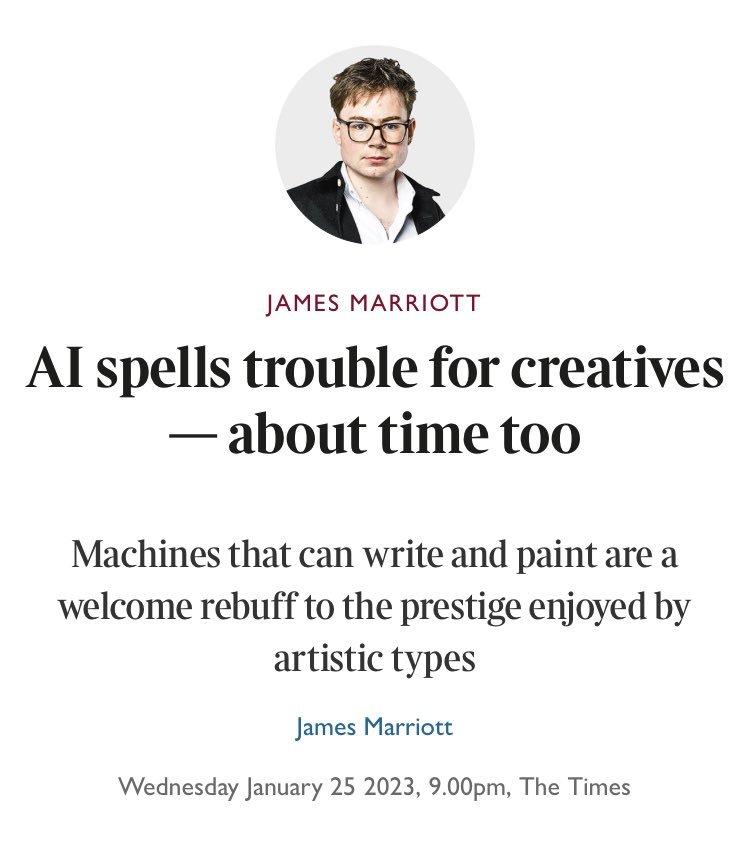
PS: Also this, from The Times. “Artistic types” indeed.

Thursday, October 13, 2022

About 1922

Searching for something else, I find this:


In the context of the other papers it's bundles with, I'd say it's from about 2004. I think it's a plan for one of several interations of a book that I'd started writing in about 1991, with the rather presumptuous idea of updating Ulysses and moving it to London. The “one-eyed man” is presumably the equivalent of Joyce's bigoted Cyclops and I guess the fictional pubs and cafés (if that's what they are) are meant to be analogous to the places where Bloom and Dedalus hang out. 

The middle column is packed with references to what I was probably reading around that time. I'd hope that Coupland, Zadie and M Amis are self-explanatory; The Mezzanine is by Nicholson Baker, Mystery Train by Greil Marcus (unless it’s the Jim Jarmusch movie or the Elvis song) and Mammon Inc, which I confess I'd entirely forgotten, by Hwee Hwee Tan. But why are they there? Is Dorian about Oscar Wilde or Will Self or the next-door neighbour from Birds of a Feather? Habbakuk? Jaspberry Ram? And as for the third column, what the hell might “crap food typing qvc” mean? 

The most coherent (or least incoherent) references (“hollow men”; “weialala”; “coffeespoons”) are to TS Eliot and I think I had the idea of weaving these into the cod-Joyce framework on the basis that, well, Ulysses and The Waste Land were both published in 1922, so, er, there's that. Which means that if I hadn't mislaid this scrap amidst a bundle of letters from my bank and cuttings about Morrissey, I might have come up with something that was worth publication this year.

And then I remember that I had the bright idea of inserting myself in the narrative, rather as Martin Amis does in Money. The gag was that I’d be working in a cloakroom (maybe in club “”, almost certainly a nod to the Modern Review’s love-hate relationship with ironic quotation marks) and would filch a peanut-packed chocolate bar from the protagonist’s jacket, enabling me to deploy a riff on the line, “and I have seen the eternal Footman hold my coat, and snicker”. Which, apart from being a truly lame joke, is from Prufrock rather than The Waste Land. That said, there does seem to be a reference (“brekkek”) to Finnegans Wake in there, which I haven’t even read (who has?), so maybe I was just chucking around several fistfuls of supposedly cool quotations and hoping that some of them would stick.

Anyway, what pet projects did you think were a good idea at the time, but now you’re deeply thankful they never saw the light of day?

PS: Rather good documentary about The Waste Land, on BBC2 of all places.

Wednesday, June 08, 2022

About Missed Connection

I suddenly half-remembered this story a few months ago (What was the time frame? Was it in the New Yorker?) and started to wonder whether I’d imagined it. So this isn’t really a post, more a placeholder, something that in a few years’ time may assure me that it was real. 

I saw you on the Manhattan-bound Brooklyn Q train. I was wearing a blue-striped t-shirt and a pair of maroon pants. 

You were wearing a vintage red skirt and a smart white blouse. We both wore glasses. I guess we still do...

Thursday, April 01, 2021

I remember (part one)

 (An explanation.) 

I remember watching the Marx Brothers’ movie A Day At The Races for the first time, on TV, when somebody repeated a reel by mistake; and I was so wrapped up in the lunacy, I just assumed it was part of the film. 

I remember Richard Nixon’s blood clot.

I remember Stanley Green the protein man and Lord Mustard the tap-dancing busker. 

I remember answering the phone with a number. 

I remember the London Planetarium. 

I remember when everybody had a poster of Béatrice Dalle.

I remember Hercules the Bear and Victor the Giraffe. 

I remember the death of General Franco. I didn't know who Franco was or why it was important; but my mother said it meant her friend Carmen could go home now. 

I remember polo necks under shirts. 

I remember “Nicholas Parsons is the Neo-Opiate of the People”.

Monday, March 15, 2021

About symbolism and the like

I’ve long admired Samuel Beckett’s exasperated response to overreaching critics, that if he’d really meant his play to be about God he would have called it Waiting for God. Haruki Murakami (who, as I usually point out at moments like this, bequeathed the title of this blog) is inevitably more polite, but he comes from pretty much the same place:

I’ve had a number of opportunities to discuss my work with college students in their classes, and the students always seem to end up confused, because they can’t find the theme or the point of my stories. But that doesn’t bother me at all.

Sunday, December 13, 2020

About beginnings

Wednesday, December 09, 2020

About writing about music


The first proper book about music I read was Philip Norman’s Shout! And because it was the first, and because I was 13 years old, I accepted its analysis, that the recently deceased Lennon was the towering, tortured genius of the band, while McCartney was a thin-skinned prima donna writing plinky-plonky singalongs about sheepdogs and cross-dressing market traders for your mum and auntie. After a while, I began to realise that life and art were probably more complicated than that, especially when I read other books that didn’t necessarily followed Norman’s conventional “and then this happened” model of history. Among the most significant on my thinking and my own writing were Greil Marcus’s Lipstick Traces, which redefines punk rock in the context of Dada, Situationism and even the medieval Cathars; and then Peter Guralnick’s Sweet Soul Music, about the triumphs and tragedies of black musicians in the Southern states, against the backdrop of the political turbulence of the 60s and 70s. These books, and other, reinforced the idea that I hope informs my own writing: great art is always about more than itself. (Also, mainly thanks to Ian MacDonald’s Revolution in the Head, I came to realise that there was more depth to McCartney’s work than I’d realised, and that some of Lennon’s was a bit crap, really.)

So, with no slight intended to Norman’s work, I rather grew out of it, just as I’d grown out of Roald Dahl or CS Lewis (but retained a nostalgic fondness for them). And apparently Norman hasn’t taken such rejections lying down

In Britain, writing about rock music still isn’t really taken seriously – and, by and large, doesn’t deserve to be. In the US, by contrast, it’s taken far too seriously, with the earnest, plodding pair Greil Marcus and Peter Guralnick vying for supremacy in the field. To me, their combined surnames suggests a new verb, “to greilnick” – ie churn out leaden paragraphs overstuffed with show-offy facts, yet be unable to create a compelling narrative or convey character or atmosphere.

Poor Philip. Maybe the problem is that some of us are shallow enough to fall for the charm of those “show-offy facts”.

Tuesday, November 10, 2020

About The Great American Novel

 From All My Colors, by David Quantick:

I was going to write The Great American Novel. It was a simple plan, and it didn’t work out. First of all I wrote The Worst American Novel, then The Shortest American Novel, and finally I wrote The Okay American Novel, and someone printed it.

Tuesday, June 16, 2020

About Bennett and Eliot


Despite the plague, life goes on. Alan Bennett has admitted that, since his Talking Heads monologues were put on the A-level syllabus he’s frequently pestered by students seeking help with their homework; his advice is to “treat me like a dead author who was thus unavailable for comment”. It may just be a way to shake them off, or it could be a subtle attempt to introduce them to the works of Roland Barthes. Who knows?

In other news, the current craze for protecting statues has extended to George Eliot in Nuneaton, although some have suggested that the defenders have confused her with the late blackface entertainer GH Elliott, whose gravestone is to be removed from his Sussex resting place.

And The Sun’s idea of a “highbrow drama” is, uh, Downton Abbey.