Who remembers Andrew Keen? He was (still is, I guess) the tech entrepreneur who foresaw how widespread access to the tools of media production would lead to what he described as The Cult of the Amateur. And as he was doing this towards the end of the 2000s, it was blogging that really provoked his ire. I was a bit harsh on him at the time but finally I’m starting to think he may have had a point. As Sid Vicious pointed out, “I’ve met the man on the street and he’s a cunt.”
Frank Gehry has died. You may not be able to place the name, let alone fit a face to it, but you know the buildings, the ones that look like a stack of imploding loo rolls, the Guggenheim in Bilbao, the Dancing House in Prague, the residential add-ons at our very own Battersea Power Station, beggin’ yer pardon, guvnor.
Not in the mind of a Daily Mail sub, though. In that strange, empty space, Gehry’s not an architect. He’s “Brad Pitt’s architect friend”. And, look, a rock star employed him, and another actor wrote something. So he must be important. And moreover, the two actors and the musician require no clarification, but we need to have it explained to us that Gehry was an architect. Although if you need that level of explanation, why would you even care that he died?
I was recently getting a bit self-indulgent about how blogging used to be a community but now feels like howling into the wind. Which I guess says something about its place in the continuum of massive leaps in communication technology that were identified as a big threat to existing formats, only to die in their own right (see faxes, BlackBerry, MiniDiscs, VHS, smoke signals and more). One of the victims of the social media onrush, or so we are told, was the notion of TV as a collective experience, the whole Morecambe-and-Wise-Christmas-Show meme, watercooler moments even before offices has watercoolers. It was best expressed during my brief, inglorious stint teaching secondary school English, when I asked a bunch of 13-year-olds what TV or movie they liked and one girl declared flatly that the only thing she liked was “stuff on my phone”.
But maybe announcements about the death of TV are premature. After all the basic grammar of the stuff on her phone (TikTok, YouTube, Instagram etc) is as much TV as anything else, albeit truncated and bastardised. As Derek Thompson recently observed:
Social media has evolved from text to photo to video to streams of text, photo, and video, and finally, it seems to have reached a kind of settled end state, in which TikTok and Meta are trying to become the same thing: a screen showing hours and hours of video made by people we don’t know. Social media has turned into television.
I guess the only real change we have to countenance is that McLuhan’s characterisation of TV as cool media, in that it required the audience’s active participation to fill in the informational gaps, is now pretty passé. Nowadays it feels as if active participation, beyond an occasional tired swipe, is the last thing anyone – by which I mean the people who put the stuff out there – wants. Howling into the wind again.
Because in Hendon there are plenty of people just dying to explain the meaning of life to you. I guess that’s true in New York too, but in New York everyone seems to disagree with everyone else about what the meaning of life is. In Hendon, at least the Hendon I grew up in, everything faced in one direction, there was nowhere to get a grip. You needed that disagreement, we all do, so that we can realize that the world isn’t smooth and even, not everyone agrees with everyone else. You need a window into another world to work out what you thought of your own.
Alderman wrote this in the mid-2000s but it has had special resonance in recent days. For example, in the aftermath of the Kirk shooting it became clear that a great many Americans on the political right were completely unaware of the murders in June of the Minnesota legislator Melissa Dortman and her husband. It wasn’t that they didn’t care, or regarded the Dortmans as being less worthy of sympathy. They simply didn’t know the deaths had happened. They’re all in a big silo, all facing in one direction.
In Alderman’s novel, the protagonist (who was brought up in an Orthdox Jewish community in north London) recalls escaping from her own cultural silo by perusing the magazines in WH Smith:
I didn’t properly understand the differences between them. I couldn’t have told you about their target audiences or demographics. I read Loaded and Vogue, Woman’s Own and the NME, PC World and The Tablet. In my mind they became jumbled, those scraps of other lives. There seemed to be so many different things to know about: music, films, TV, fashion, celebrities and sex.
And if you got your information this way, selecting your favoured text from the vast swathe of titles on the newsagent’s shelves, you inevitably pick up other data, almost by osmosis. Even if your own magazine didn’t cover the Hortman killings, or the new Primal Scream album, or Versace’s autumn/winter collection, or which Hollyoaks startlet is posing in her pants, glimpsing the cover lines of the others gives you a few droplets of fact. You may not have the full story but you know these things exist.
We blame the clunky algorithms of social media for forcing us into these political and cultural silos but maybe that’s looking at the problem in the wrong way. Rather than the presence of social media, it’s more specifically the absence of what it replaced, scanning the headlines as you grabbed a paper from the station kiosk or browsing aimlessly in Smith’s on the way home from school, that ensured we knew at least a bit of stuff from the other side.
(Godwin’s Law alert.) Also nudged into the light by the Kirk thing, with specific reference to the silencing of Jimmy Kimmel et al:
Alwyn Turner argues that we are in a “post-fiction world” in which the death of any form of common culture means that any remaining common points of reference (Sherlock Holmes, Daleks and so on) are from the past. Nothing new is coming along that we can assume everybody, or even a healthy majority, will know and understand. (Turner also reminds us that you don’t need to have read a line of Doyle, or even seen a film or TV adaptation, to know who Sherlock Holmes is.) And what stands in their place is the mundanity of fact:
The need for a shared culture remains, but in the absence of fiction we have the dominance of ‘reality’, a social agenda dominated by news stories and sport, not by Morecambe and Wise or who was on Top of the Pops last night. Strip away major events – the Royal Family, Brexit, Covid – and what have been the shared moments of the last ten years? The fortunes of the various national football teams, dissatisfaction with politicians and politics, and a handful of hashtags (#MeToo, #BlackLivesMatter) that emerged from the internet to dominate conversation around the dinner-tables and water-coolers of the nation. It’s all factual.
Coincidentally, I’ve been reading Félix Fénéon’s Novels in Three Lines, which collects short news items from French publications in the early 20th century, any one of which might be the starting point for some convoluted epic by Flaubert or Hugo. Or, indeed, to monopolise a water-cooler for a few minutes.
“To die like Joan of Arc!” cried Terbaud from the top of a pyre made of his furniture. The fireman of Saint-Open stifled his ambition.
At Troyes, M.M.C., a hide merchant, was run over by a train. One of his legs rolled into a ditch.
Accountant Auguste Bailly, from Boulogne, fractured his skull when he fell from a flying trapeze.
The gendarmes of Morlaix were sent to Plougar to substitute lay teachers for the nuns who had barricaded themselves in the school.
Frogs, sucked up from Belgian ponds by the storm, rained down upon the streets of the red-light district of Dunkirk.
Nurse Elise Bachmann, whose day off was yesterday, put on a public display of insanity.
And a few lines later...
A certain madwoman arrested downtown falsely claimed to be nurse Elise Bachmann. The latter is perfectly sane.
Jonathan Bate’s worries about undergraduates’ declining ability to cope with long, complex books are taken up by the Daily Mail, which confidently pins the blame on social media. By which, inevitably, it means TikTok rather than inane globules of micro-celeb gossip emanating from certain tabloid... ah, right, that would be it...
The BBC, we are informed, will attempt to attract viewers from less affluent socio-economic groups by producing more sports documentaries, crime dramas and other “lighter” products. Except that nobody asks why such groups (allegedly) prefer such material. Furthermore, does an individual’s socio-economic status determine the media he or she consumes, or is it the other way round? Does the choice of media put them on the path to a specific rung on the socio-economic ladder? By giving the punters what they want (which is supposedly restricted to variations on what they already know), the BBC would be fulfilling its remit to reach out to all social groups, but at the same time reinforcing the inequalities that keep those groups apart – and pissing the Reithian mission to educate all over the walls of Broadcasting House. And then what’s the point of the BBC?
Have been a bit distracted lately, so here are two things upon which I’ve alighted only recently. First, OK Computer all at once — all the tracks played simultaneously.
Somewhat inevitably, it sounds not unlike the orchestral freeform bits in A Day in the Life, but I suspect that would happen if you objected most albums to similar indignities. Oh, did I mention that I once wrote a book about OK Computer? (And yes, if you go to that site the first review is from someone who called it “a phenomenally dumb book” although I still get a perfect score for a book that neither I nor anybody else wrote, so there’s that.)
And then, a magazine that has got to issue 13 without me noticing it and I’m now tempted to hunt down back issues of The Fence, or maybe even to send in a contribution on spec, something I don’t think I’ve done for more than a decade. It clearly owes something to Private Eye in terms of aesthetic and attitude (two-colour, non-glossy, print-first, London-y without necessarily being about London) but its subject matter is wider-ranging (in this issue, TS Eliot, clip joints, five-a-side football results, Zimbabwean goblins). There are no ads, so I couldn’t work out how it’s survived so long, although this article suggests a wealthy, aristocratic benefactor has been handy. Which should annoy me, but for some reason adds to its ramshackle, flâneuristic charm. (If it were a hedge-fund manager behind it, I’d be annoyed.)
I was hoping not to have to say anything about the royal family here for a long while; fortunately, the excellent Bonnie Greer has pretty much said it for me.
Want to know why the #RoyalFamily are going nowhere?
They're the space where a "body language expert" can ply their wares ; You can project your own life on them: the good; the bad and the ugly; The national #piñata for anything and everything.
An article by Liz Pelly about how that quintessentially middle-class problem, how one might discover and listen to new music after quitting Spotify, offers six options – none of which involve listening to the opinions of music critics. (One of the suggestions is interviews with musicians, but in that case, the interviewer is merely a conduit to the opinion – whether s/he agrees or not is irrelevant.)
The queue to view the Queen’s coffin will live on, in sociology theses if not in blessed memory, mainly because the end point was a bit of a disappointment. A few people, especially those with some kind of military background, had prepared some sort of ritual (a salute, a curtsey, just a brisk nod) but many, even after all those hours living off sandwiches and some warped folk memory of the Blitz spirit, spent their 10 seconds of communion with the late monarch frozen in the headlights, so afraid of committing some arcane faux pas that they just stared, then waddled off.
An analogy with Brexit seems apt. People definitely wanted Brexit, but many of them weren’t sure why, and even more had no idea what to do after it had happened. Endless iterations of “we’ve got our country back” aren’t really a basis for operating a major, if declining, 21st-century economy. And gawping mutely at a wooden box under a flag for a fraction of a minute is no substitute for a functioning constitution.
I’ve consumed the events of the past week and a half with a sort of baffled scepticism. As I’ve said before, I wish no ill on the Queen, and I hope her family and friends have had a chance to grieve properly. And I don’t really have anything against the people in the queue; they simply have a hobby that doesn’t ring my particular bell, like golf or potholing or light opera. But this morning I discovered that two people I vaguely know through social media have had medical appointments cancelled at the last moment, because it was thought to be more important that NHS staff get a chance to watch the funeral. My scepticism is hardening into anger; to mangle Elvis Costello, I used to be amused, now I fully intend to be disgusted.
PS: Will the sentimental Stalinism never end? Corgi owners throughout the land claim their dogs are in mourning too...
PPS: From Mic Wright, a trilogy of invective that goes into more detail. (This is part 3, links to 1 & 2 beneath the pic.)
An article in the Telegraph marking the 30th anniversary of Classic FM (inadvertently?) exposes an ideological divergence in the way modern conservatives deal with culture.
Ivan Hewitt takes what one might describe as the market-based approach, arguing that Classic FM gives the punters what they want – “delicious treats of an aural kind” – and by doing so attracts twice as many listeners as Radio 3. So that’s good, then. And there’s a passing dig at the BBC licence fee, always a dog whistle to Telegraph readers, even if radio listeners aren’t obliged to pay it. This is the Thatcherite model of culture, free of both state subsidy and a self-appointed elite telling you what’s good. And it has achieved its apotheosis in recent years with the appointment of the ludicrous Nadine Dorries as Secretary of State.
Simon Heffer, meanwhile, takes what to me is a more authentically conservative (as distinct from classical liberal) attitude, in the tradition of Arnold and Eliot: some things are just better than others, even if not many people like them. He grudgingly acknowledges the popularity of Classic FM but...
...it cheapens classical music by treating it as a commodity; worse, it patronises its audience, lulling them into a sort of cultural Stockholm syndrome where they mistake mediocrity for excellence, and where boundaries are seldom pushed out.
The example he gives is the poll of listeners' favourite music, which places the Star Wars theme 250 places above Elgar’s First Symphony. But to define this preference as being objectively wrong, as Heffer does, takes him to dangerous ground. “As a measure of the taste of the most gullible element of the British public, it is invaluable,” he argues. But couldn’t that in turn be applied to the antics of the modern Conservative Party, including the way Liz Truss panders to the prejudices of the party members who are probably going to elect her in the next few days, and indeed to Brexit – which Heffer supported?
(Incidentally, the weight of opinion in the comments section seems to favour Hewitt and Classic FM — which, paradoxically, tends to prove Heffer’s point.)
PS: On a vaguely related theme, quiz show contestant turned researcher Lillian Crawford on what knowledge is for (and which knowledge needs to be known). “Competing on University Challenge made me realise that I quiz not to perform knowledge, but to acquire it.”
I’ve remarked before about the way BBC journalists – presumably in the spirit of accessibility and inclusivity – have taken to explaining references that 10 years ago would have needed no gloss; thus, a mention of Hamlet becomes “Shakespeare’s play Hamlet” and so on.
But some other aspects of our culture have become embedded in the stuff-you’re-assumed-to-know box, and remarkably quickly at that. A year ago, I’m pretty sure I’d never heard of Non-Fungible Tokens (NFTs), but today a BBC website story not only refrained from explaining what they are (there’s a link to a separate article that does that) but didn’t even say what the abbreviation stands for. Or whether “a professional NFT collector” is a real job.
And just as I’m about to hit send, another BBC-related thought. Geronimo the alpaca met his fate today; it was a bit of a silly season story, and some questioned why a culture that happily slaughters thousands of animals a day should fixate on this one beast. Evan Davis, on the PM show, mused on similar lines, as an explanation of why he wasn’t covering the story. But surely by doing so, he’s covering the story. The only thing worse than being talked about, as Wilde nearly said, is having one’s purported newsworthiness dismissed live on Radio 4. Well, that and being shot in the head by a vet.
I spent the weekend with my parents, who still insist on reading the analogue papers of a Sunday morning. I don’t know whether the medium affects the message all that much, but two verbal nuggets caught my eye, both of them related to food.
One is Jay Rayner’s appropriation of a phrase – via his late mother Claire, and ultimately from Bernard Levin – to describe someone who has no faith, but accepts his cultural inheritance through the medium of food: “Pantry Jew”. And from the Reverend Richard Coles, pointing out how every diner’s background and memory is subtly different, making any notion of culinary authenticity fuzzy to say the least: “Nostalgia is bespoke”.
The journalist Fred Dellar has died. He was famous for compiling the NME’s weekly crossword, and also for the Fred Fact column, which answered readers’ queries. I never met him but I did write in – remember that in the days before Google, Wikipedia, Spotify or Shazam this was often the only way to clear up abstruse matters of musicological ontology (not to mention sumptuous nuggets of myth and gossip).
But even in the 1990s, before most of us even had e-mail, I’m pretty sure Fred was aware of the limitations of the snail-mail/print media process. I once asked him to identify the music used for a then-current beer commercial and in the 10 days or so between post box and publication the piece was released as a single. His response began, with an implicit sigh: “As you probably know by now...”
Beyond his cute looks, the model and singer Nick Kamen – whose death was announced today – didn’t seem to have all that much going for him. Yet, as the star of a single TV commercial, he gave a significant boost to sales and visibility not just of Levi’s jeans (the purported product of the ad) but also himself (five chart singles including one in the Top 10 and a dalliance with Madonna), the Marvin Gaye song on the soundtrack (another Top 10 placing, one of the many soul and R&B reissues that cropped up throughout the mid-80s) and, of course, boxer shorts. A true influencer avant la lettre. RIP, Nick.
91 years ago today, on April 18, 1930, the BBC evening news bulletin consisted of the words “there is no news”, with piano music filling the rest of the 15 minutes. Cursory Googling suggests that this wasn’t a bad call, and that very little of historical importance occurred on that day; beyond, of course, the announcement that there was news, which became the only thing that anyone knows about that day, certainly raising its significance above that of the 17th or 19th. Once again, absence becomes a presence.
There is much generic media mulch sustaining a collective derangement over the death of an old, old man, but one or two useful responses – very few of them originating in Britain, sadly – have appeared. Anthony Lane in the New Yorker, for example, who analyses Philip’s strange social status, half macho action man and half placid househusband (and to some in Vanuatu, of course, a god), wittily but not without sympathy. And while others compile jolly listicles about the Duke’s various sub-Bernard-Manning one-liners (“slitty eyes”, ho ho ho), Lane pulls out one quote that is at once genuinely funny and rather poignant. Called upon to cut the ribbon at a new college building, he declared:
A lot of time and energy has been spent on arranging for you to listen to me to take a long time to declare open a building which everyone knows is open already.
It’s as if he was entirely clear-eyed, fully aware of the daftness of his role, but even if he drew attention to it, nobody listened; like Brian declaring he’s not the Messiah, or a first draft for a particularly bleak sitcom, one in which Tom Good never dares to try self-sufficiency, Reggie Perrin never goes for that naked swim, and they just carry on and on in an unpleasant dream from which they can’t be roused. I almost feel sorry for the old boy.
Having a monarchy next door is a little like having a neighbour who’s really into clowns and has daubed their house with clown murals, displays clown dolls in each window and has an insatiable desire to hear about and discuss clown-related news stories. More specifically, for the Irish, it’s like having a neighbour who’s really into clowns and, also, your grandfather was murdered by a clown.
PPS: Stewart Lee on a collective delusion from years past:
PPPS: Michael Rosen, whose nib appears to have been sharpened by his recent brush with death, on the monarchy:
I gather
they give us continuity
I gather that
if we didn't have them
we wouldn't feel continuous.
If I want continuity
I read an old book
I gather
they give us permanence.
I gather that
if we didn't have them
we wouldn't feel permanent.
If I want permanence
I look at a rock.
PPPPS: And I’m not sure who did this, or how sincerely it was intended but, um...
PPPPPS: Clearly someone didn’t think the above was quite mad enough. This is what passes these days for proper journalism by a proper journalist in a proper newspaper:
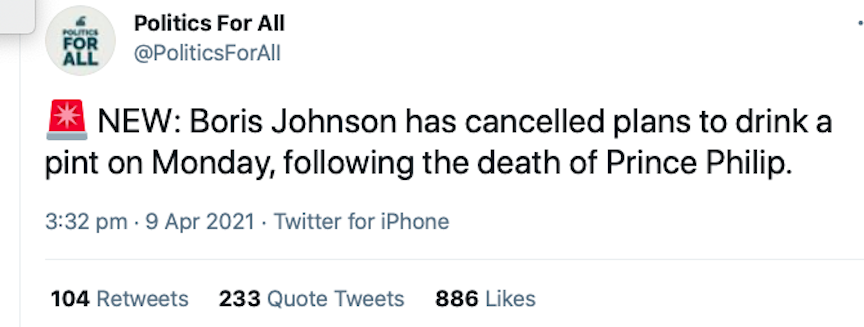
I will not be pointing and laughing at an old man who has just died, nor at a woman who has lost her husband of over 70 years. However, I hope I’ll be permitted to raise an eyebrow at the various media organisations that have seen fit to pad out what’s at best a 20-minute story (he’s dead; here’s some archive of when he was alive; here are some people saying nice things about him) into a rolling news juggernaut that’s swept all other programming before it. The BBC in particular is tugging its forelock across all channels, which is pretty impressive for an organisation that’s supposedly a quivering nest of Trotskyite wokeness.
Special mention though to Reuters which ran a live feed of an aerial view of Buckingham Palace, which would have been an odd thing to do even if Prince Philip had died there (he was at Windsor Castle) and then it turned out the footage was of the Tower of London anyway.
PS: A reminder of the wonderful Kastom people of Vanuatu, who worshipped the late Prince as a god.
PPS: And this.
PPPS:
PPPPS: The BBC. Eight hours. Across all channels. Now try to imagine what it’ll be like when *she* goes...