Showing posts with label health. Show all posts

Sunday, July 05, 2015

About not having cancer

So there was a lump. There’s always a lump first, isn’t there, when people blog about it? It was a small, slightly pointed lump on my forehead and I would have let it stay there, but then it started to hurt when anything brushed against it and then it started to bleed and I was sure it wasn’t anything particularly serious but you know, just to be sure, I went to the doctor. And the doctor said that it was almost totally certainly a wart (a filiform wart, in case you’re interested, so there’s a new word) and she could take it off there and then but afterwards, you know, just to be sure, she could send it to the lab, but only if I wanted. And I said, yeah, you know, just to be sure. So that’s what she did, took it off, sent it to the lab, just to be sure. And of course, I didn’t really think it was anything particularly serious and didn’t think very much about it at all. Except that I just received the e-mail from the lab telling me it was definitely a filiform wart and nothing else and so everything’s OK and it’s only then that I notice that nobody’s actually said the word “cancer” and suddenly it feels as if I’ve been holding my breath for the past few days without realising I was doing it. 

Tuesday, August 13, 2013

I just can’t be happy today

I’ve long had a tendency to anhedonia, the inability to derive pleasure, to enjoy. Mine’s by no means the worst of cases. I can be happy for a while, in the moment; but then I find myself thinking too hard about the situation I’m in and I start to feel guilty or self-conscious or just plain bored. I suppose I could stop thinking, but I’d rather be sad than stupid, to be honest.

So I was intrigued to read today of Malcolm Myatt, who in 2004 suffered a stroke that left him unable to feel sadness. Which all sounds lovely, but surely without at least an occasional spasm of sadness you cease to recognise joy? Am I reading too much into Mr Myatt’s pathological cheeriness if I claim to detect a hint of quiet desperation behind his eyes? It all reminds me of Marcel Marceau’s routine The Mask Maker, in which he’s trapped in a rictus of happiness, able to communicate his anguish only through his body movements. I saw Marceau perform it live over 30 years ago and hadn’t realised there was a filmed version available; nor that it was scripted (can a mime routine be scripted) by maverick movie director Alejandro Jodorowsky, who went on to make El Topo, Santa Sangre and other slabs of cinematic grand guignol. Not that that would have meant much to me when I saw it, at the age of 12 or so. Anyway, enjoy the clip; or don’t.

Friday, November 23, 2012

Radiohead and the allergy to now


When I started reading about Velma Lyrae, a London woman who suffers from electromagnetic hypersensitivity syndrome, my immediate thought was, “She sounds like something out of a Radiohead song.” Her condition means that she suffers multiple debilitating symptoms if she comes into contact with computers, mobile phones, even hairdryers, and she spend most of her time inside a protective cage in her Blackheath flat. The Radiohead connection was because of Thom Yorke’s contention that one of the defining themes of the band’s 1997 albums OK Computer is “fridge buzz”, the inescapable background noise, actual or metaphorical, that pervades the modern world, and which the band covers in the song ‘Karma Police’. Damn, another missed opportunity; when I was writing my Radiohead book (hey, the Cohen and the Noughties ones got plugs in the past few days, I’m only spreading the love) I should have created a mythical, rejected song called ‘Velma In Her Cage’, featuring Jonny Greenwood playing an ondes martenot through a bank of vintage detuned radios and Thom curled in a ball, mumbling about how he can only communicate the evils of technology and capitalism by utilising the fruits of technology and capitalism, innit?

But hey, what’s this? Velma says:
I used to love going to festivals and experiencing live music, but because everyone has a mobile I can’t even go near a gig now. The last gig I went to was Radiohead. I knew I was getting worse and wouldn’t be able to go to any more so I wanted to make it a good one.
I can just picture her, heart pounding, joints aching, desperately hanging on Thom’s every baleful squawk despite the distraction of the tens of thousands of iPhones surrounding her, pulsing their evil ones and zeroes into her throbbing skull. And then I start to feel a little heartless as I wonder whether the whole thing might be some sort of conceptual joke to plug the next Radiohead album seeing as how an anagram of Velma Lyrae is

“rave lamely”
 
(And incidentally, that Infinite Jest blog of mine has shuddered back into some semblance of life, if anybody’s still pretending to be interested.)

Thursday, August 16, 2012

How can I plot the downfall of civilisation on the back of a fag packet when there are no fag packets left?

From December, all cigarettes in Australia will have to be sold in uniform, olive-green packets. I’m not going to get into a fight over the rights and wrongs of tobacco laws, beyond mentioning what a doctor friend pointed out to me, that it costs rather less to treat a terminal case of lung cancer for 18 months than it does to manage a cocktail of dementia, osteoporosis and various other age-related conditions for 20 years. No, what really interests me is that the battleground on which the government and the tobacco companies have been slugging it out isn’t actually the thing that actually kills people – tobacco itself and its various noxious components – but something apparently peripheral, the pictures that surround the tobacco. First it was the advertising, now the boxes. They’re getting closer to the stuff itself, but they’re still not there. It’s as if someone had reframed that cliché in defence of the US Second Amendment: “It’s not guns that kill people, or even people that kill people – it’s the designer holsters that the guns come in.”

The reason Big Tobacco has resisted these encroachments so stoutly is that they know that they can’t hope to keep making profits based on the quality of their products alone. Branding and packaging are what keep their industry going but it’s a bigger fight even than that – without pretty pictures, huge chunks of capitalism would wither and die. Even supposedly sophisticated consumers can be gulled by a good label, as academics have shown with tweaked wine tastings (but let’s pass over the fact that that article was the work of pretty-boy auto-plagiariser Jonah Lehrer). BAT and Philip Morris aren’t just sticking up for your your right to kill yourself; it’s also about your sacred right to bullshit yourself as you do it. But which amendment covers that?

PS: In the Guardian, Alex Hoban predicts that the tobacco companies will make a virtue out of the enforced uniformity, as part of their strategy of co-opting anti-corporate adbusting techniques. Nice.

Friday, January 27, 2012

In dreams


Developers in Switzerland are planning a project that will house people with dementia in a mock-1950s village. Most of us who have spent time with someone suffering from Alzheimer’s or a similar condition will have noticed that long-term memories often remain clear long after the banal minutiae of today has become irreversibly fuzzy; the idea here, presumably, is that if someone thinks it’s 1952, why not create an environment that supports that illusion, free from any disturbing references to the recent. The present is a foreign country; we do things differently here.

One does wonder, though, whether the 1950s that will be created outside Berne will be an accurate replica, or one mediated through multiple subsequent representations of community life, whether it’s the wholesome innocence of Happy Days or the dark-underbelly school of David Lynch, The Truman Show or The Prisoner: carers dressed as gardeners and hairdressers will ensure that nobody leaves the village. Once again, we have a perfect simulacrum, a replica of something that never existed. I can see a small, silver-haired army shuffling across the trimmed lawns and past the hat shop, muttering “That is not what I meant at all; that is not it, at all.”

Tuesday, January 17, 2012

Barbed

There is a Facebook campaign afoot to encourage Mattel to bring out a bald Barbie, to offer encouragement to girls who have lost their hair because of cancer treatment. While I can’t argue with the core motivation at work here – making sick children feel a bit happier – I do have a few qualms about what appears to be the endgame. Rather than toe-poking the whole ghastly Barbie aesthetic into the prehistoric swamp where it properly belongs, these well-meaning agitators just seek to shift the parameters a little: it is as important as ever to be a beewootiful puhwincess, it seems, but you can still achieve that goal even if you’re as hairless as a porn star’s undercarriage and throwing up every few hours.

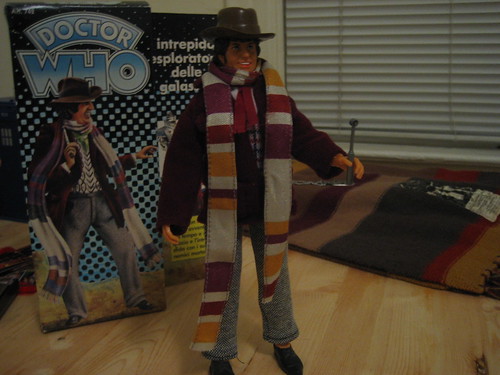
Moreover, the campaigners have apparently missed the chance to offer a sense of empowerment to the children on whose behalf they claim to act. Want a bald Barbie? Get a normal Barbie; cut its hair off. And the same goes for those who prefer their anatomically unfeasible homunculi to be black or amputees or multiply pierced; do it yourself. Many was the happy hour I spent inflicting ghastly tortures on my Doctor Who doll, including a doomed attempt to create a functioning iron maiden from Lego. Are kids today really so incapable of such acts of creative destruction? Answers, if there are any, to be carved into the severed head of Action Man and sent to the usual address.

Friday, March 12, 2010

Not raving but frowning

I’ve been reading a piece about the veteran film critic Roger Ebert, who as a result of cancer, or more specifically the attendant surgeries and complications, has had most of his lower jaw removed. Now he can’t eat, drink or speak, which would strike most observers as a horrible state of affairs. But it’s this passage that really struck home:
...because he’s missing sections of his jaw, and because he’s lost some of the engineering behind his face, Ebert can’t really do anything but smile. It really does take more muscles to frown, and he doesn't have those muscles anymore. His eyes will water and his face will go red — but if he opens his mouth, his bottom lip will sink most deeply in the middle, pulled down by the weight of his empty chin, and the corners of his upper lip will stay raised, frozen in place. Even when he’s really angry, his open smile mutes it: The top half of his face won’t match the bottom half, but his smile is what most people will see first, and by instinct they will smile back. The only way Ebert can show someone he’s mad is by writing in all caps on a Post-it note or turning up the volume on his speakers. Anger isn’t as easy for him as it used to be. Now his anger rarely lasts long enough for him to write it down.
This does make Ebert sound a bit like Canio in Pagliacci or, according to one’s inclinations, James Stewart in The Greatest Show On Earth or Marcel Marceau’s The Maskmaker; the clown who needs/is forced to keep a happy face for the world, whatever might be happening inside. And the fact that Ebert’s fans still expect him to make his trademark thumbs-up gesture 2,078 times a day just adds to the impression of compulsory jollity.

I tend to have the opposite problem. Even if I’m in a relatively jolly mood, my default setting is one of moderate disgruntlement. I’m the sort of person to whom perfect strangers feel able to chirrup that indicator of gittishness, “Cheer up, it may never happen.” Which makes me wonder whether there’s an equivalent that can be directed towards the permanently cheerful? Maybe we should just walk up to them, stare directly into those vast, shiny, 24-hour grins and whisper: “You do realise it’s happened?”

Thursday, January 08, 2009

Diet of worms

I've got a feeling this may be the greatest advertisement ever created:


It's the double-whammy combination of initial kitsch overload, followed by the ghastly realisation (half-way down the right-hand side, maybe five seconds later) of what it's actually selling. Thanks to Eric D for bringing it to my attention.

Monday, February 11, 2008

Who wants to live forever?

It may be helpful to regard this as a modest proposal sort of thing. Or, then again, it may not...

"A medical friend once told me that if everybody in the UK were to stop smoking, the NHS would collapse. I thought she was offering that old chestnut about smokers and drinkers handing over billions to the state in tax, but it was more subtle argument than that. Her point was that it's much cheaper to treat a 50-year-old who's taking 18 months to die of lung cancer than it is to treat a 90-year-old who's spent the last 20 years slowly fading away from a cocktail of osteoporosis, angina, pneumonia, Parkinson's, Alzheimer's and non-specific decrepitude..."

Read the full spiel here.

And in a similarly glum mood, RIP Roy Scheider, who effectively recorded his own wake nearly 30 years ago.