Wednesday, April 06, 2022

About reading

David Peace:
I was fortunate to be brought up in a house with a lot of books. My dad read David Storey and Stan Barstow, who came from where I came from, but also Chandler, Maigret, Camus, and more sports books than you’ve ever seen. There was Dewsbury market for comic books and secondhand books, and I can’t overstate the education you got from reading the NME between 1979 and 1985. A review of the Birthday Party would be talking about Dostoevsky; Mark E Smith, Nick Cave, Coil and Morrissey all talked about books, painting, other forms of music, and I just absorbed it all. You could be reading Beckett and Philip K Dick, watching the football and The Singing Detective, going to see a band and a Francis Bacon exhibition; almost every week you were hearing or reading something you’d never seen the like of before. I’m not sure that’s the case these days.
Maybe the cut-off came in the mid-1990s, when the likes of Oasis proclaimed themselves heirs to the mantle of indie greatness, but coupled it with a strand of (performative?) bibliophobia. And 20 years later, Noel Gallagher still seemed deeply suspicious of the whole idea of reading and writing books:
“…people who write and read and review books are f***ing putting themselves a tiny little bit above the rest of us who f***ing make records and write pathetic little songs for a living.”
It’s not an either-or scenario, and I wouldn’t presume that by not offering their fans a bespoke to-read list packed with dystopia and existential angst modern musicians are implicitly endorsing Gallagher’s philistinism. But it could be that they’re advised not to talk about it, at least not in the opinionated, evangelical tones of their 80s forebears.

Monday, April 04, 2022

About Jordan

I’ve always felt an uncomfortable empathy with the Rosencrantzes and Guildensterns of this world, those whose greatest claim to fame is their (often accidental) proximity to a bigger, brighter star. And as such, I mourn the magnificent Pamela Rooke, aka Jordan, whose snarling presence in press coverage of the Sex Pistols made the whole three-chords-now-start-a-band formula feel too much like hard work. You didn’t even need to pick up a guitar. You just needed to be.

Monday, March 28, 2022

About the ploughperson's lunch

A pub on Dartmoor has provoked what people are still intent on describing as “a Twitter storm” by labelling a plate of bread and cheese as a “ploughperson’s lunch”. It’s a reference to the people of any gender who till and tend the land in that lovely chunk of Devon but it has inevitably attracted the ire of the gammon massive. “Sorry guys, won’t be visiting a ‘woke’ pub for my lunch. Yes, there are lots of women farmers today and I salute them, but stop changing the past.” 

But what past? What we used to call a ploughman’s may have had its roots in the distant, bucolic past but The Ploughman’s Lunch as a pub staple only goes back as far as the 1950s when the Cheese Bureau sought a way to encourage consumption of their just-off-ration product. That said, since Brexit seems to have been a project of prosthetic nostalgia, luring us back to a decade that nobody remembers because it never happened, maybe that’s entirely appropriate.

Thursday, March 24, 2022

About the Smiths

Presented without comment.


Also: vegan curries with Mozz overtones:

Saturday, March 12, 2022

About cultural capital

An academic study has determined that school visits to museums or theatres have no beneficial effect on GCSE results. They may of course “contribute to educational enjoyment” but, hey, who cares about that?

Sunday, March 06, 2022

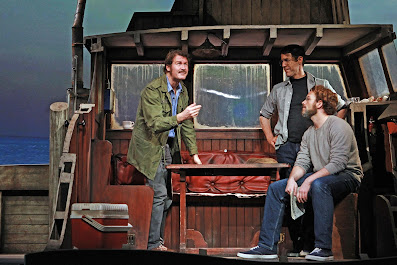
About The Shark Is Broken


(I started writing this a month ago, when the show was still running, so it seemed relevant-ish. And then life intervened.)

Approaching the Ambassadors Theatre, where The Shark Is Broken is nearing the end of its run, you encounter the usual array of glowing accolades, artfully extracted from the critical slurry. One in particular stands out: “You don’t need to have seen the film.”

Which is, I guess, technically true. The play, about imagined interchanges between the three main actors during the filming of Jaws in 1974, operates a bit like Rosencrantz and Guildenstern are Dead; the exciting stuff is happening somewhere else, so our focus is on the dreams and frustrations of people who aren’t really in control of their lives. And surely that’s something with which we can all identify, even if we haven’t seen Jaws, or for that matter Hamlet.

That said, it’s fairly clear that to fully appreciate the play, one needs at least a passing knowledge of the film and its context; not least to appreciate the piquancy of having the actor and co-writer, Ian Shaw, portraying his father, who played the shark hunter Quint, and died just four years after events depicted on stage. And the audience, it would seem, has far more than a passing knowledge. Not only do they chuckle sagely at in-jokes that hint towards the film’s sequel, and Spielberg’s next project, Close Encounters of the Third Kind; they actually sing along when the actors-as-actors replicate music from the film (‘Spanish Ladies’ and ‘Show Me The Way To Go Home’) and recite, word-for-word, Shaw-as-Shaw-as-Quint’s USS Indianapolis speech, which ends the play.

It’s a well-made, enjoyable show but ultimately, like so much happening in the West End, it relies immensely on the punters’ fondness for and familiarity with the source material. Effectively, it’s just another jukebox musical.

Saturday, February 19, 2022

About James Malone-Lee

I never knew the urologist Professor James Malone-Lee. But someone I knew many years ago did know him, which is why, by the wonders of Twitter algorithms, I saw this, an object lesson in level-headed understatement in the face of the inevitable. “...a little inconvenient” indeed. He died peacefully this morning.

Thursday, February 17, 2022

About the Bayeux Tapestry

I am intrigued by the tale of Mia Hansson, who has since 2016 occupied herself with creating a life-size replica of the Bayeux Tapestry, but can’t help but think of Borges’s Pierre Menard, who became the author of Don Quixote by writing it out. (And I wonder what sort of journalist could cover this story without once asking: “Why?”)