Showing posts with label science fiction. Show all posts

Sunday, January 05, 2014

Soylent: all you can eat

Science fiction, of course, remains so until it becomes fact. Which is why it’s such fun to revisit the predictions that Isaac Asimov made in 1964 about what life would be like 50 years hence – which is now, of course (thanks to Richard for the pointer). I was particularly interested in his notion of truly instant meals, which are finally coming to pass in the form of Soylent. Rob Rhinehardt’s invention takes its name from a soy/lentil blend described in Harry Harrison’s dystopian novel Make Room! Make Room! (published in 1966) so one could argue that Asimov’s idea predates the fiction, let alone the science; although one could also see as a model the meal-substitute chewing gum – tomato soup, roast beef and blueberry pie – that does for Violet Beauregarde in Charlie and the Chocolate Factory (1964, the same year as Asimov’s think piece). Incidentally, the inclusion of processed human flesh in the Soylent blend wasn’t in Harrison’s book – it was an invention for the 1973 movie Soylent Green. But I’d still be intrigued to find out who was behind the brand name and what their reasoning was; it’s certainly attention-grabbing but not necessarily in a good way. Death cigarettes, anyone? Touching Cloth?


Geekery aside, Soylent does make us think anew about food. While the low cost of the product has potential humanitarian benefits, it’s clear that Rhinehardt’s prime market will be those who aren’t really that bothered one way or other about the pleasures of eating and need fuel rather than gastronomic titillation. Which strikes me immediately as barbaric, although on reflection it’s just a personal preference. Some people really aren’t bothered one way or another about music or art or books either, which I find deeply weird, but each to their own. I guess they find my ambivalence about cars and guns and golf equally peculiar. The difference is that if I avoid golf for a year it won’t kill me; the gastronomic agnostics still need to consume calories, even if the process doesn’t bring them pleasure. 

Maybe the odd thing is that eating is the only function that’s vital to human survival that we’ve turned into a source of pleasure; we don’t have glossy magazines or high-concept TV shows dedicated to breathing or defecation or the circulation of the blood. (I suppose sex is still a necessity for the human race as a whole but on an individual basis it’s quite feasible to opt out.) And while the idea of a cheap, non-perishable source of nutrition is clearly attractive, I can see a rapid transition to a state of affairs where the social, communal pleasures of food are fenced off as a non-essential, reserved for those who can afford them. I mean, we could get rid of all these politically inconvenient food banks and just hand out Soylent instead.

Or we could just eat people after all.

Monday, April 15, 2013

Is Justin Bieber a wonky robot?


Ridicule and worse has greeted Justin Bieber’s apparent conviction that the highest compliment he might pay to Anne Frank is the hope that had she lived today she would have been one of his fans. Of course this is just the latest in a succession of PR pratfalls that have befallen the Canadian popster in recent weeks; there have been altercations with photographers, odd Twitter outbursts, fainting fits, that notorious two-hour delay in his O2 show and the ongoing legal spat over his monkey.

The simian-related brouhaha has of course prompted comparisons with another child star who had a troubled road to adulthood; indeed, some would argue that Bubbles’s owner never really completed the transition, even though he reached the chronological age of 50. There is a difference though; when Michael Jackson first strutted on the global stage, he appeared to be a normal – albeit preposterously talented – child. It was only later that he began to morph into what I described in my Noughties book as “a grotesque post-human, a parody of celebrity concocted by a cabal of publicists and plastic surgeons”.

But when Bieber appeared, he was already hyperreal. That absurd, androgynous smoothness to which Jackson began to aspire in his mid-20s was already Bieber’s default setting as a teenager, as if he yearned to be the ‘after’ shot in an acne cream commercial. It may be something to do with the new demands made by technological advances in visual media; not only are cameras everywhere but they can pick out and magnify flaws with infinitely greater cruelty than could have been managed when young Michael was first busting his moves. We don’t spot Bieber’s transformation into the other; he’s always been other, always been something beyond mere homo sapiens.


Yesterday, I jokingly raised the question of whether Bieber may be an android on Facebook and Twitter. I wasn’t thinking of any particular sci-fi reference; maybe Blade Runner (specifically the long-running controversy over whether Deckard is a replicant and whether he knows it) with a bit of the Doctor Who story The Robots of Death thrown in (because the metal beasts in that are smoothly beautiful and go mad and start strangling people). It was @curiousiguana on Twitter who identified the specific fictional creation that Bieber resembles; it’s David (Haley Joel Osment), the child-robot in Spielberg’s A.I. Artificial Intelligence, who has had the capacity for love – or the ones and zeroes that allow him to emulate love – programmed into him. It’s as if Bieber has been created to rehearse a specific range of pop star behaviours and he’s been doing OK up to this point, but as he gets into darker territory various bugs and glitches start to reveal themselves. Someone keyed in the code for going off the rails, expecting the 19-year-old maybe to throw a TV out of a hotel window, but something went wrong somewhere and he made a git of himself in a museum’s visitors’ book instead. If he’d been caught smoking a joint or biting the head off a bat, we would have just accepted it as phew, rock ‘n’ roll, but the Anne Frank thing doesn’t quite fit our parameters of misbehaviour. There’s something not quite right about this boy. Has he been found out?

My memories of A.I. are sketchy, but as I recall it, David’s two best friends are also robots, one a teddy bear, the other Jude Law as a gigolo. And he’s nearly torn to pieces by a wild anti-robot mob, but survives even as humanity itself perishes in an ecological meltdown and he carries on in his wide-eyed, pre-pubescent form for millions of years and Meryl Streep shows up as God or something.

So I guess Bieber’s got at least a couple of albums in him yet.

Monday, July 16, 2012

Tomorrow I'll Wake Up and Scald Myself With Tea: 30 years on


Huge chunks of what I know and love about movies I owe to BBC2. Younger readers may not believe that the channel was once something other than a repository for antiques shows, cookery shows, quiz shows and combinations thereof but in the days of three analogue channels and that’s yer lot it was a trove of unexpected gems. There was still a Reithian educate-and-entertain meme in the programming, so they were big on themed seasons that gave an overview of a particular genre or period: over successive Saturday nights I’d watch the Warner gangster movies with Cagney, Bogart and Robinson; the Astaire/Rogers musicals from RKO; contrasting double bills of a Universal horror movie from the 1930s and a Hammer equivalent from the 50s/60; or they’d get the auteur bug and give you a couple of months of Buñuel or Wilder.

But the real joy came when you came across a movie of which you knew absolutely nothing, that had no connection with what came before or after, that just seemed to be thrown into the schedules on a whim. This was pre-Wikipedia, pre-IMDb, remember; all you had to go on was what the Radio Times told you (unless it was in Halliwell’s Film Guide or Elkan Allan’s Movies on TV, the only other references I would have had to hand). So I was rather under-prepared when, at the age of 13 and a half, Auntie presented to me a Czech film,  Jindřich Polák’s 1977 science-fiction comedy Zítra vstanu a opařim se čajem, aka Tomorrow I’ll Wake Up and Scald Myself With Tea.

I’ve mentioned this experience – not just the film, but the fact of catching it by chance on a winter weekend in 1982 – to many people over the years. Most of them respond blankly, presumably because they were doing what people were meant to do on a Saturday night in 1982, drinking sweet cocktails to a soundtrack of the Human League. Or maybe they were watching the football. But every once in a while I find someone who was about the right age and the right level of social ineptitude to have been on the sofa, watching the only minority channel going. They usually offer that face of bafflement easing into vague recollection, followed by a specific aspect of the film suddenly leaping back into their consciousness after all this time. “The twins!” “The green faces!” “The comedy Hitler!” I wouldn’t say I’ve consolidated lifelong friendships this way, but there’s a tenuous network of geeks and losers who now understand they weren’t alone, united as they are in a sort of extended water-cooler moment across the decades.

The only reason I know the solid facts about that fateful transition (that it was on Saturday January 16 at 9.35pm, and so on) is that they’re laid out in this review of the DVD, from 2006. As soon as I read it, I felt an urge to get hold of the disc, but at the same time a certain reluctance. Although my 13-year-old self loved the film, something told me that the 40-something me would immediately realise it was a bit crap. So I held off. Until, a few days ago, I happened to come across the whole bloody thing online. And I gave in.


OK, here’s the basic set-up. In the 1990s (or a mid-70s imagining thereof), time travel is a feasible leisure activity and a group of fascists decide to use this to go back to 1944 and give Hitler a hydrogen bomb. They bribe a pilot on one of the time flights to help them; he lives with his identical twin, a scientist who was responsible for developing the technology. On the day on which the trip is scheduled, the pilot chokes to death on his breakfastl; his brother, who knows nothing about the plot, dons his uniform and goes to work in his place.

Well, it wasn’t quite as good as I’d remembered, nor nearly as bad as I’d feared. The budget was evidently tight and the effects now seem primitive, but that’s never bothered me too much; I still enjoy episodes of Doctor Who and Blake’s 7 from around the same time. Polák clearly assumed that the 1990s would look much like the 1970s, but with a few hi-tech innovations thrown in, so flares, fedoras and kipper ties abound alongside the aforementioned time travel, and also washing-up liquid that simply dissolves the dirty dishes. I remember being stunned at the audacity of playing Hitler for laughs (as distinct from something like The Producers, which played *the idea of Hitler* for laughs) but we’ve been through so many Downfall spoofs these sequences have lost their impact. That said, the casting of the historical Nazis is spot on; Goering and Goebbels in particular look just right. And allowing Hitler to converse with a pair of Chicagoan time tourists by having them both speak fluent Czech presents no problems; in my world, Daleks and Zygons and the Sevateem all spoke English.

I must have been so swept away in 1982 by the weirdness and audacity of the premise that I failed to pick up on some fairly contrived bits of plot, such as the anti-ageing pills that a Nazi officer takes to remain pretty much unchanged 50 years after the war. And it’s never properly explained why Jan, the sweet, clumsy scientist, immediately assumes the identity of his amoral brother Karel; there are elements of resentment and jealousy at work (Jan carries a torch for at least one of Karel’s several girlfriends) but the switch seems to be driven by the need to set up a situation rather than arising naturally from the action. The relationship between the two brothers is evidently dysfunctional, but would Jan really be so blasé about Karel’s sudden demise? Other incongruities don’t even have a reason for existing: why, for instance, would a Nazi have a black secretary? And if you’re going to set up a bit of slapstick by the contrivance of having a trampoline on a roof, at least make the ensuing carnage somehow worth the effort.

What does feel uncomfortable – something that would have passed me by 30 years ago – is the political subtext. In this version of the 90s, the Berlin Wall didn’t come down and, we assume, Czechoslovakia never split in two; the last we see of the pro-Hitler plotters, they are being driven away, presumably left to the tender mercies of the Communist authorities. The film was made less than a decade after Warsaw Pact tanks rolled into Prague; are we to infer that a plot to hand the H-bomb to Stalin in 1944 would have been perfectly OK? And the final twist, which I won’t give away, almost steps over the line between black humour and pragmatic callousness. Only the excellent, understated performance by Petr Kostka (as Jan/Karel) stops things from getting too icky.

What still works, after the sometimes clunky exposition of the first half, is the insane confusion of the conclusion, with characters returning from the 1940s to a time just before they left and thus populating Prague with several versions of themselves. Again, I was already attuned to temporal paradoxes and multiple realities but Polák pushes the idea far further than I’d ever imagined possible, while still keeping things under control; it’s always clear to the viewer which model of each character is which.


Beyond the merits of the film itself though, there’s the whole issue of how we see films now. Sure, Polák’s work is far more available to people who might want to see it, anywhere in the world, whenever they want, whether or not there’s football going on elsewhere. But according to the counter on the video site, fewer than 1,500 people have taken advantage of such an opportunity; whereas back in January, 1982, several hundred thousand did so, even though they were forced to do it at a time when the BBC2 schedulers demanded. And if I hadn’t seen it 30 years ago, I probably wouldn’t have done it again this time. And this time, I can’t go into school on Monday morning and say “Bloody hell, did you see that bizarre film with the Nazis and the green faces?” in the reasonable expectation that maybe two or three people might have decided not to watch the football.

Sunday, May 01, 2011

The black death

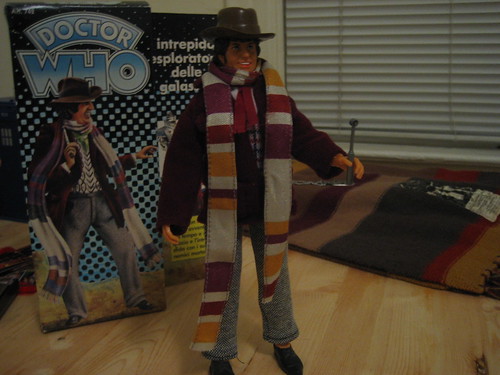
When I was rather smaller than I am today, I was a fan of Doctor Who. Actually, I say I was a fan, but fandom is an entirely relative concept. I watched the show religiously, of course. And I’d also seen both the movies (in which Peter Cushing played the Doctor) when they cropped up on TV. But my loyalty wasn’t all-consuming. I can’t remember ever going to the Longleat exhibition, for example. I did buy and read lots of the Target novelisations, but I wasn’t a completist, and in the end I sold my collection. And although I pestered my mother to up the family’s fibre intake so I could amass the Weetabix card set, I’ve no idea what happened to it; the same goes for the 10th anniversary Radio Times special and the Tom Baker doll. I started to lose interest some time during the Romana era, and by the time Colin Baker’s unlovely persona had dragged the show into an 18-month hiatus, I barely noticed. By comparison with some fans, I was a complete bloody lightweight.

One area into which I did put a little extra effort was in writing my own Doctor Who fiction. To be honest, even there I was something of a dilettante, as I don’t think I ever finished a story. I’d come up with a title, something like The Daleks of Doom, or  maybe Doom to the Daleks, then begin with an incredibly violent opening passage, usually involving the spectacular destruction of several Ogrons. (These were the hulking, simian sidekicks of the Daleks, who helped them with the stuff they couldn’t do in those days, like carrying things and climbing stairs. I think I saw them as analogous to the hard boys at school who were good at football and laughed at my glasses and said Doctor Who was for poofs.) Then the Doctor would arrive and survey the carnage and wonder what was going on and so would I and I’d go off and have some lemon squash and forget about it.

One thing I didn’t do was to attempt to render the stories that I’d seen on TV as prose. This was partly because of the existence of those Target books: I knew that if I waited long enough, Terrance Dicks or Philip Hinchcliffe or someone like them would put each story between covers. Instead, I was intent on creating my own narratives, even if they were never going to go anywhere. Of course, after the show had gone off air, an entire sub-culture of original stories appeared in print form, with hundreds of books to keep the Who brand alive, but as I said, I was well out of the loop by that point.

Although I was careful not to tread on Target’s turf, I probably took a few hints from the books, albeit subconsciously. (Not that I have any examples of my deathless genius to hand, and I suspect they suffered the same fate as the Weetabix stuff, so this is all based on my increasingly fuzzy memory.) I wasn’t a slave to the house style, though: the Target books were careful not to acknowledge the real-world status of Doctor Who, beyond a cursory acknowledgement of the scriptwriter of the story on which the book was based. So the much-derided artwork might depict the actor who played the Doctor, but Pat or Jon or Tom never got a mention. Instead, there would be a stock explanation of which incarnation was in play, such as:

THE CHANGING FACE OF DOCTOR WHO. 
The cover illustration of this book portrays the third DOCTOR WHO whose physical appearance was altered by the Time Lords when they banished him to planet Earth in the Twentieth Century.

Whereas I preferred:

THE CHANGING FACE OF DOCTOR WHO. 
The cover illustration of this book portrays the third DOCTOR WHO who was played by Jon Pertwee.

Moreover, whenever a character in a Target book incurred the wrath of the Daleks, there would be a searing flash of light, a scream, and the unfortunate individual would slump to the floor, often with wisps of smoke rising from his body. Whereas I knew what happened to people who were exterminated. They went negative. You could see it happening. So when the Daleks exterminated someone or something in my stories (I’m not sure how old I was when I realised that “exterminate” was a proper word, not one invented for the purposes of the show, like TARDIS) I’d write something along the lines of “The Dalek fired his gun and everything went negative and the Zygon died.”

In many ways, it betrayed an early fondness for metafiction and similar postmodern japeries, although at that stage I probably thought metafiction was next door to Metebelis III. Yes, that’s the sort of thing that passed for humour back then. These days, although I do like the resurrected Who immensely, it’s more of an indulgent, nostalgic fondness. Although I finally have a sofa with plenty of space behind it, I don’t hide there. And in retrospect, I even feel a tiny bit sorry for the Ogrons.

Saturday, November 29, 2008

Together in electric dreams

Oddly enough, I didn't read much science fiction as a child. I'm sure I looked and dressed as if I did; and plenty of my friends were the sort of high-functioning sociophobes who devoured the oeuvres of Isaac Asimov and Stanislaw Lem and L. Sprague du Camp and Dean Koontz. (Incidentally, I've long believed that all the birth names of actors that are rejected as marquee-inappropriate - names such as Issur Danielovich Demsky and Spangler Arlington Brugh and Herbert Kuchacevich zu Schluderpacheru and Diana Fluck - are redistributed to SF authors whose monickers are deemed to be too ordinary.)

I loved Dr Who, of course, and must have had about 40 of the Target novelisations, but that wasn't *proper* SF, any more than Star Wars was. I think I dabbled with a bit of HG Wells and John Wyndham, and I know I read Fahrenheit 451. But one book that has stuck in my memory is Ben Bova's The Dueling Machine, which I remember borrowing from Leigh Park library at least three times.

So when I picked up a second-hand copy a few weeks ago, it was more than a potential read or even a re-read; it was a matter of revisiting my own younger self. What was it that grabbed my eight-year-old imagination so fiercely?

The eponymous machine is a device that allows people to settle disputes without bloodshed, in a virtual arena; problems arise when combatants actually start dying. The obvious comparison is with the Dr Who story The Deadly Assassin, written by Robert Holmes, which would have been transmitted at around the time I first read Bova's book. Passably interestingly, the conceptual battleground in which the Doctor takes on Chancellor Goth is called The Matrix, and if we leap forwards a further 20-odd years, there are also clear similarities between ideas in Bova's and Holmes's works and the notions that underpin the Wachowski franchise (although that's really only a remake of Tron, but with better clothes and worse acting).

Not only does Bova get his head round the concept of virtual reality over three decades before Second Life, he also second-guesses both how the Web would work, and the uses to which it would be put:

The order was scanned and routed automatically and finally beamed to the Star Watch unit commandant in charge of the area closest to the Acquataine Cluster, on the sixth planet circling the star Perseus Alpha. Here again the order was processed automatically and routed through the local headquarters to the personnel files. The automated files selected three microcard dossiers that matched the requirements of the order...

The personnel officer selected the third man, routed his dossier and Sir Harold's order back into the automatic processing system, and returned to the film of primitive dancing girls that he had been watching before this matter of decision had arrived at his desk...


When I first read The Dueling Machine it was a fantasy; now it seems almost spookily perceptive (although the gender roles underpinning the entirely superfluous love story must have looked pretty outmoded even in 1969) . Back then, I missed his nods to Marshall McLuhan and Vance Packard, which may even have extended to the Situationist appreciation for the subversive power of the decontextualised slogan. The hero and villain are fighting in a TV editing suite, and one of them falls onto a row of switches:

"LOOKING FOR THE IDEAL VACATION PARADISE?" a voice boomed at them. From behind Odal's shoulder a girl in a see-through spacesuit did a free-fall somersault. Hector blinked at her, and Odal looked over his shoulder, momentarily amazed. the voice blared on, "JOIN THE FUN CROWD AT ORBIT HOUSE, ACQUATAINIA'S NEWEST ZERO-GRAVITY RESORT..."

Through his mind flashed another maxim from his old instructor: "Whenever possible, divert your opponent's attention. Create confusion. Feint, maneuver!"

Hector rolled off the desk top and ran along the master control unit, pounding every switch in sight.

"TIRED OF BEING CALLED SHORTY?" A disgruntled young man, standing on tiptoes next to a gorgeous, statuesque redhead, appeared beside Odal...


Of course, it's only when they're out of context that these texts and images make us feel truly uneasy. Under normal circumstances, they're designed to lull us into a dream state, as much a replacement for reality as the dueling machine itself; even if they create insecurity, the solution is inevitably in the next paragraph. And when the prescribed solution to a financial crisis caused by injudicious consumption is for people to go out and buy stuff, sometimes with fatal consequences, you know the slogan-makers have won the war.


Which is why I find the newest purported mental dysfunction on the block so unconvincing. People afflicted with Truman Show syndrome apparently believe they are unwitting performers in some kind of reality TV show, and their only desire is for some omnipotent director to call "cut!"

But surely that's not a psychiatric disorder. Rather, it's the most sensible coping mechanism for modern existence, and I suspect everyone in the developed world does it to some extent. When I was a child, when I first read The Dueling Machine, I would sometimes create a fantasy life, and believe it to be reality. Now, I tend to look at reality, and wish it were a fantasy.