I’m quietly impressed by the Danish artist Jens Haaning, who was commissioned to reproduce one of his old works, but delivered a pair of empty frames, claiming that his failure to deliver on the contract was the art. Were I in charge of the Kunsten Museum of Modern Art in Aalborg, which spent half a million kroner on said work, I might not be so enamoured.
Tuesday, September 28, 2021
Thursday, September 23, 2021
About iconoclasts
“Iconic” is on my list of words to avoid, because it’s been abused to the point of meaninglessness, but it might still be usefully applied in a few select cases. And in that spirit, following on from a chat elsewhere about Julie Burchill (although it might equally apply to John Lydon, Guy Debord, Oscar Wilde, or anyone else who appears in the index to Lipstick Traces), what happens to iconic iconoclasts? Do they inevitably self-destruct?
Thursday, September 16, 2021
About Nadine Dorries
There’s so much to unpack regarding the new Culture Secretary and I know it’s very lazy just to post endless tweets but I’m quite busy at the moment and this sums up the neo-liberal attitude to everything that matters better than anything I could write. Something more considered at the weekend, maybe.
Willing to bet that Nadine Dorries' books have sold a thousand times was many copies as her French counterpart's book on Verdi. https://t.co/mN7MNzkdcB
— Robert Hutton (@RobDotHutton) September 16, 2021
Wednesday, September 08, 2021
About The Exorcist
What if it turns out Mark Kermode has never seen The Exorcist and he's just been going on what someone told him in the playground all this time?
— Richard Blandford (@rblandford) September 8, 2021
Wednesday, September 01, 2021
About good books
I’m intrigued by the story of the judge who spared a young man from jail on terrorism offences, provided he committed himself to reading a prescribed list of works by Jane Austen, Dickens and the like. What’s not clear is whether he intended the mere effort of reading – and submitting to the judge’s test of said reading after Christmas – to be a sufficient distraction from plotting neo-Nazi unpleasantness; or whether those books in particular might reset his befuddled brain, because of some inherent moral qualities. Pride and Prejudice, most would agree, is a good book in an aesthetic, literary sense, which is what fixes its place in the canon; but does that make it good in the same way we’d describe a good person, someone who is essentially righteous? And even if it were, might something more overtly didactic (To Kill A Mockingbird, say) do a better job in changing hearts and minds?
Of course, if Judge Timothy Spencer QC had just told the accused to go away and read a few books, he might have curled up with a copy of Mein Kampf. Or even The Picture of Dorian Gray, wherein he would have found this snippet of subversion:
There is no such thing as a moral or an immoral book. Books are well written or badly written. That is all.
Tuesday, August 31, 2021
About NFTs and Geronimo
I’ve remarked before about the way BBC journalists – presumably in the spirit of accessibility and inclusivity – have taken to explaining references that 10 years ago would have needed no gloss; thus, a mention of Hamlet becomes “Shakespeare’s play Hamlet” and so on.
But some other aspects of our culture have become embedded in the stuff-you’re-assumed-to-know box, and remarkably quickly at that. A year ago, I’m pretty sure I’d never heard of Non-Fungible Tokens (NFTs), but today a BBC website story not only refrained from explaining what they are (there’s a link to a separate article that does that) but didn’t even say what the abbreviation stands for. Or whether “a professional NFT collector” is a real job.
And just as I’m about to hit send, another BBC-related thought. Geronimo the alpaca met his fate today; it was a bit of a silly season story, and some questioned why a culture that happily slaughters thousands of animals a day should fixate on this one beast. Evan Davis, on the PM show, mused on similar lines, as an explanation of why he wasn’t covering the story. But surely by doing so, he’s covering the story. The only thing worse than being talked about, as Wilde nearly said, is having one’s purported newsworthiness dismissed live on Radio 4. Well, that and being shot in the head by a vet.
Thursday, August 26, 2021
About Aaliyah
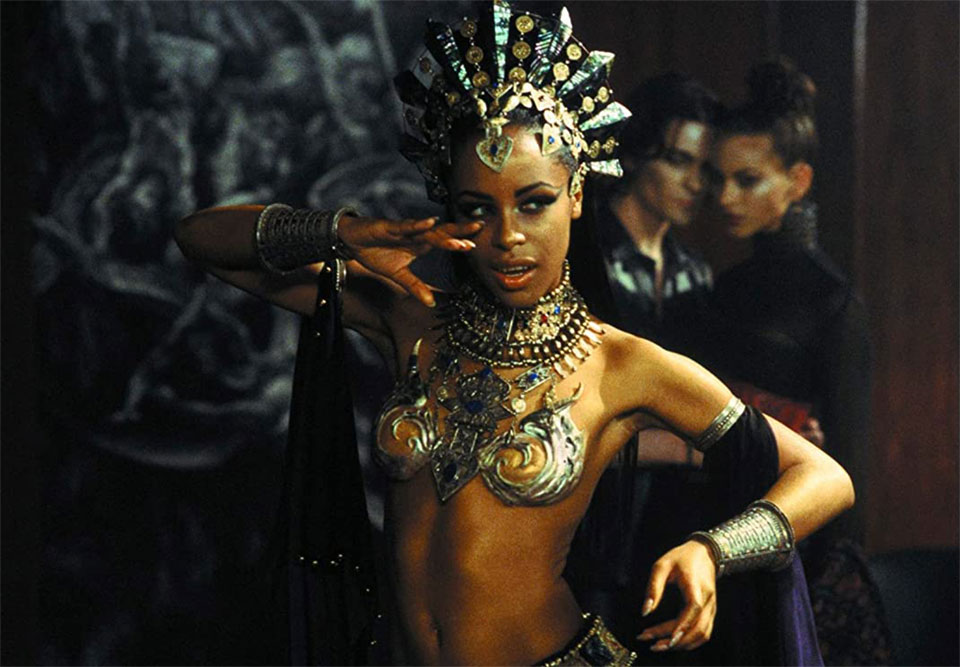
Many years ago I wrote a cheap and cheerful tome about the late R&B (and movie) star Aaliyah and since very few people have followed my example since, I’ve become a sort of default expert. At least I think that’s why a nice Swiss lady asked me some questions about her, on the occasion of the 20th anniversary of her death, and two of her albums finally appearing on Spotify. (And no, I didn’t do it in French.)
Wednesday, August 25, 2021
About snooker
I remember the extraordinary final of the 1985 World Snooker Championship, and the screams of delight echoing around the neighbourhood when Dennis Taylor finally potted that last black ball. It wasn’t that people disliked Steve Davis per se, simply that anyone who challenged his hegemony at the time acquired automatic plucky underdog status.
Plenty of other folk remember it as well, it seems, to the extent that the whole final frame is being restaged as a live event, a simulacrum of a match, a bit like one of those re-enactments of Civil War battles, but with cues replacing pikestaffs. It’ll be a lot of nostalgic fun, but what made the original event really exciting – as with any sporting event – was the tension, the jeopardy, the fact that nobody, including those pacing round the table, knew what was going to happen next, how the whole thing was going to end, who was going to lift the silverware and who was going to look rueful on the periphery. Short of tweaking reality so that Davis wins, I’m not quite sure how they can bring that back.