49% of students at Cambridge University have admitted to plagiarism, according to an online survey.
“Sometimes when I am really fed up,” said one student, “I Google the essay title, copy and throw everything on to a blank Word document and jiggle the order a bit. They usually end up being the best essays.”
But isn't that how everyone always writes everything?
Friday, October 31, 2008


Wednesday, October 29, 2008
Hit the Wife in the North
Following Betty's foray into identity politics ("I AM A BLOGGER, NOT A WRITER"), comes an interesting short piece by Adrian Slatcher on the Manchester Blog Awards that apparently wants to blur the boundaries:
I think what is interesting is how a format that began as a semi-public "diary" now has almost no pretence about its pretension - the blogger is now craving an audience, and all last night's readers were more accomplished than some more literary types I've seen over the years.
Which raises an interesting question - at what point does a blogger become a writer? When money changes hands? When the presses roll? Or just when readership exceeds a certain level? That said, he isn't quite brave enough to contradict the Betster. Not all bloggers are necessarily writers but:
...I'd be surprised to find a young writer who now wasn't putting out some of their work via a blog.
I think what is interesting is how a format that began as a semi-public "diary" now has almost no pretence about its pretension - the blogger is now craving an audience, and all last night's readers were more accomplished than some more literary types I've seen over the years.
Which raises an interesting question - at what point does a blogger become a writer? When money changes hands? When the presses roll? Or just when readership exceeds a certain level? That said, he isn't quite brave enough to contradict the Betster. Not all bloggers are necessarily writers but:
...I'd be surprised to find a young writer who now wasn't putting out some of their work via a blog.
Tuesday, October 28, 2008
Guns and buns
 In which I contrast American and British methods of registering disapproval of our elected representatives, and have a dig at a former NUS President while I'm at it:
I am of course delighted that the alleged plot to murder Barack Obama and over 100 other African-Americans has been foiled. And yet, deep down, I can't help thinking that at least it shows someone's taking this election seriously.
One nation separated by a common cheesecake recipe here.
Sunday, October 26, 2008
And I guess that's why they call it...
(I wrote this about four years ago, for the lamented literary magazine Zembla. Recently, while looking for something completely different, I found it again. Normally such rediscoveries are excruciating, but I think this one just about stands up.
Which is a contrived excuse for not being able to come up with anything new.)
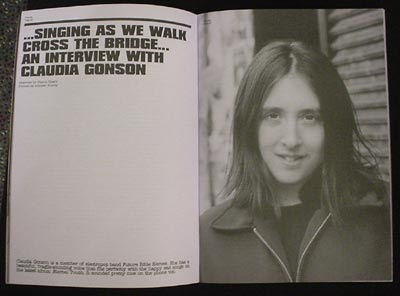
When you're fifteen, sixteen, pop music speaks to you. Not just figuratively, in that it's aimed towards you with all the black arts that the marketing Nazis of the music biz can muster. But it really talks. To. You.
When I was fifteen, sixteen, I was listening to The Smiths, and heaven knows my bicycle was punctured and I walked home alone. The boy with the thorn in his ear and the hearing aid in his side, he knew me. He said plenty to me about my life.
But then I wasn't fifteen, sixteen any more, but I was still listening to The Smiths and Primal Scream and The Stone Roses and De La Soul and The House of Love and Syd Barrett and The Velvet Underground and James Brown and Northern soul and Jamaican ska and Stravinsky, and I still enjoyed them all. But they didn't sit down at the foot of my bed and say: "Yeah, I know what you're thinking. I know your problems. Of course I understand." And that, I thought, was that - another thing you leave behind when you're fifteen, sixteen, like acne and anarchism.
Spool forward a while and it's 2000 and I'm working for a big publishing company and life is OK, you know. I make decisions. I exchange droll badinage with the likes of Ian Hislop and Johnny Vaughan. I consider getting a suit made, a proper one. Occasionally I Google my own name and the result is not displeasing. And pop music is still there but I'm not listening to it, just hearing it. In fact, I'm starting to prefer instrumentals because they make better background music while I work. Print runs. Blurbs. Find a picture researcher. What about the Spanish edition. Talk to the Daily Express. Stay late. Drink coffee. Talk to The Bookseller. Reissue, repackage. Pick a colour for the cover.
And at the same time, I'm playing a triple CD called 69 Love Songs by The Magnetic Fields. And, crazy as it seems, it contains sixty-nine songs about love: sweet, bitter and the other. And there I am, trying to choose a colour for the cover of the next book, when track five of the first disc begins. It's called 'Reno Dakota'. Female vocal (Claudia Gonson). Something that sounds like a ukulele or an autoharp or a banjo (as played by Gabriel the toad on Bagpuss). Crazy rhymes, some of them for "Dakota". One minute five seconds. And Claudia sings the couplet...
It's making me blue
Pantone 292
...just as I'm looking at the swatches of colours to pick the Pantone reference for the book (numerical Pantone references indicate a specific combination of primary colours, to enable designers and printers to get a precise match). And, for about two of the sixty-five seconds that the track lasts, Claudia is talking to me. Me. She said that to *me*. She's saying a little something to me about my life in a way that nobody has for a decade and a half.
And then I decide we'll do the cover in orange. Which is significant, I think, although I'm not quite sure how or why.
Which is a contrived excuse for not being able to come up with anything new.)

When you're fifteen, sixteen, pop music speaks to you. Not just figuratively, in that it's aimed towards you with all the black arts that the marketing Nazis of the music biz can muster. But it really talks. To. You.
When I was fifteen, sixteen, I was listening to The Smiths, and heaven knows my bicycle was punctured and I walked home alone. The boy with the thorn in his ear and the hearing aid in his side, he knew me. He said plenty to me about my life.
But then I wasn't fifteen, sixteen any more, but I was still listening to The Smiths and Primal Scream and The Stone Roses and De La Soul and The House of Love and Syd Barrett and The Velvet Underground and James Brown and Northern soul and Jamaican ska and Stravinsky, and I still enjoyed them all. But they didn't sit down at the foot of my bed and say: "Yeah, I know what you're thinking. I know your problems. Of course I understand." And that, I thought, was that - another thing you leave behind when you're fifteen, sixteen, like acne and anarchism.
Spool forward a while and it's 2000 and I'm working for a big publishing company and life is OK, you know. I make decisions. I exchange droll badinage with the likes of Ian Hislop and Johnny Vaughan. I consider getting a suit made, a proper one. Occasionally I Google my own name and the result is not displeasing. And pop music is still there but I'm not listening to it, just hearing it. In fact, I'm starting to prefer instrumentals because they make better background music while I work. Print runs. Blurbs. Find a picture researcher. What about the Spanish edition. Talk to the Daily Express. Stay late. Drink coffee. Talk to The Bookseller. Reissue, repackage. Pick a colour for the cover.
And at the same time, I'm playing a triple CD called 69 Love Songs by The Magnetic Fields. And, crazy as it seems, it contains sixty-nine songs about love: sweet, bitter and the other. And there I am, trying to choose a colour for the cover of the next book, when track five of the first disc begins. It's called 'Reno Dakota'. Female vocal (Claudia Gonson). Something that sounds like a ukulele or an autoharp or a banjo (as played by Gabriel the toad on Bagpuss). Crazy rhymes, some of them for "Dakota". One minute five seconds. And Claudia sings the couplet...
It's making me blue
Pantone 292
...just as I'm looking at the swatches of colours to pick the Pantone reference for the book (numerical Pantone references indicate a specific combination of primary colours, to enable designers and printers to get a precise match). And, for about two of the sixty-five seconds that the track lasts, Claudia is talking to me. Me. She said that to *me*. She's saying a little something to me about my life in a way that nobody has for a decade and a half.
And then I decide we'll do the cover in orange. Which is significant, I think, although I'm not quite sure how or why.
Thursday, October 23, 2008
Ceci n'est pas un blog
Just in case you haven't heard, blogging is dead, and Twitter killed it. Says so in Wired. Must be true, then.
Before my time
Clive James in The Guardian, on the late literary agent Pat Kavanagh:
Every literary career is different but the same principles apply. The first principle is to have principles. The writer should not expect to have junk published; the publisher should not expect to get away with publishing junk; and the agent should not expect to be praised for extracting a huge advance from the publisher for a piece of junk that will never get the advance back.
Ouch. You know what, Clive, you can't get Spangles any more, either.
Every literary career is different but the same principles apply. The first principle is to have principles. The writer should not expect to have junk published; the publisher should not expect to get away with publishing junk; and the agent should not expect to be praised for extracting a huge advance from the publisher for a piece of junk that will never get the advance back.
Ouch. You know what, Clive, you can't get Spangles any more, either.
Wednesday, October 22, 2008
Race uncertainty
The news media seem to be obsessed with a) the credit crunch; b) the US election; c) Tories on Russian yachts. So I decided to write something for Cif about a Mongolian accountant. In north Wales. Which sounds like a dire, yet lucrative fish-out-of-water memoir arriving in the grubby slipstream of Judith arsing O'Reilly. But don't worry, it isn't.
PS: Ooh hang on, it's gone.
PPS: ...aaand it's back again. Go here, if you fancy.
PS: Ooh hang on, it's gone.
PPS: ...aaand it's back again. Go here, if you fancy.
Monday, October 20, 2008
Conjunctionitis
An exam question set by Vladimir Nabokov when he was a college tutor in the 1950s, quoted by Martin Amis:
"Discuss Flaubert's use of the word 'and'."
"Discuss Flaubert's use of the word 'and'."
Subscribe to:
Posts (Atom)