Showing posts with label sex. Show all posts

Saturday, July 05, 2025

About Zola (three things)

A couple of years ago I bought a cheap copy of Emile Zola’s The Masterpiece (L’Oeuvre), prompted by a Cezanne exhibition at Tate Modern. (Zola and Cezanne’s friendship ended because of what the latter perceived to be his negative depiction in the novel.)  And, inevitably, it slipped under a pile of other books and I’ve only just read it.

A few thoughts from the first couple of chapters:

1. Back in the days when Dan Brown was A Thing, I was far from the only one to point and laugh at his gauche telling-not-showing schtick, displayed most notoriously in the first bloody line of The Da Vinci Code when he told you that a character was a renowned curator by introducing him as “Renowned curator Jacques Saunière” (and then killing him). Does Zola do any better? Well, of course he does. After the first sentence introduces the central character, Claude, we get:

He was an artist and liked to ramble around Paris till the small hours, but wandering about the Halles on that hot July evening he had lost all sense of time.

(Il s'était oublié à rôder dans les Halles, par cette nuit brûlante de juillet, en artiste flâneur, amoureux du Paris nocturne...)

So you get the information, but there’s a reason, a context for your getting the information. Even if it relies on the stereotype of the artist wandering around the city at night, up to no good. Which may, in Claude’s case, be accurate...

2. Claude meets a distressed young woman and lets her stay the night in his studio. She is nervous about the situation, and he is annoyed by her nervousness, the fact that she thinks he might want to take advantage of her, but then:

In the hothouse heat of the sunlit room, the girl had thrown back the sheet and, exhausted after a night without sleep, was now slumbering peacefully, bathed in sunlight, and so lost to consciousness that not a sign of a tremor disturbed her naked innocence. During her sleepless tossing the shoulder-straps of her chemise had come unfastened and the one on her left shoulder had slipped off completely, leaving her bosom bare. Her flesh was faintly golden and silk-like in its texture, her firm little breasts, tipped with palest rose-colour, thrust upwards with all the freshness of spring. Her sleepy head lay back upon the pillow, her right arm folded under it, thus displaying her bosom in a line of trusting, delicious abandon, clothed only in the dark mantle of her loose black hair.

Good heavens, that’s pretty racy stuff for the 1880s. But what does Claude do? He begins to draw her still-sleeping form, and carries on after she wakes, gruffly overriding her objections. All sorts of modern concerns about consent and agency and surreptitious image-making come into play. But he doesn’t touch her little breasts, only draws them, so that’s OK (or at least Claude himself thinks that’s OK, but Zola stays out of it).

3. Claude and his chums are at the vanguard of something that may turn out to be Impressionism, but with the names changed, and he wants to present a sense of authenticity, as distinct from “the run-of-the-mill, made-to-measure École des Beaux-Arts stuff”. But, in his mind at least, the logical end of this is the triumph of the mundane, familiar image that Warhol might have envisaged:

The day was not far off when one solitary, original carrot might be pregnant with revolution!

And later, he comes close to precognition of Duchamp:

...a naked woman’s body with neither head nor shoulders, a mutilated trunk, a vague, corpselike shape, the dead flesh of the beauty of his dreams.

Tell you what, it’s better than Dan Brown, isn’t it?

Saturday, September 21, 2024

About Poppy Baynham

There have been hundreds of (two, actually) complaints about an art work by one Poppy Baynham in a gallery in Hay-on-Wye which includes a black triangle with pink wool on top and those of you who recall (however vaguely) my past posts about Gustave Courbet and Deborah de Robertis and Egon Schiele and Leena McCall will realise that, yes, he’s talking about ladyparts again or, more specifically, images of ladyparts, with a side order of the hairy bits in images of ladyparts and the questions of whether said hair makes said images more or less dangerous.

Two new angles: one, that Ms Baynham is quite upfront that she’s actively seeking all this attention, and any comments received will be used in her final-year dissertation. (Will they then Become Art? Another day, maybe.)

The other is that in this blog’s new, pic-free state, I don’t need to agonise over whether any particular picture I use might be pandering to and/or subverting the male gaze. 

Wednesday, July 17, 2024

About Bacchus

(For some reason I suddenly find myself unable to post pictures here. It may be a signal from the digital deities that I need to upgrade my computer, or migrate from Blogger or knock the whole archaic blogging thing on the head just as I’m staggering towards my 20th anniversary but for the moment at least I’ll take as a cue to rely on text alone, an OuLiPo-like constraint that may or may not enhance my creativity. And just to demonstrate how constrained that creativity is, the post is almost certainly going to be shorter than this mundane preamble.)

Performative outrage aplenty at the images of a female tourist simulating coitus with Giambologna’s statue of Bacchus. Except that I can’t help but think that if you’re going to dry-hump a deity, who better to do it with than the god of fertility and madness?

[IMAGINE SUITABLY DIONYSIAN PIC HERE]

PS: Previous collisions of fleshy and carved naughtiness, but in Cambodia.

PPS: And in Olympic news, apparently it’s wrong to mock Christian images but it turns out to have been nothing more than a bunch of Greek gods after all, so that’s OK.

Monday, September 25, 2023

About the Noughties


In 2009, I wrote a book about the decade that was then stumbling towards its demise. Inevitably it was going to be imperfect; not only did I have little more than 200 pages to tell the story, but I needed to deliver the manuscript about six months before the story ended. And, just as importantly, I was a white, educated-ish, straight male (also cis but I‘m not sure that concept would have even resonated then) in his early 40s, who’d never been south of the equator. The narrative was necessarily partial, in both senses of the word.

That said, I don’t think the story I told about the period was too far off. I argued that we’d been so fixated on the symbolic turning-point of the millennium that we’d never bothered to decide what the decade was going to be called. (“Noughties” was a best guess and plenty of people didn’t get the memo.) And, despite the historian’s desire to package stretches of time into next units that corresponded with the calendar (what Ferdinand Mount called “decaditis”), real life rarely obliges. I suggested that the 1990s, the decade of Fukuyama’s liberal triumphalism when history supposedly ended, spilled over until September 2001; and the truncated decade came to an end when Lehman Brothers did, two collapses, just seven years and a few New York blocks apart. Fear and technology were the two themes that permeated the period and the meeting of the two created a characteristic sense of twitchy unease: should I be more worried about a terrorist attack, or about the CCTV camera that’s meant to prevent it? What was really lacking was a single image that encapsulated our (received) memory of what the decade was like, to compare with the dedicated followers going through the racks in Carnaby Street, punks striding across the King’s Road, a besuited yuppy on a slab-like mobile phone.

I knew my utter wrongness would become clear eventually. What I wasn’t expecting was that it would take so long to happen; and certainly not that the catalyst would be a nest-haired narcissist called Russell Brand. Because of the laws of libel (and possibly a worry about prejudicing any subsequent legal proceedings) all we can say openly about the man himself is that he wasn’t very nice and we never found him funny or, if you’re a devotee of his second career as a hawker of conspiracy theories and associated quackeries, that it’s the New World Order/Rothschilds/Mainstream Media/Giant Lizards trying to gag the gallant speaker of truths blah blah blah.

Instead, the finger pointed at... the Noughties themselves. Endeavouring to contextualise Brand, Sarah Ditum characterises the decade as: 

...a period of viciousness and excess, where cruelty was the norm and misogyny was celebrated... Lad culture, which had once seemed like a corrective to smothering Nineties niceness, flourished into a full backlash. Second-wave feminism had spent decades explaining why porn, objectification and rape jokes should be unacceptable. Now they came surging back, this time with a protective sheen of irony.

Others seem retrospectively baffled, even when they were right at the heart of the shenanigans, and presumably in a position to stamp out misbehavior; here’s Lorraine Heggessey, who was controller of BBC One at the time:

It's not actually that long ago. This was the 2000s, so let's not think it was the dim and distant past. It wasn't. I don't think it would be acceptable to say anything like that. I'm amazed that it was acceptable at that time frankly. 

Obviously I’d completely missed all this in the book but I can console myself that pretty much everyone else did at the time. It’s taken nearly 14 years for that decade-defining image to make itself known; it‘ll be a clip of Russell Brand getting away with it (“it” being, if nothing else, a sort of non-specific nastiness, enabled by his gender and celebrity status), and the rest of us letting him.

PS: And while we’re talking about partial memories of a decade, this morning the Absolute 80s radio station heralded a day celebrating one-hit wonders with a tweet (or whatever we call them this week – Xpectoration?) depicting ‘Come On Eileen’ by Dexys Midnight Runners, a band that enjoyed seven more Top 20 singles in the decade. The usual suspects jumped in to point and laugh at the cock-up, but one brave soul asserted that his own limited awareness of the Dexys oeuvre trumped any silly ideas about empirical reality:

Friday, June 14, 2019

About etcetera

Back in the olden days, when I’d get nervous if I hadn’t blogged for 48 hours, I’d often end up with half a dozen half-finished, half-arsed posts, all entirely unrelated to each other, that I’d crunch together into a single slab of incoherence. Inevitably these would usually turn out to be more popular than the finely crafted single-issue bits.

In that spirit, but with considerably less bang for your digital buck: a fascinating look at the Tokyo that nearly was; then a slice of urban strangeness that actually happened, with Simon Reynolds interviewing the late Andy Gill about the Sheffield music scene in the late 70s/early 80s; and this:


and this:


PS: ....aaand how we feel when we realise exactly how bloody old our favourite music is.

Tuesday, September 25, 2018

About Courbet

I’ve previously discussed at immoderate length the knots into which mass media gets itself when trying to discuss Gustave Courbet’s The Origin of the World without actually depicting or even describing what it represents? So full marks to the BBC for giving us the real deal (after a “graphic content” warning), while reporting a story about the rediscovery of Courbet’s model; and at the same time leading, above the digital fold, with a clean version that’s actually rather funny.


PS: And the comments section for Jonathan Jones’s piece on the above degenerates into a digital snowball fight regarding the distinction between a vagina and a vulva.

Saturday, August 04, 2018

About Ottessa Moshfegh

Ottessa Moshfegh has written a piece in which she discusses a brief, strange, awkward sort-of-relationship she had 20 years ago with a well-known writer that she refers to as “Rupert Dicks”. In the accompanying interview, Alex Clark says, “Inevitably readers will come to it in the context of the wider conversation about male privilege and predatory behaviour.” Which may well be true, but surely they’ll also come to it in the context of WHO THE HELL IS IT?

I’m saying John Updike, but what do I know?

Tuesday, November 14, 2017

About Schiele


Yesterday’s Evening Standard featured an advertising wraparound that makes a virtue of society’s prim and proper attitude to the naked body. But I suspect many people would be more shocked by the pubes on the original than the nudity per se. (See here, here and here for past musings on the subject.)

Tuesday, March 21, 2017

About Girlz Wetter


I’ve been sorting through a whole load of storage crates over the past few weeks, some of which have been undisturbed for 13 years or more. Inevitably some of the contents prompt a certain sting of nostalgia: in a few cases I can recall the precise circumstances in which I acquired a particular book or record, or wrote or drew something. But I’m also coming across things that push no buttons whatsoever, even if I feel they ought to.


One such example is this copy of the fanzine Girlz Wetter. Although maybe calling it a fanzine is to overstate its significance. It’s a single A4 sheet of pink paper, folded into a pamphlet tiny enough to fit in your wallet. There’s a review of a gig by the Yeah Yeah Yeahs, an interview with Jef Steartfield of Plan A (me neither) and a rather NSFW 14-point “Guide to Being a Groupie”. And that’s your lot, as the back cover announces in no uncertain terms.

The thing is, I have no memory of how I came into possession of this piece. At first I assumed I must have got hold of it in about 1997/8, when I spent a lot of time on the Camden gig circuit: it was hidden amidst a pile of compilation CDs from that era, boasting tracks by the likes of Dweeb, Midget and The Bigger The God. But the Yeah Yeah Yeahs reference pitches it forwards, to 2001 at the earliest.

What’s interesting about that is that by then it would already have been something of a throwback, as the early rumblings of blogging and social media started to encroach of the turf of print zines. And what’s more, it makes no attempt to perform even those limited gestures of social interaction that print can offer. There’s no information about who the author may be, not even a pseudonym; no contact details, not even a good old analogue PO Box; it’s just there, in your face, make of it what you will. It’s entirely devoid of context, whether in itself or in terms of my own memories. And there’s something rather magnificent about that. I’d be intrigued to know who created it, but at the same time, I quite like the state of ignorance in which I find myself.


Wednesday, April 15, 2015

Lewis Hamilton pops his cork


I’m profoundly uninterested in motor sport, and also very wary of investing too much symbolic significance into silly little moments, but I couldn’t help but feel uncomfortable about Lewis Hamilton’s champagne celebrations following the Chinese Grand Prix. It’s long been pretty obvious what the uncorking and spraying of the fizz represents but we don’t need to delve too deeply into the semiotics of porn tropes to decide that there’s a big difference between a general splurging in the rough direction of the watching fans (who apparently rather like the experience) and firing it into a specific woman’s head (and she clearly didn’t). 

Talking of wankers and cars, apparently the very notion that A WOMAN, not to mention A LESBIAN WOMAN might take the place of Jeremy Clarkson in Top Gear has prompted some of his halfwit catamites into wishing said woman might burn to death. Look, I’m not arguing that a deep and intimate fascination for all things automotive correlates with being a socially inept thug but, yes, well, I am really.

To be fair, though, just to prove that such levels of abject idiocy are not confined to people with penises: Jon Ronson is getting grief for a line about rape in his new book that might be misconstrued — despite the fact he removed it from the published edition, lest it be misconstrued. You know what? I need a drink.

Monday, January 26, 2015

Page 3, Charlie Hebdo and the bare boobs of Angkor

Last week, The Sun pulled off what was widely regarded — through gritted teeth — as a PR masterstroke, by appearing to retire its venerable Page 3 feature (an attractive young lady with her breasts on display) and then, with all the brouhaha for and against still sounding in the air, bringing it back. But before the other media were forced to retract their obituaries, their coverage seemed to come up against the same sort of dilemmas and paradoxes that were exposed by all the Charlie Hebdo-related comment: essentially, if the key issue is whether it’s appropriate or not to depict something (Mohammed, boobs) you’re forced to take sides when you choose whether or not to depict it. Many of the papers and other news sources attempted to fudge the task by running pictures of former Page 3 stars such as Samantha Fox or Linda Lusardi, but choosing poses where they weren’t airing their areolae. This in turn raises further questions, since these more demure poses were still cheesecake shots for the gratification of the straight male gaze, which is apparently the whole problem with Page 3 — otherwise we’d have to infer that breasts per se were the problem, a profoundly anti-female stance that would probably have found favour with the Kouachi brothers, albeit maybe not with the sort of fervour that might have prompted them to shoot up an editorial meeting of The Sun. Because bare breasts when deployed in the cause of feminism — as in the case of Femen, say, are a good thing. Oh, hang on, maybe not.


In a parallel development, there has been outrage at the appearance of photos of topless women taken in and around the historic temples of Angkor in Cambodia; this is particularly controversial because what clothes they are wearing make them resemble apsara, cloud spirits of Hindu/Buddhist mythology. Apart from the fact that this is far from the first time such a scandal has erupted, observers have been quick to point out that Angkor is absolutely swimming in images of underclad females, in the form of the carvings on the temple walls, but that cuts no ice with Kerya Chau Sun of the Apsara Authority: “When you insult someone’s culture, it’s not art at all,” she says. Which is pretty lame as a code of aesthetics but I suppose it neatly encapsulates the thinking behind the campaigns against both Charlie Hebdo and Page 3. Although it does raise a further question: if it were art, would that make it OK?

Wednesday, January 14, 2015

Ahmed Aboutaleb says “fuck off” (or does he?)


In the wake of the Charlie Hebdo massacre and associated horrible events, the mayor of Rotterdam, Ahmed Aboutaleb, has told Muslims who don’t like the city’s chilled pluralism and might consider taking violent offence at the contents of a newspaper to “rot toch op”, which has been translated in the British media — with varying numbers of asterisks — as “fuck off”. I don’t speak Dutch; some contacts have suggested that in reality Aboutaleb’s words might be translated as a rather milder “go to hell” or even just “go away”, but he’s still earned plaudits for his straight-talking approach to the enemies of freedom. Of course, Mr Aboutaleb is of Moroccan extraction, so he can probably use more direct language than some other civic leaders could get away with, without being accused of racism or Islamophobia. (I’m thinking of Boris Johnson, his Turkish ancestry notwithstanding.)

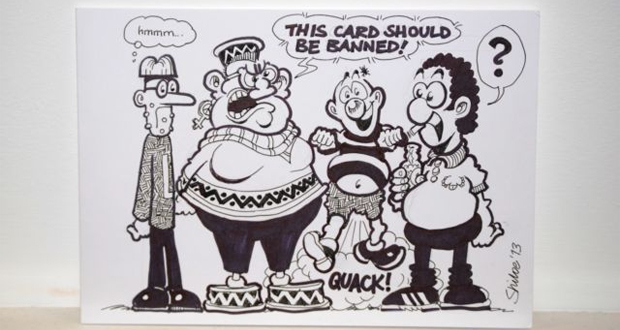
But the discussion did get me thinking about what an odd beast our favourite expletive construction really is. If we accept that “fuck” means to copulate, how exactly does one “fuck off”? It creates images of someone copulating so forcefully that he or she is propelled bodily from the bed or other surface, rather in the manner of Viz’s Johnny Fartpants being sent skywards by the power of his own bottom burps. The American “fuck yourself” is more satisfying as an insult, casting the recipient as a sort of carnal oureboros, pleasuring and consuming himself at once, the ultimate in squalid self-indulgence. But then the “off” does reinforce that your ultimate goal is for the person in question to leave your presence entirely, which I guess was Mr Aboutaleb’s main point. Maybe in celebration of this excellent fellow we should recalibrate our default swear mode to “rot toch op”. And unless we’re telling a Dutch person where to go, only we know how rude we’re being.

PS: This:

Saturday, September 13, 2014

A cock and ball story

As far as I can deduce from my infidel’s grasp of Christian theology, Satan is the source and summation of all that is evil, the sine qua non of moral wrongness, the do-badder to outdo them all. You think Voldemort’s a rotter? By comparison, he’s still nicking sweets from the pick-and-mix. So I was interested to see that when a statue of Beelzebub appeared recently in Vancouver, what troubled the locals was not the artistic representation of all that offends God’s will but the fact that the erection was sporting an erection. Moreover, when it was reported in the mainstream media, although the statue’s priapic appendage was the main point of the story, it was demurely blacked out in the photos. 


There seems to be a similar level of prudishness elsewhere in Her Maj’s Commonwealth, as a confectionery company in New Zealand has withdrawn gummy sweets in the shape of, well, what do you think?


Outside the Anglosphere, however, it seems that they’re rather more relaxed about such matters.


Monday, September 01, 2014

Check out this picture of a famous actress not naked

I was a bit behind the curve when it came to the news that photographs of an underclothed Jennifer Lawrence, along with several other actresses in a similar condition, had suddenly appeared in the digital ether without said actresses’ bidding. The first I heard of it was when I was directed to an article by Clementine Ford that said that this was a bad thing (yup), that it was a gross violation of said women’s privacy (agreed) and that people who went out of that way to look at the pictures were complicit in the said violation (on board with that as well). I then remarked, under the social media post that had pointed me to the article, that, while I couldn’t fault the author’s logic, this was indeed the first time I’d been aware of said pics of Ms Lawrence, and that in a tiny way, the article was helping to fan the flames, by letting people know that they were out there to be gawped at, if one so wished. I was immediately shot down, apparently because I was attempting to shut down women’s voices in the argument. So presumably had the article been written by a man making the self-same points — with which, as I said, I agree — I’d have been in the clear. Whatever. In the event, I suddenly became so jaded with the direction in which certain strands of modern feminism seem to be progressing that I was almost tempted to search for said pics of J-Law in the rudey nude, just to be obnoxious, until I remembered that she’s apparently going out with Chris Martin out of lame, bedwetting beat combo Coldplay so I don’t fancy her any more.

But still, I agree with what Ms Ford was saying, regardless of her chromosomes. It’s all about having control over your own body, innit? If Jennifer Lawrence wishes to flash her various inny and/or outy bits to the world, she should be permitted and if she doesn’t, it must not happen without her permission. And if she wants to show a lot of her body in a bikini, or not very much of it in a burqa, that’s up to her, and the same goes for men, so there. And then I read another article about another actress.

It’s Keira Knightley this time, who is lauded in the Telegraph for striking a blow for small-breasted women by, well showing off her small breasts in a magazine article. And there may well be a debate about whether this is a wise thing to do, or a moral thing, or even whether the pictures are any good. But I hope nobody would disagree that they’re Ms Knightley’s own small breasts and it’s bloody well up to her to cover them or uncover them as she sees fit. Except, apparently, whoever makes these decisions at the Telegraph; since, alongside the article (by a woman, incidentally, not that it should matter, although apparently it does) saying what a good thing it is she bared her small breasts, the only pictures have said small breasts obscured by a strip of the dullest grey.


Now, I’m not suggesting that this is an outrage against Ms Knightley’s dignity on a par with what Ms Lawrence and her colleagues have suffered. Just because KK elects to get them out, the Telegraph isn’t obliged to show them. It just seems that once again, a woman’s decision to do what she wants with her body is being overruled.

Except that now I’m not sure if I’m allowed to say that.

PS: Further perspectives on the Lawrence thing from Fleet Street Fox and Anne Helen Petersen.

PPS: And this from the Daily Mash.

PPPS: Stuart Jeffries brings Slavoj Žižek to the party, as you do. (Žižek isn’t naked.)

PPPPS: And now it’s art.

Sunday, July 13, 2014

On pubic hair, and/or the absence thereof

I’ve stroked my chin a couple of times (here and here) about the odd reactions provoked by Courbet’s painting The Origin of the World and, yes, we’re back on the vexed question of how we respond to public displays of women’s body hair, with the response to Leena McCall’s painting Portrait of Ms Ruby May, which was removed from a show at the Mall Galleries. The Guardian hedges its bets in its coverage of the story, not wanting to be as prim and silly as the Daily Mail but at the same time not wanting to give offence. (But to whom? Feminists? Puritans? Feminist puritans? Body fascists who think all women should be utterly shorn below the neckline? Tiresome hippies who insist with similar vehemence that all women should be innocent to the attention of waxes and razors whether they want to be or not?) They offer a censored version of the image but allow you to click if you want to see it in all its glory. I don’t have the energy for such things. Here’s the painting, take it or leave it:


Without wishing to delve too deeply into the minutiae of Ms May’s intimate beautification routines, she does appear to have done some tidying down there, although by what means I wouldn’t presume to guess. And of course there’s a whole thesis that could be concocted into our vexed relationship with pubes, encompassing Classical and Renaissance nudes, that urban myth about Ruskin, those pens with pictures of naked ladies who lose and acquire swimsuits depending on the angle at which you hold them and the shifting attitude of magazines such as Playboy, where hair was a proud badge of sexual liberation in the early 1970s, only to retreat over the years to the point at which it’s now as unacceptable as it was when the magazine first launched. And of course, the pubic paradox, that the presence of hair in some ways reveals what it also purports to conceal, which is verging on Baudrillard if you think about it, which I do, probably too much. I think I may go a bit further on this at a later date, although I suspect I’m already attracting some funny looks. Maybe I need to wax my blog.

PS: A photographer’s perspective (and a quirky video, if you speak a bit of French).

PPS: And more censorious silliness, this time about album sleeves. (Do they still exist?)

Thursday, July 03, 2014

Rolf Harris: can we see what it was yet?


So, following the precedent established by Gary Glitter, Jimmy Savile and others, the disgraced Rolf Harris is being written out of our cultural history, never more to pop up on light-hearted, list-based, celeb-sprinkled retrospectives of specific decades or genres. Fair enough: he’s a bad man and footage of his wobbleboard singalongs, or even of him comforting the owners of deceased parakeets, is now impossible to watch without thinking of his misdeeds.

But performance is inextricably linked with an individual’s personality. Other art forms, such as writing or visual art, can more easily be appreciated at a distance from those who created them. This is why we are still permitted to appreciate the sculptures of Eric Gill (who abused his daughters and even his dog) or the poetry of Philip Larkin (racist devotee of lesbian spanking porn) but might have been less forgiving had they sung about kangaroos and extra legs.

Harris, of course, is a more complicated case, because he was also a painter of some fame — yet it appears that he’s not being cut the same level of slack extended to Gill, nor yet to Paul Gauguin, who frolicked with Tahitian nubiles and probably gave them syphilis. The Harris portrait of the Queen seems to have disappeared from sight and owners of some of his other works are desperate to be rid of them. I was especially touched by the anguish of one Cathy Sims, who used to sing to her picture of Bonnie Tyler but now wants to burn it.

Maybe the difference is that Harris’s paintings can’t be detached from his now-tainted public persona; his TV appearances added to the fame and value of his art and now that we can’t watch them without retching, we can’t look at his paintings either. Essentially, without Rolf the performer, Rolf the painter wouldn’t have got a look in. And maybe one day, once the collective memories of his misdeeds are less raw, we’ll be able to look at those paintings coolly objectively, unaffected by knowledge of the artist either as avuncular entertainer or cynical predator. And with luck we’ll be able to see that, in purely aesthetic terms, they’re pretty bloody awful.

PS: The demands for retrospective airbrushing begin...

Saturday, June 07, 2014

Deborah de Robertis: ceci n’est pas une chatte

At the Musée d’Orsay a few days ago, the performance artist Deborah de Robertis further blurred the lines between performance, art, criticism, gender politics and self-marketing by re-enacting Origin of the World in front of the original painting. Which, if you’re not aware of Courbet’s controversial masterpiece, essentially means displaying her ladyparts to all and sundry.

De Robertis explained her actions thus:
There is a gap in art history, the absent point of view of the object of the gaze. In his realist painting, the painter shows the open legs, but the vagina remains closed. He does not reveal the hole, that is to say, the eye. I am not showing my vagina, but I am revealing what we do not see in the painting, the eye of the vagina, the black hole, this concealed eye, this chasm, which, beyond the flesh, refers to infinity, to the origin of the origin.
...which is essentially a riff on the feminist argument that in too much art, the male gaze at once sexualises the female body and makes it passive. Fair enough. But the stunt (cunning or otherwise) also refers back to the questions raised by René Magritte 85 years ago when he forced us to contemplate the distinction between a real object and a painting thereof. If it’s OK to show a painting of female genitalia, de Robertis seems to ask, why is it so disturbing — not least for the museum authorities — to show the real thing? When we get to media coverage of the event we get beyond reality top the competing claims of different kinds of representation. After all, unless we happened to be present when she sat down in the museum, we don’t see de Robertis’s genitalia, only photographic representations of it — just as we only see Courbet’s rendering in oils of his anonymous subject’s pudenda.

Said media tend to play things safe. In the Artnet article, the Courbet painting is shown in all its glory; Ms de Robertis’s tender areas are blotted out (is this the black hole to which she refers?); but there’s a link to a video in which all is bared and you can also see the upset that resulted. A brouhaha about a hoo-ha, one could say. When Le Figaro covered the same story they were even more puritanical, not even showing the original painting; but in the photo they used an attendant’s leg protects the artist’s modesty, thus making the act of censorship feel slightly less crass. (Indeed, that image rather reminds me of the classic photo of the Twickenham streaker Michael O’Brien, in which a London bobby’s helmet shields us from his, um, helmet.) When the Daily Mail ran a different story relating to Courbet’s painting last year they were equally wary of showing it in all its glory but felt able to offer up a rough sketch: which suggests that its readers can cope with neither female genitalia nor paintings of female genitalia but half-assed doodles of female genitalia are OK.

But let’s go back to de Robertis’s original point, which is essentially about how artists use and abuse female nudity. She’s reasserting her claim to ownership of her body, so the depiction of a naked woman is OK if it’s the woman herself doing it. Context is all. But she may well have been making a feminist statement when she sat down but if you wait till the end of the video clip and go to some of the suggested viewing, you’ll find that some of those who appreciated the ideological intent behind her gesture also wanted to see attractive Italian ladies in their underwear and a story about Scarlett Johansson getting naked. In today’s infinitely connected world, context begins to die after a single click.

Which puts me in a spot: how can I illustrate this story without seeming to be a prim, censorious puritan on one hand or a leering pornographer on the other. I suppose I’ll just avoid the issue, with a pretty picture of a cat, albeit one involving an artist who raised similar questions about the points at which empowerment and titillation intersect. Will this do?


Thursday, June 05, 2014

Audrey Hepburn’s bra: the revenge of the East

God knows the West has had some daft ideas about Asia over the years. From the prurience of 19th-century Orientalism via the half-arsed borrowing of religion and philosophy that characterises New Age thinking through to every movie that’s been badly and pointlessly remade — although I still maintain that The Magnificent Seven is more fun than Seven Samurai even if it’s not actually a better film — I’m sorry. That said, Asia’s more than capable of missing the point when it comes to Western culture. Call it Occidentalism.

For example, a Thai lingerie firm is currently running a big campaign featuring a well-known model/starlet adopting a selection of Hollywood poses that I’d describe as iconic if that word hadn’t by now been devalued to a point where it’s essentially meaningless. The problem is that the images take what’s most obviously appealing about the originals (famous, stylish, beautiful woman) without really delving into what it represents to people who may actually have seen the film rather than just checking out the DVD cover.


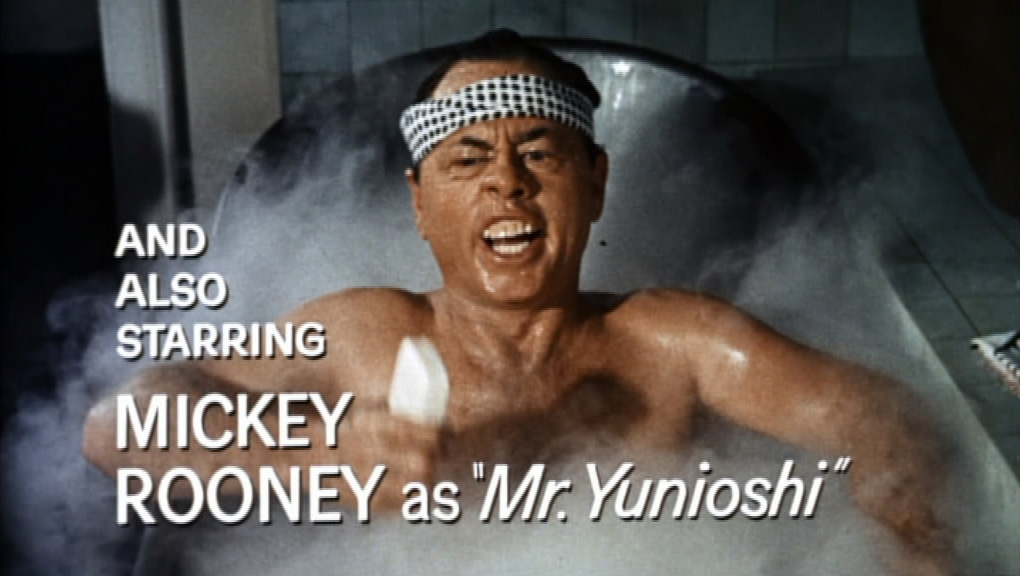
So let’s start with Audrey Hepburn. The whole damn point of Audrey Hepburn was that she could be elegant and sexy without the need for big knockers or an enhanced cleavage and certainly felt no obligation to flash around what little she had. If there’s a single movie legend who looks out of place advertising bras, it’s either Audrey or John Wayne. And, as inevitably happens when people try to sum up her particular charm, it’s Breakfast at Tiffany’s, one of her worst movies, that gets picked as a reference point. And in it, Audrey was playing a character who may not have been a hooker exactly but was something pretty close, which I’m not sure is quite the sort of role model the brand wants to present to the Bangkok middle classes. Maybe this is just payback from Asia for Mickey Rooney’s horrific yellowface act in the film? If so, fair enough.


Next, on the left, we have Sharon Stone in Basic Instinct. Now, it’s a long time since I’ve seen the movie, but as I recall, the whole point of this scene is that Ms Stone’s character isn’t wearing any knickers — which makes it a very odd reference point for a company that makes undergarments. I’m not even sure who the one on the right is meant to be, by the way. Edie Sedgwick? Frankie from The Saturdays? A very young Angela Merkel? Answers, please, on a pair of Sharon Stone’s unworn knickers.


But this is the one that really unnerves me. The reference is presumably to Dominique Swain in the 1997 adaptation of Lolita, which may have been more faithful to Nabokov than Kubrick’s earlier version but was otherwise worse in pretty much every respect. Leaving that aside, child abuse is at the heart of the movie and the seductive, lolly-licking, bra-strap-dropping, skirt-lifting character being portrayed in this picture is meant, in the novel at least, to be just 12 years old. In this case, I really do hope they’ve missed the point.

Monday, March 10, 2014

Kitty and Playboy: at it like rabbits

 The news that the French retailer Colette has created a Frankenstein splice of Hello Kitty with the Playboy bunny has provoked some harrumphing in certain quarters, with objections focusing on the suggestion that the overtly sexual overtones of the Playboy brand are an unsuitable match for a character that’s aimed at small children. The odd thing though is that, in Asia at least, many of the most devoted acolytes of Hello Kitty are women in their 20s, 30s and beyond; and Playboy, far from being a byword for sleazy pornography, is just one more aspirational brand. While the Thai edition of the magazine is full of purportedly attractive young ladies, there’s considerably less flesh on show than in the average copy of a British magazine such as FHM and it’s probably read by a similar demographic (eg, sweaty-palmed boys). So it could be argued that Hello Kitty is in some ways a more adult brand than Playboy and it’s the former that’s corrupting the latter.