Showing posts with label nudity. Show all posts

Saturday, September 21, 2024

About Poppy Baynham

There have been hundreds of (two, actually) complaints about an art work by one Poppy Baynham in a gallery in Hay-on-Wye which includes a black triangle with pink wool on top and those of you who recall (however vaguely) my past posts about Gustave Courbet and Deborah de Robertis and Egon Schiele and Leena McCall will realise that, yes, he’s talking about ladyparts again or, more specifically, images of ladyparts, with a side order of the hairy bits in images of ladyparts and the questions of whether said hair makes said images more or less dangerous.

Two new angles: one, that Ms Baynham is quite upfront that she’s actively seeking all this attention, and any comments received will be used in her final-year dissertation. (Will they then Become Art? Another day, maybe.)

The other is that in this blog’s new, pic-free state, I don’t need to agonise over whether any particular picture I use might be pandering to and/or subverting the male gaze. 

Tuesday, September 25, 2018

About Courbet

I’ve previously discussed at immoderate length the knots into which mass media gets itself when trying to discuss Gustave Courbet’s The Origin of the World without actually depicting or even describing what it represents? So full marks to the BBC for giving us the real deal (after a “graphic content” warning), while reporting a story about the rediscovery of Courbet’s model; and at the same time leading, above the digital fold, with a clean version that’s actually rather funny.


PS: And the comments section for Jonathan Jones’s piece on the above degenerates into a digital snowball fight regarding the distinction between a vagina and a vulva.

Monday, January 26, 2015

Page 3, Charlie Hebdo and the bare boobs of Angkor

Last week, The Sun pulled off what was widely regarded — through gritted teeth — as a PR masterstroke, by appearing to retire its venerable Page 3 feature (an attractive young lady with her breasts on display) and then, with all the brouhaha for and against still sounding in the air, bringing it back. But before the other media were forced to retract their obituaries, their coverage seemed to come up against the same sort of dilemmas and paradoxes that were exposed by all the Charlie Hebdo-related comment: essentially, if the key issue is whether it’s appropriate or not to depict something (Mohammed, boobs) you’re forced to take sides when you choose whether or not to depict it. Many of the papers and other news sources attempted to fudge the task by running pictures of former Page 3 stars such as Samantha Fox or Linda Lusardi, but choosing poses where they weren’t airing their areolae. This in turn raises further questions, since these more demure poses were still cheesecake shots for the gratification of the straight male gaze, which is apparently the whole problem with Page 3 — otherwise we’d have to infer that breasts per se were the problem, a profoundly anti-female stance that would probably have found favour with the Kouachi brothers, albeit maybe not with the sort of fervour that might have prompted them to shoot up an editorial meeting of The Sun. Because bare breasts when deployed in the cause of feminism — as in the case of Femen, say, are a good thing. Oh, hang on, maybe not.


In a parallel development, there has been outrage at the appearance of photos of topless women taken in and around the historic temples of Angkor in Cambodia; this is particularly controversial because what clothes they are wearing make them resemble apsara, cloud spirits of Hindu/Buddhist mythology. Apart from the fact that this is far from the first time such a scandal has erupted, observers have been quick to point out that Angkor is absolutely swimming in images of underclad females, in the form of the carvings on the temple walls, but that cuts no ice with Kerya Chau Sun of the Apsara Authority: “When you insult someone’s culture, it’s not art at all,” she says. Which is pretty lame as a code of aesthetics but I suppose it neatly encapsulates the thinking behind the campaigns against both Charlie Hebdo and Page 3. Although it does raise a further question: if it were art, would that make it OK?

Monday, September 01, 2014

Check out this picture of a famous actress not naked

I was a bit behind the curve when it came to the news that photographs of an underclothed Jennifer Lawrence, along with several other actresses in a similar condition, had suddenly appeared in the digital ether without said actresses’ bidding. The first I heard of it was when I was directed to an article by Clementine Ford that said that this was a bad thing (yup), that it was a gross violation of said women’s privacy (agreed) and that people who went out of that way to look at the pictures were complicit in the said violation (on board with that as well). I then remarked, under the social media post that had pointed me to the article, that, while I couldn’t fault the author’s logic, this was indeed the first time I’d been aware of said pics of Ms Lawrence, and that in a tiny way, the article was helping to fan the flames, by letting people know that they were out there to be gawped at, if one so wished. I was immediately shot down, apparently because I was attempting to shut down women’s voices in the argument. So presumably had the article been written by a man making the self-same points — with which, as I said, I agree — I’d have been in the clear. Whatever. In the event, I suddenly became so jaded with the direction in which certain strands of modern feminism seem to be progressing that I was almost tempted to search for said pics of J-Law in the rudey nude, just to be obnoxious, until I remembered that she’s apparently going out with Chris Martin out of lame, bedwetting beat combo Coldplay so I don’t fancy her any more.

But still, I agree with what Ms Ford was saying, regardless of her chromosomes. It’s all about having control over your own body, innit? If Jennifer Lawrence wishes to flash her various inny and/or outy bits to the world, she should be permitted and if she doesn’t, it must not happen without her permission. And if she wants to show a lot of her body in a bikini, or not very much of it in a burqa, that’s up to her, and the same goes for men, so there. And then I read another article about another actress.

It’s Keira Knightley this time, who is lauded in the Telegraph for striking a blow for small-breasted women by, well showing off her small breasts in a magazine article. And there may well be a debate about whether this is a wise thing to do, or a moral thing, or even whether the pictures are any good. But I hope nobody would disagree that they’re Ms Knightley’s own small breasts and it’s bloody well up to her to cover them or uncover them as she sees fit. Except, apparently, whoever makes these decisions at the Telegraph; since, alongside the article (by a woman, incidentally, not that it should matter, although apparently it does) saying what a good thing it is she bared her small breasts, the only pictures have said small breasts obscured by a strip of the dullest grey.


Now, I’m not suggesting that this is an outrage against Ms Knightley’s dignity on a par with what Ms Lawrence and her colleagues have suffered. Just because KK elects to get them out, the Telegraph isn’t obliged to show them. It just seems that once again, a woman’s decision to do what she wants with her body is being overruled.

Except that now I’m not sure if I’m allowed to say that.

PS: Further perspectives on the Lawrence thing from Fleet Street Fox and Anne Helen Petersen.

PPS: And this from the Daily Mash.

PPPS: Stuart Jeffries brings Slavoj Žižek to the party, as you do. (Žižek isn’t naked.)

PPPPS: And now it’s art.

Saturday, June 07, 2014

Deborah de Robertis: ceci n’est pas une chatte

At the Musée d’Orsay a few days ago, the performance artist Deborah de Robertis further blurred the lines between performance, art, criticism, gender politics and self-marketing by re-enacting Origin of the World in front of the original painting. Which, if you’re not aware of Courbet’s controversial masterpiece, essentially means displaying her ladyparts to all and sundry.

De Robertis explained her actions thus:
There is a gap in art history, the absent point of view of the object of the gaze. In his realist painting, the painter shows the open legs, but the vagina remains closed. He does not reveal the hole, that is to say, the eye. I am not showing my vagina, but I am revealing what we do not see in the painting, the eye of the vagina, the black hole, this concealed eye, this chasm, which, beyond the flesh, refers to infinity, to the origin of the origin.
...which is essentially a riff on the feminist argument that in too much art, the male gaze at once sexualises the female body and makes it passive. Fair enough. But the stunt (cunning or otherwise) also refers back to the questions raised by René Magritte 85 years ago when he forced us to contemplate the distinction between a real object and a painting thereof. If it’s OK to show a painting of female genitalia, de Robertis seems to ask, why is it so disturbing — not least for the museum authorities — to show the real thing? When we get to media coverage of the event we get beyond reality top the competing claims of different kinds of representation. After all, unless we happened to be present when she sat down in the museum, we don’t see de Robertis’s genitalia, only photographic representations of it — just as we only see Courbet’s rendering in oils of his anonymous subject’s pudenda.

Said media tend to play things safe. In the Artnet article, the Courbet painting is shown in all its glory; Ms de Robertis’s tender areas are blotted out (is this the black hole to which she refers?); but there’s a link to a video in which all is bared and you can also see the upset that resulted. A brouhaha about a hoo-ha, one could say. When Le Figaro covered the same story they were even more puritanical, not even showing the original painting; but in the photo they used an attendant’s leg protects the artist’s modesty, thus making the act of censorship feel slightly less crass. (Indeed, that image rather reminds me of the classic photo of the Twickenham streaker Michael O’Brien, in which a London bobby’s helmet shields us from his, um, helmet.) When the Daily Mail ran a different story relating to Courbet’s painting last year they were equally wary of showing it in all its glory but felt able to offer up a rough sketch: which suggests that its readers can cope with neither female genitalia nor paintings of female genitalia but half-assed doodles of female genitalia are OK.

But let’s go back to de Robertis’s original point, which is essentially about how artists use and abuse female nudity. She’s reasserting her claim to ownership of her body, so the depiction of a naked woman is OK if it’s the woman herself doing it. Context is all. But she may well have been making a feminist statement when she sat down but if you wait till the end of the video clip and go to some of the suggested viewing, you’ll find that some of those who appreciated the ideological intent behind her gesture also wanted to see attractive Italian ladies in their underwear and a story about Scarlett Johansson getting naked. In today’s infinitely connected world, context begins to die after a single click.

Which puts me in a spot: how can I illustrate this story without seeming to be a prim, censorious puritan on one hand or a leering pornographer on the other. I suppose I’ll just avoid the issue, with a pretty picture of a cat, albeit one involving an artist who raised similar questions about the points at which empowerment and titillation intersect. Will this do?


Tuesday, November 06, 2012

Bodypainting: what’s it all about? (NSFW)


Is bodypainting art? Or is it mere craft, with a bit of titillation thrown in, sometimes on the verge of soft porn? Danny Setiawan, I suppose, thinks it’s art. His stuff is available through Saatchi, although I’m not sure whether when you buy one of his works, you also buy the person on whom the art is painted. Where does the art stop and the canvas start? More to the point, when Setiawan paints a Klimt on a model’s chest, is it more or less art than if he’d used an original design? Maybe we could argue that Klimt is art; copying Klimt is craft; copying Klimt onto boobs is porn? Or is that unfair? Would painting a Rubens nude (art) on a real nude (porn) confuse the issue further?

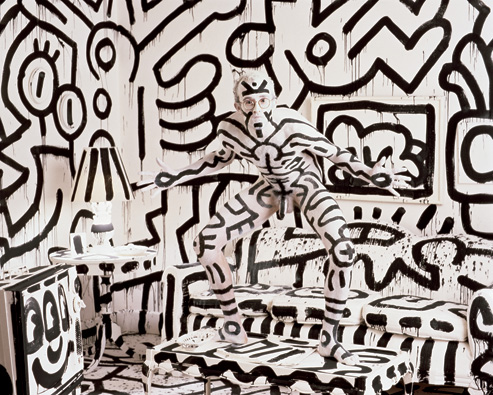
We can have even more fun with Olaf Breuning. He’s also inspired by other artists when he paints on naked people, but his stuff is less about copying an existing, well known painting, more about identifying a theme. But some of the artists he chooses were known for their own paint/skin interfaces, such as Keith Haring:


and Yves Klein:


In fact, one could argue that Klein’s art was in fact the marks left behind by his blue-painted models, rather than the models themselves; so what Breuning is creating is a simulacrum not of Klein’s art, nor even his canvas, but of his paintbrushes. In fact, since his pieces depend entirely on our knowledge of the original works and our response to them (if we like or dislike Haring or Klein, does that make us like or dislike Breuning’s takes on them more or less?) then what he is doing isn’t so much art or craft or porn – it’s more like criticism. With boobs.

Thursday, June 21, 2012

What’s the Thai for “Ooh la la”?

A few days ago, the TV show Thailand’s Got Talent featured a woman who did a (bad) painting with her bare breasts. The event spun out into multiple different directions, some of them more predictable than others: the female judge who disliked the act so vociferously was revealed to have done something similar in a fashion magazine a few years previously; the official complaints that this was somehow contrary to “Thai values” met with the response that Thailand has a massive and thriving sex industry that makes this sort of thing look pretty milk-and-water and in any case, bare boobs were pretty standard outdoor wear less than 100 years ago; and the whole kerfuffle seems to have been a concocted stunt anyway, with the so-called artist having been hired and instructed by the producers for publicity purposes.

I wouldn’t have minded, except that the act wasn’t even original. The French artist Yves Klein did pretty much the same thing in the 1960s. And he didn’t ask people to vote for it.


(Thanks to Jinda Wedel for getting me thinking.)

Saturday, December 13, 2008

The naked truth: postscript

Just an addendum to my earlier witterings about The Fermata; I read the book last weekend, in a beach hut near Pattaya, east of Bangkok. From the window, I could see lots of (Western) people in various states of undress: bikinis; topless; those tight thongs that German males of a certain age deem to be appropriate beachware. Now, all these people knew they were lurching towards nakedness; but did they know that, by Thai cultural standards, they were exceeding the boundaries of decency? Several Thai families were on the same beach, swimming fully clothed, as is the Thai way. When a scantily-clad farang loomed into view, they just looked in the other direction, feeling awkward but not wanting to make a fuss; as is also the Thai way. Unless the Westerners were being particularly crass and insensitive (possibly believing that with the Thai tourist industry in such a dire state, the locals should be pathetically grateful for their mere presence) I presume that they just didn't know the effect their unclad state was having, the message it was sending.

By watching the Westerners parade about with their nipples twinkling in the sun, the outlines of their genitalia clearly visible, was I being another Arno Strine; seeing them exposed to an extent they didn't necessarily realise? Should I have alerted them, like the serpent in Eden, awakening Adam and Eve (or Helmut und Heidi) to their own fall from grace? Or should I have just watched from a distance, hoping that none of them reads this?