Showing posts with label criticism. Show all posts

Thursday, April 16, 2026

About SMiLE

Ian Penman reviews a new Brian Wilson biography and raises the vexed question of whether the Beach Boys’ Quixotic project known first as Dumb Angel, then SMiLE, should ever have seen the light of day: 

For some fans it should have remained a glorious dream, better left unrealised. A labyrinth without a centre. The Arcades Project of pop.

Penman’s writing in the London Review of Books so maybe he doesn’t feel it necessary to explain a reference to Walter Benjamin, because the readership would get it (or feel too embarrassed to admit they didn’t get it). That said, given his previous form, I suspect he’d have done the same thing when he was writing for the NME.

Sunday, February 08, 2026

About restaurants

Following on from last week’s celebration of musical meh-ness, here’s Marina O’Loughlin in the FT explaining why it’s OK for reviewers to say that a rubbish restaurant is rubbish.

The job of newspaper critics — film, TV, restaurant, whatever — is to sell newspapers, not proselytise for what they’re employed to critique. Opinions are just that, so we find voices we trust and follow accordingly. If not, if personality and preferences, tendencies and turns of phrase don’t matter, then bring on our AI overlords. There are some restaurant critics I find almost unreadable, but then I don’t have to read them, do I? But nor do I feel the need to announce their obsolescence from a standpoint that celebrates the vanilla.

Sunday, February 01, 2026

About Uncut

This could become a habit. For the second time in a few months, I find myself picking up a real live music magazine. This time it’s Uncut, to which I was never particularly loyal even when I did read such things on a regular basis, but there’s a cover story about one of my favourite American bands, and a review of a box set by the other one, plus some other intriguing stuff, so, well, sorry, Mojo.

One thing that’s changed since I did regularly peruse Uncut (and Mojo, The Wire, NME, Select, Vox...) is that each review now carries a score, a mark out of 10. Journalists don’t usually like doing these, as it appears to reduce critical engagement to some kind of mathematical construct, but apparently the record companies do, so the advertising departments do, so they happen.

The odd thing is that, in this edition of Uncut at least, pretty much all the given marks occupy a small space on the scale, a critical cluster. They’re either 7/10, 8/10 or 9/10. Nothing’s truly dire, but nothing’s utterly brilliant either. Don’t frighten the horses, whatever you do. Even the album of the month (by Gorillaz), only gets a 9. Maybe it’s a quiet month, or maybe that’s what music’s like nowadays. In any case, it does make the whole process seem a bit pointless.

Wait, though – what’s this? Tucked away on page 33 is a soundtrack album by Jon Hopkins and Biggi Hilmers (of whom I have never heard) for a documentary called Wilding (of which I have never heard, again) and it actually manages to disappoint the writer so much that it only scrapes 6/10, three lesser than Gorillaz as Nigel Tufnell might have put it. Which surely isn’t truly bad, but possibly edges into being mediocrity-adjacent. Here’s a bit. Go on, you decide.

Wednesday, October 01, 2025

About cultural snobbery

An interesting piece by Rachel Aroesti arguing that the prevalence of algorithm-driven drivel might necessitate the resurgence of cultural snobbery, allowing people to suggest that what you like is shit, actually (and as such a rejection of the hideous “don’t yuck my yum” mantra I discussed a few weeks back): 

These days, “let people enjoy things” is the prevailing attitude towards all cultural consumption... With any negativity now considered psychic violence (sometimes countered by threats of actual violence from fans), enthusiasm took over as the default mode. Ironically, considering the Gallaghers’ track record of insulting their peers, it’s a mindset that has benefited the Oasis reunion no end: don’t call them derivative, dull or lyrically inane like people did in the 1990s; just focus on the rare and precious sight of British people having fun. 

PS: Looks as if Aroesti’s a lone voice though (or at best a lonely one, as I think she might have a point). Ho hum. The best lack all conviction... Although in the midst of all that, I think someone called me a Leavisite.

PPS: Also plucked from the carnage, Brian Klaas suggests that we shouldn’t slag off Dan Brown because that might discourage people from reading anything whatsoever. But even Klaas acknowledges that “Brown’s prose is clunky, his characters so thin that they occasionally resemble crepes with speech bubbles.” So might we be permitted to hold such opinions in places where the fans won’t see them? If I point and laugh at Oasis fans in a forest while all the Oasis fans are in a stadium 50 miles away...

Saturday, September 06, 2025

About music criticism

In the New Yorker, interesting thoughts from Kelefa Sanneh about how music criticism got too nice. I find two particular takeaways. One I really should have known already: that in 1970, Robert Christgau classified some of his favourite bands (in his case the Flying Burrito Brothers and the Stooges) as “semipopular music”. I take this to mean acts that are neither (or no longer) in the underground, but nor are they selling out arenas; credible but more or less profitable; perhaps a bit more known about than known. And I wonder who from my own collection might occupy the same space. Perhaps Belle & Sebastian, Mogwai, Stereolab, Magnetic Fields... and then I recall that two of the Magnetic Fields aren’t coming on their next European jaunt because of “work commitments” which suggests they have real, dull jobs and the Mags are perhaps a bit less than “semipopular”. And then in turn I recall that Field Music (nine albums and counting) have to moonlight as a Doors cover act to make ends meet. And I wonder whether the blanding of music criticism really matters, because it looks as if music sure as hell doesn’t.

And then something I wish I hadn’t known: one reason critics are wary of giving a proper early-80s-NME-style kicking to music is for fear of giving offence. Not necessarily to the artists themselves, but to anybody who happens to like those artists. And not just because some of the more devoted fans (Sanneh notes the behaviour of Nicki Minaj’s acolytes among others) might take forceful exception to anyone pointing out flaws in their idols. No, apparently it’s rude simply to dislike something that others might like, and the exhortation to refrain from this has its own emetic label: “don’t yuck my yum”. Which I don’t like, but maybe I’m not allowed to say that.

Saturday, July 26, 2025

About English literature

A thoughtful review, by James Marriott in the New Statesman, of Stefan Collini’s book about the glory days of Eng Lit, ending with the author’s pessimistic moan: 
In time... it may become possible to be accepted as a cultivated person (whatever that archaic term will by then have come to represent) without having an acquaintance with any literature written before one’s own era, or perhaps with any literature at all.
and then the critic’s resigned observation that this time is already upon us. Marriott gets a bit over 2,000 words to work with, which is pretty generous these days, but would be considered a mere footnote by the sort of academics that Collini invokes, the likes of FR Leavis and IA Richards. But then Marriott gets half an hour to stretch his case out in the video. Which rather proves his point, no?

Saturday, May 31, 2025

About literalism

In the New Yorker, Namwali Serpell laments the excessive literalism that bedevils modern movies, exemplified by the Best Picture Oscar winner Anora, in which the viewer is not permitted to infer the narrative model for the story until a character actually bleats out the word “Cinderella”. Everything must be signposted, labelled, hammered home:

Artists and audiences sometimes defend this legibility as democratic, a way to reach everyone. It is, in fact, condescending. Forget the degradation of art into content. Content has been demoted to concept. And concept has become a banner ad.

No complaints from this end. Serpell is wary of endless perfect repetition (of themes, images, ideas) and calls on Freud to laud “the inexact reiteration of what came before”, the unpredictability of Nina Simone and Samuel Beckett, Andy Warhol and David Lynch, surprises, improvisations, imperfections. Again, all good. And Barthes and Baudrillard get invited to the party and I couldn’t be happier.

But... in castigating the generic, point-missing nature of fashion, she snipes: “we all wear Doc Martens but no one is actually goth.” Hang on? Are goths meant to wear Docs? Or more specifically, are Doc-wearers meant to be goths? Did I miss that e-mail? And then she says “da Vinci” when she means Leonardo. And you scroll to one of those deliciously deadpan New Yorker erratum notices that leaves you desperate to know exactly what horrible solecism has been excised:

An earlier version of this article incorrectly described the ending of “A Complete Unknown.”

In normal circumstances, I’d sneer at this catalogue of sloppiness and congratulate myself for knowing better. But I wonder whether Serpell is just practising what she preaches, embodying her enthusiasm for imperfection by getting stuff wrong.

On a similar theme, I’ve long despaired at BBC Radio 4’s habit – doubtless encouraged by the laudable aim of inclusivity – to gloss every cultural reference that might smell even slightly of high art. In other words, it’s never enough to say “Hamlet”; it has to be “William Shakespeare’s tragedy Hamlet” in case  someone somewhere thinks you’re talking about a cigar or a football team in Dulwich or an omelette. 

That said, in a recent edition of the lexicographical panel show Unspeakable (go to 04.45), Russell Kane explained that he uses “Immanuel” (the forename of the author of The Critique of Pure Reason) as a euphemism for, well, the surname. But if Kane had uttered the surname, this might have disturbed the guardians of pre-watershed taste, so the gag remained inexplicable to anyone not on at least nodding terms with 18th-century philosophy. Although only minutes before, Kane had felt the need to explain that Pride and Prejudice was written by Jane Austen.

PS: Bookmark time: in the New York Times, the career vicissitudes of Generation X; while Gen Z yearns for an internet-free past it never knew.

Thursday, May 22, 2025

About book lists

Of course the news that an AI-generated summer reading list for the Chicago Sun-Times was weighted heavily in favour of books that, er, don’t actually exist has embattled meat-and-mucus critics crowing over another thing that our new digital overlords have royally arsed up.

But hang on a minute. We don’t need ones and zeroes to invent new works from the likes of Isabel Allende or Percival Everett. Remember Jim Crace’s Useless America, which owed its (non-) existence to a mangled phone conversation with someone at Penguin? Or indeed my own Lady Gaga biography, which never progressed beyond a few weeks of research, but still garnered five stars on GoodReads. 

In any case, even when the product is real, do you really think the (human) author of such thumbs-up compendia has made a series of informed decisions about what should or should not be included? I spent several years on a strange planet called Lifestyle Journalism and, trust me, very often you have little to go on bar a press release and an advertising exec suggesting forcefully that it would be very helpful if specific products from her client might be included, or else. So, yes, this book (or holiday or necklace or vodka or cardigan or chi-chi gluten-free bistro or invasive surgical procedure) is good and you should buy it, because we say so, even if we’ve never been in the same room as the bloody thing.

Ultimately, AI succeeds not by doing things better than humans, but by doing them equally badly.

PS: Another example from the archives: in defence of the Black Crowes review that was more like an educated guess.

Sunday, March 16, 2025

About literary fiction

Back in the olden days I started a blog about The Da Vinci Code, attempting to deconstruct exactly what Dan Brown was doing right/wrong, attracting millions of readers while at the same time breaking pretty much every rule of half-decent writing (including those followed by other writers of popular, non-literary fiction). I gave up, of course, but I was never dissuaded from my initial premise that the book is badly written. What might have shifted is whether, in a post-literate era, that matters any more.

And now, after all these years, in The Spectator of all places, one Sean Thomas reads the last rites to what may once have been identified as good books, the ones that dominated the cultural agenda in the 80s and 90s. Except, he’s quite glad to see the genre go, even though he (like me) was a bit of an Amis fanboy back in the day. And what was it turned his head around? Why, The Da Vinci Code, of course, because it privileged plot over navel-gazing. But what about the writing, the thing that made critics’ teeth hurt just from thinking about it? Thomas describes that as “all quite workmanlike”.

It’s not though, is it? It’s crap. Go back to my blog for myriad examples. I can only infer that Mr Thomas has had some unfortunate run-ins with workmen.

PS: Just before posting, I Googled Sean Thomas and discovered that he’s the son of DM Thomas, whose novel The White Hotel was pipped to the Booker Prize by Midnight’s Children. From which I won’t draw any conclusions. I’ll just leave it there.

Tuesday, December 24, 2024

About Stoppard

I wrote a while back about someone who gave a disobliging review to a play because it was stuffed with obscure references; not that he, the reviewer, found them obscure, but he assumed that younger theatre-goers would be baffled by TS Eliot and the Marx brothers.

And now Fiona Mountford goes one better, delivering a kicking to a revival of Tom Stoppard’s The Invention of Love because it’s “three hours of often indistinguishable men exchanging achingly arch lines about the minutiae of classical grammar and quoting screeds and screeds of Latin at each other”. And of course Ms Mountford gets the minutiae, the screeds, even, because she read classics at Oxford; but she thinks the other punters probably wouldn’t. The fact that the play’s author is a refugee speaker of English as a second language who never went to university at all doesn’t seem to figure in her calculations. “Far too often,” she sighs, “it feels less like drama and more like intellectual masturbation and that, surely, is not why we go to the theatre.” Quite right too. It’s why we write theatre reviews though, or should be.

PS: To be fair, Stoppard himself has worried about leaving the audience behind.

Sunday, November 10, 2024

About Bob Dylan

A currently popular model for online content is what I call “I went” journalism, in which a cultural product (a stage play, a theme park, a restaurant, you name it) is covered in the form of a narrative, in which the writer’s own personal experience takes precedence over any explicit critical engagement. So the banausic details of the evening (how easy it is to park, the variety of ice creams available in the interval, whether there was someone unusually tall in front of the writer) get equal billing with such trifles as acting or direction or the provenance of the hispi cabbage. 

Consider, for example, Kayleigh Cantrell’s piece about Bob Dylan’s recent gig in Liverpool. Yes, she gives some idea what it was like. The band “performed elegantly”, assisted by “stage lamps, which simply added to the classiness”. And, fear not, Bob “played his signature harmonica”. Kayleigh does namecheck several songs, and observes that Dylan played them differently from the way he did them on his records, but doesn’t explain how, nor does she ever venture an opinion as to why.

Because if she did that, she wouldn’t have had time to reflect on her excitement at going to her first phone-free gig. (“It added so much more to the experience” – OK, but what exactly did it add?). Or indeed for an extended coda about a busker playing Dylan tunes outside the arena, who appears to have made lots of money from the punters and Kayleigh’s wondering how much he made. (So why didn’t she ask him? Like a journalist might?)

Let’s not heap any opprobrium upon Kayleigh, though. She’s just giving readers what they want, a bare description of what happened, alongside how it made her feel. Nothing to frighten the horses. No analysis, no inference, no theory. After all, more people watch Gogglebox than read what’s left of the music press, let alone anything with “CULTURAL” in the title. And what she’s doing is far from new, of course. Think back to 2012 and Marilyn Hagerty’s legendary appreciation of a new branch of Olive Garden. Keep it up, Kayleigh. Never mind what might be going on inside the head of the Nobel-winning harmonica-blower. Just remember the breadsticks.

PS: If you’re one of the half-dozen people who still give a toss what old-style critics think, here’s David Thomson interviewing Greil Marcus.

PPS: I suppose this week I should have been musing about what’s happened on the other side of the Atlantic. I’ve got form, haven’t I? But then, all the success of the populist right appears to be based on surface observation and gut reaction rather than anything deeper or more intellectually testing, so maybe Kayleigh in Dylanland and four more years of Trump are just two manifestations of the same thing.

PPPS: Ah, another one of those old-fashioned music hacks – in this instance Richard Williams, formerly of Melody Maker and Time Out, and the original presenter of Whistle Test – also reviews a Dylan gig, this time putting the experience in some sort of context, and even going so far as to suggest that he wasn’t all that great, actually. And he doesn’t mention a busker, or what happened to his phone. Or, indeed, breadsticks. That said, Williams, his own track record notwithstanding, is reduced to putting the review up on his own blog. One-nil to Kayleigh, I reckon. 

PPPPS: Yet another oldie weighs in, this time Toby Litt. And he actually mentions history. The very nerve...

Thursday, October 24, 2024

About Amazon reviews

Not having published much in recent years, I’ve got out of the habit of scouring Amazon and similar sites for what people have deigned to say about my offerings. Which is why I’ve only just noticed that, three and a half years ago, a user known only as “magic” declared that my book about the Noughties was

Fun, and easy to read

which I’m sure was meant kindly but feels like a variant on Mostly Harmless.

Monday, February 19, 2024

About new music

Sean Thomas in The Spectator claims to have found empirical evidence that music is getting worse. I agree with his conclusion, but don’t recognise his claim to objectivity; music is getting worse because I’m getting old and so, presumably, is Mr Thomas. If I were young, it would all be great, but I’m not, which is why I only get excited by the Top of the Pops re-runs on Saturday nights if they date from 1978 to 1983. Incidentally, Thomas’s characterisation of a modern lyric as “the desire of the singer to ‘kill his mofo bitches’ and celebrate his expensive car, hat and Rolex watch” suggests that he last listened to a rap record in about 1991, and then only fleetingly.

Moreover, it needs to be noted that this year sees the 100th anniversary of Gershwin’s Rhapsody in Blue, and the 200th of Beethoven’s Ninth Symphony, two groundbreaking works whose influence is still being felt. But I bet that in 1924 and 1824, there were plenty of people who could come up with an algorithm to prove that they were rubbish.

There is great music being produced now that will still be heard and loved in 2124 and beyond. We just don’t know what it is yet.

Friday, January 26, 2024

About Barbie and being good


Oh what a brouhaha there is about the lack of love Barbie has received in terms of nominations for the upcoming Oscars. (In short, it got a nod in the Best Picture category, but its female director and female star were less happy. Ryan Gosling, nominated for Best Supporting Actor, spoke up for his spurned sisters but not to the extent of throwing his own chance away.)

For the record, I enjoyed the movie, especially its design (definitely one that has to be seen on the big screen) although it probably wouldn’t be in any of my best-of lists. Gerwig and Robbie are talented people but they’ve each done better things (Lady Bird and I, Tonya). That’s not what this is about, though, is it? Barbie, beneath the pink gleam, is a satire of sexism and patriarchy and masculinist assumptions and, so the logic goes, to deprive it of recognition is to condone all those bad things. 

Except that it really isn’t, is it? Films that are on the side of the angels aren’t inherently great films and yet the Oscar voters have long had a tendency to reward movies on the basis of their social values alone. The nadir of this came at the 78th awards, when the Best Picture gong went to Crash, a movie at once incoherent and simplistic, the script of which is pretty much the song ‘Everyone’s a Little Bit Racist’ stretched over two hours. To add to the fun, it edged out Brokeback Mountain, so even as the Academy patted itself on the back for acknowledging that Racism Is A Bad Thing, it was panicking in case anyone might think it considered homophobia not to be equally reprehensible. Barbie’s relatively slim pickings may be a sign that Hollywood is finally shaking its way out of such ethical quandaries.

Society as a whole isn’t there yet. Maybe the problem is that at the same time as we have become more confident, even to the point of sanctimony, in our moral and political opinions, we feel less able to make aesthetic judgements, to declare that one film (book, song, play, etc) better than another by virtue of imagination, craft and skill rather than just, well, virtue. To argue on purely artistic grounds that X is a better actor or director or composer or balloon sculptor than Y takes us too close to assumptions about class and education that feel too uncomfortable to express. (Incidentally, we are in similar territory when it comes to language. We are encouraged seize on instances of misgendering or outdated racial epithets, but suggesting that the phrase “would of” is in some way incorrect looks plain rude.)

It almost feels as if we’ve slipped back to the Victorian era, when finger-wagging critics dismissed the likes of Wuthering Heights and Tess of the d’Urbervilles, not for any inherent literary faults but because they were morally suspect. The specific criteria have changed (racism and misogyny and homophobia rather than fornication) but the priorities would be familiar to Hardy or the Brontës. We know what’s good, but not what’s good.

PS: My old mucker Clair, who used to hang around these parts as the Urban Woo, deals with the matter in characteristically brisk, no-nonsense fashion in The Independent.

PPS: Reductress, as it tends to, also gets it right:

Monday, September 04, 2023

About the Beatles

I asked ChatGPT to identify the worst Beatles song and this is what happened:
It’s important to remember that opinions on music are highly subjective, and what one person considers the “worst” song by The Beatles, another might enjoy. The Beatles are widely regarded as one of the greatest and most influential bands in the history of music, and their catalog includes a vast array of songs spanning different genres and styles. Rather than singling out a specific song as the “worst,” it's more constructive to acknowledge that The Beatles had a few songs that were less popular or less critically acclaimed than their most iconic tracks. However, even these less celebrated songs have their own merits and are appreciated by some fans. Musical taste is personal, so what one person may dislike, another may find enjoyable. Ultimately, The Beatles’ legacy is defined by their many legendary and groundbreaking songs that have had a profound impact on the music industry, and their contributions to music far outweigh any individual song's perceived shortcomings.

There are all sorts of rumours that AI will take over from yer actual meat-and-mucus critics but this takes things in an even more worrying direction – it’s effectively decided that critical faculties are a bit impolite, actually, because you might be casting aspersions on somebody’s favourite. So it’s more “constructive” to acknowledge that some of the songs wowed the critics less than others did, provided you remember to assert the Fabs’ absolute centrality to the canon.

And it’s an easy question anyway. The answer‘s ‘What’s the New Mary Jane’, isn’t it?


PS: Elif Batuman asks ChatGPT a question about Proust and is told to, er, read Proust.

PPS: In American Songwriter, Jacob Uitti uses AI to imagine a Dylan/Cohen collaboration and, guess what, it’s dreadful. That said, much of the content here is as bad, even when it’s nominally written by humans. In a discussion of Paranoid Android we are blessed with this gem: “Despite the hurdle posed by censorship, the video managed to retain its audience’s captivation.” When I am king, bad writers, human or digital, will be first against the wall.

Sunday, August 06, 2023

About the middlebrow

 You know, I could get behind this...

Tuesday, July 18, 2023

About the best films

The critic Derek Malcolm has died, which inevitably draws us back to 2001 and his shamelessly highbrow farewell gift to The Guardian, his 100 best films; any reader of his work would have a pretty good idea of the directors that would appear, although some might query the specific movies. (The Bitter Tea of General Yen for Capra? Really?)

The fun starts when his fellow reviewers are asked to review his list. Most respond with respect, while quibbling with the details; David Thomson despairs of the whole idea. And then there’s Nick Fisher from The Sun (who also died in the past few months), who gives a lovely display of performative philistinism: 

This is a buff's list, not a punter’s list. Where's Erin Brockovich and Men In Black? Where’s American Beauty or American Pie or American Movie, come to that? Long films with dense subtitles are not my cup of rosie. I think Derek and me would be hard pushed to ever pick a Saturday night out at the flicks together. Does he even eat popcorn? I think I read down to Kes before I even recognised any of these names as movies. Kinda smells of pretension to me. But hey, without buffs there would be no poncey foreign film festivals. And we know how important they are. Not. Kes, Apocalypse Now, Raging Bull and Night At The Opera... yep, I go along with all of these as firm candidates for any Top 100. But, as for the other 96 titles, you're on your own Del. 

Two thoughts. First, although Malcolm might seem to be in thrall to the canon emforced by Sight and Sound, Cahiers du Cinéma, Film Comment and so forth, surely Fisher’s reference points are similarly unsurprising, playing the same game, but shorn of the “dense subtitles”. (Too many words, my dear Godard...)

The other is the frame of reference. Malcolm had almost certainly seen most of the films Fisher cited, and decided from a position of knowledge that they didn’t merit inclusion; could Fisher have said the same about the 96 he objected to on Malcolm’s list?


PS: And for what it’s worth, I’d probably agree with about a dozen of Malcolm’s choices. And I don’t like popcorn.

Monday, June 26, 2023

About Elton John

I’ve long been a fan of Brian Wilson and I’ve been fortunate to see him in concert three times. The first was at one of his triumphant Pet Sounds concerts in London in 2002 and it was probably the greatest musical event I’ve ever attended. The second was in Singapore, when he temporarily reunited with the Beach Boys for their 50th anniversary tour and although it was more of a case study in the dynamics of a dysfunctional family than a gig per se, it was still fun. The most recent was back in London a few years ago; he could no longer hit the high notes, and was having trouble with some of the medium range ones, and barely played the piano that seemed to serve more as a barrier to protect him from the audience than any kind of musical instrument. But the accompanying musicians filled in the gaps very well and the fans seemed to come to a consensus that what were really doing was to say thank you to this damaged genius, for the times when he could do it, and did. I probably won’t see him again if another opportunity arises, but I’m glad I did.

I was reminded of that most recent concert when I watched TV coverage of Elton John’s performance at Glastonbury last night, supposedly his last ever gig in the UK. Elton’s career trajectory has been similar to Brian’s in some respects, with mental troubles and substance abuse threatening to derail things at several junctures. But he too pulled through, and seems to be in better shape than his American counterpart, at all times aware of where he is and what he’s doing, acknowledging and appreciating the love of the crowd. And Elton's hands are definitely hammering away at those keys, unlike Brian’s, which hover a few inches above, never daring to connect.

There’s one problem, though. Elton can’t sing any more. It’s not a matter of not being able to sing in key any more, as with Brian; it’s that his diction is shot to pieces. He mumbles, he slurs, and we hadn’t heard Bernie Taupin’s lyrics a hundred, a thousand times before, we wouldn’t know what the hell he was on about. This is something that was identified during lockdown when he gave us his now-notorious Pub Singer rendition of ‘I’m Still Standing’ and many brushed off his inadequacy with the explanation that he was out of practice, that once the pandemic was over and he started to tour again, all would be well. Apparently not. It’s not clear what’s gone wrong (Something neurological? Cosmetic surgery? New teeth?) but it sounded bloody horrible.

And does that matter? Not really, certainly not to the devotees who bade him farewell at Glastonbury and from their living rooms. Just like Brian’s fans in Hammersmith, they were gathered to remember the good old days, and above all to say thank you.

But I’m baffled by the professional, paid critics (here’s one; here’s another; and there’s more) who’ve been telling us, quite rightly, that this was  an emotionally charged, joyous gathering of faithful, a celebration of a long and glorious career, without acknowledging that, as a musical performance, it was all a bit rubbish, frankly.

PS: Vaguely related, an argument that criticism doesn’t require any particular knowledge or contextual understanding. Which makes it just reaction, surely?

Thursday, June 22, 2023

About Tár

Zadie Smith in the New York Review of Books on the generational divide exposed by Todd Fields’s film Tár (which I really ought to have watched by now):

We of Tár’s generation can be quick to lambaste those we call (behind their backs) “the youngs,” but speaking for myself, I’m the one severely triggered by statements like “Chaucer is misogynistic” or “Virginia Woolf was a racist.” Not because I can’t see that both statements are partially true, but because I am of that generation whose only real shibboleth was: “Is it interesting?” Into which broad category both evils and flaws could easily be fit, not because you agreed with them personally but because they had the potential to be analyzed, just like anything else. Whereas if you grew up online, the negative attributes of individual humans are immediately disqualifying. The very phrase ad hominem has been rendered obsolete, almost incomprehensible. An argument that is directed against a person, rather than the position they are maintaining? Online a person is the position they’re maintaining and vice versa. Opinions are identities and identities are opinions. Unfollow!

Monday, January 23, 2023

About ChatGPT

Music critic Simon Reynolds is sanguine regarding the threat that an AI program such as ChatGPT might present to his trade:

...A.I. has no need to write, either — no deep-seated motivation to put words on paper or on screen. The kind of texts it generates resemble what I think of as “motiveless” writing, like school homework, or advertorial. Proper music criticism, even if done to earn a living, is closer to the sort of willed writing that fills diaries, journals and poems — where the compulsion to write is internal rather than externally imposed.

Except that what he (and, if you were to put a gun to my head, I) would define as “proper music criticism” has been in retreat for years, squeezed out by the twin monsters of economics and technology in favour of, well, advertorial. Mr Reynolds may well survive the onslaught, but any number of lesser names may not be so lucky.

In other news, I had a go with the program, and this happened:


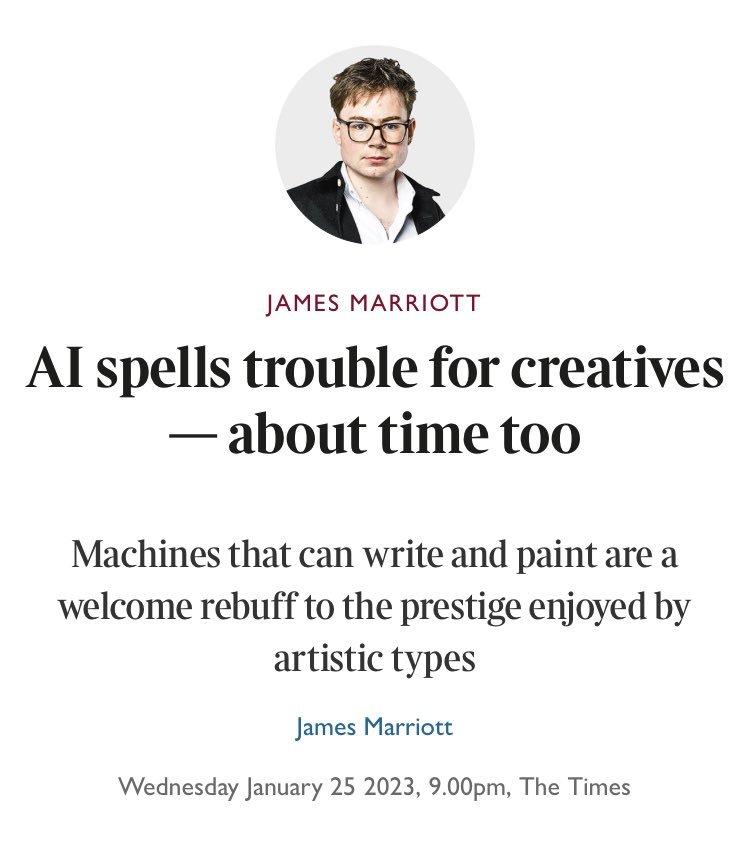
PS: Also this, from The Times. “Artistic types” indeed.