A fun interview with the Pet Shop Boys, focusing on the visual aspects of their work, in which Neil Tennant is egged into saying “Gesamtkunstwerk” as if it’s a big, dirty swear. He also muses on which magazines have survived the protracted Death Of Print, and which have withered:
The New Yorker. The Spectator. The Atlantic. The stapled magazine opens invitingly, whereas the instinct of a perfect bound magazine is to close.
I love the idea of a magazine having an instinct. But could it also be that a perfect bound magazine (essentially, one with a spine), more closely resembles that most toxic of things, a book?
Have been a bit distracted lately, so here are two things upon which I’ve alighted only recently. First, OK Computer all at once — all the tracks played simultaneously.
Somewhat inevitably, it sounds not unlike the orchestral freeform bits in A Day in the Life, but I suspect that would happen if you objected most albums to similar indignities. Oh, did I mention that I once wrote a book about OK Computer? (And yes, if you go to that site the first review is from someone who called it “a phenomenally dumb book” although I still get a perfect score for a book that neither I nor anybody else wrote, so there’s that.)
And then, a magazine that has got to issue 13 without me noticing it and I’m now tempted to hunt down back issues of The Fence, or maybe even to send in a contribution on spec, something I don’t think I’ve done for more than a decade. It clearly owes something to Private Eye in terms of aesthetic and attitude (two-colour, non-glossy, print-first, London-y without necessarily being about London) but its subject matter is wider-ranging (in this issue, TS Eliot, clip joints, five-a-side football results, Zimbabwean goblins). There are no ads, so I couldn’t work out how it’s survived so long, although this article suggests a wealthy, aristocratic benefactor has been handy. Which should annoy me, but for some reason adds to its ramshackle, flâneuristic charm. (If it were a hedge-fund manager behind it, I’d be annoyed.)
I was fortunate to be brought up in a house with a lot of books. My dad read David Storey and Stan Barstow, who came from where I came from, but also Chandler, Maigret, Camus, and more sports books than you’ve ever seen. There was Dewsbury market for comic books and secondhand books, and I can’t overstate the education you got from reading the NME between 1979 and 1985. A review of the Birthday Party would be talking about Dostoevsky; Mark E Smith, Nick Cave, Coil and Morrissey all talked about books, painting, other forms of music, and I just absorbed it all. You could be reading Beckett and Philip K Dick, watching the football and The Singing Detective, going to see a band and a Francis Bacon exhibition; almost every week you were hearing or reading something you’d never seen the like of before. I’m not sure that’s the case these days.
Maybe the cut-off came in the mid-1990s, when the likes of Oasis proclaimed themselves heirs to the mantle of indie greatness, but coupled it with a strand of (performative?) bibliophobia. And 20 years later, Noel Gallagher still seemed deeply suspicious of the whole idea of reading and writing books:
“…people who write and read and review books are f***ing putting themselves a tiny little bit above the rest of us who f***ing make records and write pathetic little songs for a living.”
It’s not an either-or scenario, and I wouldn’t presume that by not offering their fans a bespoke to-read list packed with dystopia and existential angst modern musicians are implicitly endorsing Gallagher’s philistinism. But it could be that they’re advised not to talk about it, at least not in the opinionated, evangelical tones of their 80s forebears.
I bloody loved The Modern Review. Its glory days coincided with my first few years living in London and as such it defines the early 90s for me more than fax machines, shoegaze or Amanda de Cadenet. Having gone through three years of the English literary canon, the idea of applying chin-stroking critical techniques to the guttersnipes of pop culture felt deliciously transgressive. And, yes, I miss it (although maybe there’s a distinct element of still being the right side of 30 that I miss) and on more than one occasion, I’ve yearned for its return, despite the subsequent political missteps of its co-creators, Julie Burchill and Toby Young.
Be so, so careful what you wish for. Burchill crashed and burned in 1997 with a glossy reboot that lasted a mere five issues; and now Young, who has in the intervening decades recast himself as a champion of free schools and lockdown scepticism, is having a crack at it, promising something rather more serious. Ms Burchill, always skilled at repurposing sour grapes as a conscious career move, claims to be pretty happy with that state of affairs.
Will I buy a copy? Oh, probably. Will I be disappointed? Certainly. But just as the original version reflected my own faith in words and art and subversion back at me, the new one will do the same with my middle-aged dyspepsia. It will be just the magazine we deserve.
Last weekend, I retrieved several bundles of dead-tree matter from the parental loft, including a whole load of back issues of The Modern Review. Having a letter published earned one a free subscription, which is how I got to supply the punchline to a simmering feud between Greil Marcus and Camille Paglia:
I never really got swept up in the general enthusiasm about Mad magazine, which has suffered the fate of so many print titles. But I was impressed with this 1978 edition; apparently they pre-empted the whole Adbusters/culture jamming thing by several years, even if the main objection was aesthetic rather than political.
The NME is still a thing, apparently, and it still has an editor, one Charlotte Gunn. Discussing the decision of the title to expand its live offering, whatever that means, she says, “Really, I just want NME to help get people together to have a nice time listening to great music, because isn’t that what it's all about?”
Actually, I always thought what NME was supposed to be all about was tearing people apart.
In the past few days, two German magazines have put out covers depicting two right-wing foreign leaders in highly unflattering guises. That said, the difference in tone suggests that one of the countries in question, as awful as its current boss might be, still needs to be taken seriously. The other, perhaps not so much.
I was sad to learn that Drowned in Sound is to close down, and not just because the music site was kind enough to publish a slice of my own self-indulgence a while back. But even as DiS and other titles breathe their last, old products that started in the pre-www days are enjoying something of a Lazarus moment. The hip young things are getting terribly excited over the return of style bible The Face; and now their grubbier siblings will be ecstatic to know that Sounds is back as well. Even in its heyday, the music weekly was generally seen as third best to mighty NME and Melody Maker, flying the flag for such unfashionable genres as heavy metal and goth rock; but, contrary to the generally accepted narrative it was in the smudgy pages of Sounds that the first hints of British punk were disseminated for the wider world.
I’ll be interested to see how both publications thrive in a fresh, new, multi-platform world; but I’m not going to properly lose my cool until the greatest magazine of my lifetime comes back to annoy us once again...
I was startled today to see a copy of the Modern Review Mark 2 – the glossy, vapid Burchill/Raven relaunch from 1997, rather than the scrappy, wonderful collaboration between Burchill and Landesman and Young and York – selling for over £100 on Amazon, and the psychic shock propelled me back to the days when seeing Roland Barthes and Bart Simpson on the same bill was still something subversive and beautiful.
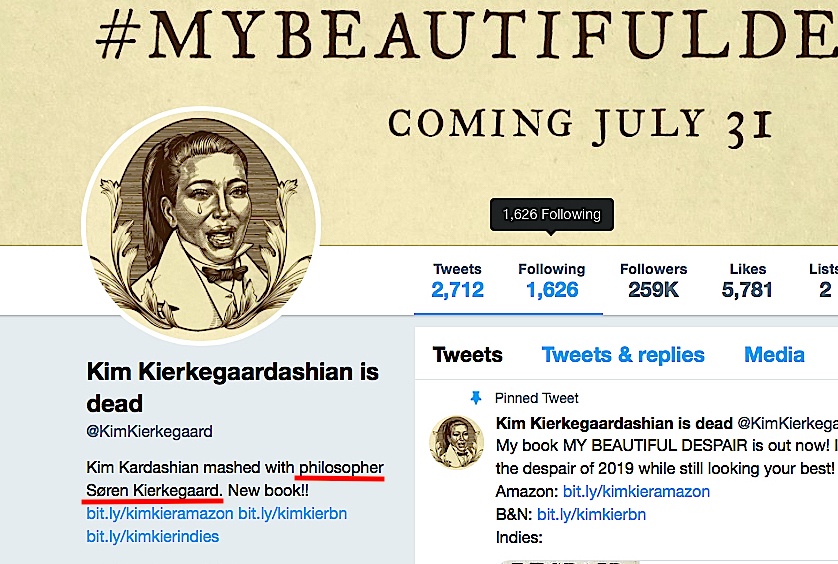
Now everyone’s doing it, the latest example being modern celebrity culture with moody 19th-century proto-existentialism. But under the egalitarian veneer, there’s a hint at what we’re expected to know or not know. In the Twitter profile, Kim Kardashian is just Kim Kardashian, while we need to have it explained to us that Søren Kierkegaard is a philosopher.
Back in the glory days, the story was that blogging was going to destroy print media, provided the underpants gnomes could work out a way to monetise it. Imagine my surprise, when ambling through the WH Smith at Euston station...
In the midst of a stack of papers, including a 60-page radio script that has my name on the cover, but I’m damned if I remember writing it, I find the filleted remains of a 15-year-old cheque book. The first thing that strikes me as I flip through the stubs is how scrupulously I noted the payee, the amount, and often the product that was being paid for. I even carried over the resulting balance in my account. Apparently I was in the black as well, which is odd.
But some of these messages from the last century now conspire to baffle me. Who or what was JM Cave, and why did I pay him/her/it £1.50 for underwear? Even in 1996, that would only have bought a single pair of pants, surely? Did some unspecified mishap leave me in desperate need of boxers, but bereft of cash? Perhaps I’ve erased the memory of such a predicament from my mind.
And then I turn to the next stub: one of your English pounds to A. Mannion, for something identified as deliceuse. And then £1.20 to L. Hoggett for suicidal lemons and it suddenly all falls into place. These – Underwear, Deliceuse, Suicidal Lemons, R*E*P*E*A*T, All About D, Michael Bolton Looks Like A Potato and so on – were all fanzines. I sent cheques to people, perhaps with stamped addressed envelopes, and they sent fanzines back to me, fanzines full of earnest, whimsical, cute, bitchy, profound, tortured, confused prose about Pulp and Bis and the Manic Street Preachers and how John Peel was going to live forever. Some even had glitter on the covers. I even thought of starting one, went as far as putting a small ad in Select magazine, asking for demos, and some arrived, and most were rubbish, but the mag never quite happened. Bikini Machine, it would have been called. In many ways, Cultural Snow is the fanzine I never wrote. All that’s missing is the glitter.
I am becoming increasingly fond of The Word magazine, and not just because they’ve mentioned my Noughties book for the third time in two issues. I suppose it’s because their prejudices gel with mine, not least in their overview of the bests and worsts of the past decade: The Wire, Twitter, winning the Ashes, BBC4, Heston Blumenthal, Brian Blessed on HIGNFY in the first camp; reality TV, The Da Vinci Code and Ugg boots in the latter.
But then we reach their Top 10 books of the last 10 years (I like to console myself with the notion that my tome was hovering somewhere around 11 or 12), and Christopher Bray’s take on Austerity Britain: 1945-1951, by David Kynaston, which is lauded as a “gloriously open-armed account of the era in which Word readers’ parents were setting up home.”
Except that my parents got married in 1966. Does this mean I’m 15 years too young to read The Word?
Much coverage of the Noughties book in the latest issue of The Word magazine, available from all good newsagents and doubtless a few iffy ones as well.
Still with the black armband on, some thoughts from Frances Morgan, publisher of the lamented Plan B, via Everett’s blog. They go some way to explain why the mag will be missed, why I’m so proud to have had even a peripheral role in the whole Careless Talk/Loose Lips/Plan B ride, and maybe why I’m cooking up a neat little ulcer over the book I’m writing in a way I might not if it were *just* a website:
Quick question – any chance of the mag continuing in on-line form, a la Pfork, The Quietus or Good.is?
I just wanted to answer this question. For me, the answer is no. This is not to slight the sterling work of the above websites, because they’re great examples of how web publishing can work. However, I feel very committed to print as a medium. There are many reasons for this, a lot of which can be picked apart and thrown aside as luddite, fetishistic, elitist, or just plain old-fashioned, and you’re welcome to do so…but it’s a commitment that I can’t switch off just because making this particular print product is no longer viable.
It is not that I’m decrying the web for making “everyone a critic”. I don’t think the web has killed criticism, not at all. It’s not that I am bemoaning the loss of “authority” of the critic – fuck authority, it’s that which has kept music criticism entrenched in such narrow gender, race and class strictures for so long (and I’d argue, actually, that the web has done less than it should to change this, but the potential is there for sure). I like a plurality of voices, wherever it occurs, although I do think that plurality often results in a lack of space to think and consider and to reflect; it seems to have generated this need for a quick response, an instant appraisal or commentary.
One thing I like about print criticism is that there is an unavoidable temporal gap between writing and print. This may not suit everyone, but I think it suits me and it suits the music I am interested in, and actually it probably suits most music. I do sometimes wonder if there is more of a connection between the music that gets reviewed and the style of reviewing than we actually acknowledge. Bit of unformulated thought, that, but I’d like to ponder it a little.
Although it might not always seem like it, we do edit things at Plan B. If you’ve written something for us, it will go through a few hands and past a few pairs of eyes before it appears on the page. If there’s time, we ask for rewrites and clarification. I like to have a little shout at everyone about punctuation. We have to stick to certain word lengths. I’m not saying web editors don’t do this too, but often more content is required at a greater speed. Put simply, it’s just different, and while I’d certainly work for online publications as a freelance writer, there’s no way I’d have busted my ass for five years on a very, very low wage to set up and maintain a web magazine. That’s not to say one shouldn’t, or that others at Plan B won’t. But it’s not for me. It never has been.
The other big factor is the visual side of Plan B, which is so important to us. The web – and again, this is my opinion – is not the right place for all those amazing photos and illustrations and layouts that go into making up an issue of Plan B. They belong on paper, decent paper at that.
As far as I remember, I only met Frances once, at Everett’s house in Brighton, where we were exerting the sort of care and attention she discussed on one of the middle issues of Careless Talk. Well, she was exerting care, I think I mostly made the tea. We got the train back to London together, and instead of talking about music in particular, we discussed the intersection of genius and lunacy, with particular reference to Louis Wain:
And, slouching towards relevance, a line by Thomas Mann, lifted from an interview with Clive James in today’s Guardian:
A writer is someone for whom writing is harder than it is for other people.
Oh good, maybe that means I’ve been getting better lately.
3:am magazine is gracious enough to direct us to Reality Studio, a Burroughs site that has the complete archive of My Own Mag, the mid-60s publication created by artist, poet and all-round provocateur Jeff Nuttall.
Now, I never really found myself on the same wavelength as Nuttall. I first heard of him in the late 1980s, when I was growing increasingly exasperated with the dayglo floristry that constituted the 1960s revival of the time, which glossed over the social and political upheavals - Vietnam, Black Power, gay and women's rights, Powellism - in favour of footage of dollybirds dancing in parks (the sort of thing I described here).
But by the time I got to Nuttall's seminal work, Bomb Culture(thanks, Murph), I'd read equivalent volumes by Abbie Hoffman, Jerry Rubin, Guy Debord and Richard Neville, and Nuttall's opinions on how to stick it to The Man gave me a distinct feeling of déjà lu.
And I bet there was some 1960s equivalent of bloody Andrew Keen to sneer about how amateurish the whole project was.
And just to prove the decade could indeed be dangerous and subversive and unexpected, not just jolly and tuneful, here's Jimi Hendrix and chums giving Lulu's producers psychedelic kittens. RIP Mitch Mitchell.