(I'm very busy this weekend, so I hope you'll forgive me if I resort to the last and lowest refuge of the lazy blogger, the YouTube post.)
Popular music, of all the art forms, seems the best able to craft precious jewels from dollops of rancid ordure. But I was still disturbed to discover, during one of those aimless, witless YouTube trawls, that one of the most scintillating slices of 80s Scouse anthemic pop:
may owe rather more than we might have guessed or wished (from 1:21) to a band that would probably be entirely forgotten were it not for the fact that their drummer was a Tomorrow Person:
Saturday, January 31, 2009


Wednesday, January 28, 2009
Do you copy?
A few thoughts arising from Nicholson Baker's Double Fold, about the continuing drive in libraries to destroy original copies of books and periodicals, replacing them with microfilm and other media.
 It's as much a bureaucratic farce as anything. Daily newspapers, as Baker reminds us, tend to come out in several editions through the day, to catch up with late-breaking news, sports results and so on: standard library policy, however, is to put just one edition on microfilm. The problem with this becomes obvious when considering the Sept 17, 1970 edition of the Chicago Sun-Times. The early edition quoted President Nixon's off-the-cuff remarks about a potential crisis in the Middle East; White House staff complained, and the words were cut from the later edition. Guess which edition was saved to film?
Baker quotes historian Jeffrey Kimball:
"For my new research project, a larger study of 'smoking-gun' documents, Nixon's quoted remarks have a critical bearing, but all I can get hold of now is the microfilm copy of the evening edition of the Sun-Times, which does not quote Nixon's comments; that is, all microfilm copies of this newspaper for this date seem to be of the evening edition."
So, not only does the quotation not exist; but because we can't compare the two editions, all evidence of its removal has also gone, like Trotsky airbrushed from the revolution. The only difference is that this state of affairs seems to be the result of sort-sighted cost-cutting rather than conspiracy.
One of Baker's particular beefs with microfilm is that it doesn't offer a true copy: we lose colour; marginal text is often cut off. Scanned pages saved to disk are often little better, with text recognition software still inferior to the combination of human eye and human brain. The author goes so far as to set up a non-profit organisation to save some back issues of the Chicago Tribune that were destined for disposal:
Sixty-three thousand dollars, or about fifty dollars a volume, may seem like a lot of money to pay for old news, but it's actually a bargain. To buy the equivalent microfilm run from Bell and Howell would cost about $177,000. We're at a bizarre moment in history, when you can have the real thing for considerably less than it would cost to buy a set of crummy black-and-white snapshots of it which you can't read without the help of a machine.
Baudrillard, of course, wouldn't have found such a state of affairs bizarre. Nor would he have particularly raised an eyebrow at the title of a report by digitisation champion Michael Lesk: "Substituting Images for Books".
Tuesday, January 27, 2009
Beastly
In 1987, I was on the Exeter team that got to the quarter-finals of University Challenge.
We lost. But not like this.
PS: Further grisly details here.
We lost. But not like this.
PS: Further grisly details here.

First, they came for the documentary producers...
Let's get things straight: the situation in Gaza is dire; and the BBC should have broadcast the DEC appeal (although what with the fallout from Brand/Ross, the Queen's exit/entrance, the Blue Peter cat and all the way back to Gilligan, it's clear the corporation's in a permanent damned-if-you-do situation).
That said, the issue has dragged a few nasties from the ideological woodshed. Here's one Josie Hines of Bradford, on Saturday's Any Answers:
"You're not permitted to say anything against Israel. If one says anything, as an individual, one is automatically anti-semitic."
Her point may have carried more weight had it not been prefaced with:
"It is possible that perhaps a large part of the hierarchy of the BBC may well be Zionist Jews who will have a great influence on the situation."
Sunday, January 25, 2009
Known unknowns
 One of the rules that most writers learn is to be very wary of the word "famous". The phrase "the famous actor Judd Nelson" is wrong, goes the logic, because if he is indeed famous, the adjective is pointless, and if he is not famous, it is untrue.
I used to follow this diktat, until I started working in Bangkok. Writers here seem desperately keen on the adjective "renowned", which is really just "famous" with a built-in positive spin. A hotel bar will be proud to present "the renowned jazz saxophonist Wally Schtuppe"; a restaurant will promise diners traditional Thai dancing from "the renowned Hogplum Theatre".
At first I cringed at all this incessant renown; until I worked out what it really meant. You have to understand that Thailand, as a rapidly developing nation, has people in positions of wealth and influence whose parents were rice-picking peasants; it is also home to a great many expatriates who would have led fairly humdrum lives at home, but suddenly find themselves in a lifestyle they might previously only have seen in the pages of Hello magazine. Add to this the overwhelming social pressure, prevalent in many east Asian societies, to maintain face at all times; and you've got a critical mass of people who are suddenly expected to be au fait with fine wine, classical music, designer frocks and all the cultural gewgaws associated with a successful lifestyle.
So what "renowned" means in these cases is an implicit nod to the culturally befuddled: this person is worthwhile, it says; this person's name is worth dropping. And if everybody in Bangkok (or everybody in Bangkok who matters) reads that Wally Schtuppe is renowned, then everyone will believe it. The fact that Wally Schtuppe's been playing bar mitzvahs in suburban Omaha for most of his career is neither here nor there, and certainly not to be mentioned in polite society.
Of course, once you leave Bangkok and start raving about Wally, and the Hogplums, and the renowned modern artist Cornelius Ding, and the renowned post-fusion tapas chef Mimosa Pondicherry, you're on risky territory. You might be exposed as someone who knows nothing about jazz or dance or art or food, beyond what you read in a fawning advertorial in a free magazine in Starbucks at Central Chidlom. On the other hand, you might discover that your new friends in London or New York know bugger-all either, and they'll start hymning these people's praises too, just as art critics began fawning over the entirely invented Nat Tate. And from such combinations of chance and embarrassment are lasting reputations made.
(All names changed to protect the irrelevant.)
Friday, January 23, 2009
Tim's fashion tips
Like anybody, I've worn things that ought to bring a shudder of embarrassment if I catch a glimpse of the photos. Dungarees. Hawaiian shirts. Leather tie. Braces. Drainpipe jeans. Floral waistcoats. (Not all at once, I hasten to add.)
But, since I've rarely been a casual employee of fashion, let alone a slave, I can usually brush aside such indiscretions on the basis that I didn't really make a conscious, calculated decision to make those purchases. Most appeared in my wardrobe by a sort of retail-related osmosis, the only thing pushing me towards any kind of proactivity being the fact that the alternative was public nakedness.
 The only time I've ever felt particularly part of a fashion gang, and made appropriate purchases, was in around 1987, when I used to hang around on the fringes of a bunch of people who were into rare groove and its associated genres; essentially, old soul, funk, Latin and jazz records, and a smattering of house and hip-hop, played in ramshackle warehouses and basements, in atmosphere that combined louche irony and sneery elitism. (I discussed the scene in more detail here.) There was a uniform of sorts, and damn, did we adhere to it. Odd that most of us were still celebrating our recent freedom from institutions that tried to force us into uniforms but hey, this isn't an exhibition at the V&A.
This is the way we wore:
• Black Doc Marten shoes or boots, but not the knee-highs favoured by Goths and gay skinheads; possibly brogues or brothel-creepers at a pinch. Black, white or Argyle socks. NO TRAINERS. Trainers were naff. People who wore snow-washed Wranglers wore trainers. We didn't even wear trainers when we were dancing to Run DMC's 'My Adidas'.
• Blue, black or (if you had the legs) white Levi's 501s, rips optional, provided it wasn't too obvious that you'd done them deliberately (a difficult trick to pull). Or black or khaki chinos.
• Plain white cotton shirt, or black polo-neck. Option of plain white t-shirt in the summer. ALL TO BE TUCKED IN. Worn with black or navy blazer/suit jacket, or Levi's denim jacket, or MA-1 flight jacket. For smart occasions, an ironically flamboyant - but not consciously comedic - silk tie could be worn.
• Headgear was optional: black trilby or red spotted bandana; beret at a pinch.
• Females could wear any of the above: in addition, they had the options of tight black skirts and cream-and-blue striped Breton tops.
The thing is, I don't feel the slightest bit embarrassed by any of this, except maybe the bandana. Can anyone else look back at what they were wearing about 20 years ago and think, "Yeah, I looked pretty good"?
Wednesday, January 21, 2009
12 books
One thing I love about LibraryThing is the chance it gives you to create whole lives for strangers on the basis of their book collections. But I'm almost at a loss when it comes to one bfromma, who I noticed because he owns a book that I wrote but of which I don't appear to own a copy (and wouldn't want to, and I only wrote it because I really needed the money).
Bfromma, if we can judge from her/his online catalogue, owns 12 books. One could make a few assumptions on this basis alone, but wait: the 12 books cover six subjects. There are two volumes each - no more, no fewer - on the following subjects: Blink-182; Slipknot; Pink Floyd; Motley Crüe; The Texas Chainsaw Massacre; and the Manson killings.
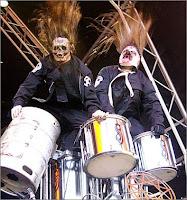 A collection such as this does not come about by accident, I feel. This is a man (it has to be a man, no?) who wakes up one morning and declares: "I wish to become more acquainted with the story of Iowa's finest mask-wearing nine-piece rock combo, Slipknot." Having perused one volume on the subject, he realises that all such narratives are necessarily subjective, and acquires another. He reads that, and now, he feels, he gets Slipknot. If someone at his place of work holds forth about Slipknot, he can keep up with the conversation. "Ah yes," he will remark, "but did you know that they were originally called The Pale Ones?" His colleagues will be impressed. Perhaps they will ask him out for a drink, or invite him to join their shove ha'penny team. Maybe Francesca from marketing will be sufficiently moved that she will be persuaded to touch him in an intimate manner at the Christmas party. This is what happens when you possess two - two - books about Slipknot.
Next, Charles Manson...
Bfromma, if we can judge from her/his online catalogue, owns 12 books. One could make a few assumptions on this basis alone, but wait: the 12 books cover six subjects. There are two volumes each - no more, no fewer - on the following subjects: Blink-182; Slipknot; Pink Floyd; Motley Crüe; The Texas Chainsaw Massacre; and the Manson killings.
 A collection such as this does not come about by accident, I feel. This is a man (it has to be a man, no?) who wakes up one morning and declares: "I wish to become more acquainted with the story of Iowa's finest mask-wearing nine-piece rock combo, Slipknot." Having perused one volume on the subject, he realises that all such narratives are necessarily subjective, and acquires another. He reads that, and now, he feels, he gets Slipknot. If someone at his place of work holds forth about Slipknot, he can keep up with the conversation. "Ah yes," he will remark, "but did you know that they were originally called The Pale Ones?" His colleagues will be impressed. Perhaps they will ask him out for a drink, or invite him to join their shove ha'penny team. Maybe Francesca from marketing will be sufficiently moved that she will be persuaded to touch him in an intimate manner at the Christmas party. This is what happens when you possess two - two - books about Slipknot.
Next, Charles Manson...
Subscribe to:
Posts (Atom)