Wednesday, March 14, 2007

You're older now and you're a clever swine

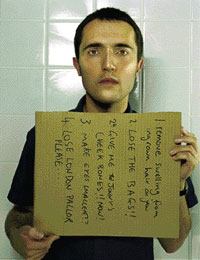
Anyway, those nice people who do The Grauniad asked me (and quite a few other people, such as Dave H) what I'd like to happen in the next 12 months. So what did I ask for, from the Santa of Farringdon Road? World peace? Cure for AIDS? End of global warming?


Yeah, right, I said...

Monday, March 12, 2007

Dumb and then some

I've written before about Jade off of Big Brother, and about Jade: My Autobiography, by Jade Goody, which is a book about Jade off of Big Brother written by Jade off of Big Brother. I feel slightly unclean in raising the subject again, but she infects the Zeitgeist to the extent that it's unavoidable. If I were writing this blog in the 14th century (apart from the fact that I'd be burned for sorcery) I'd feel obliged to raise the unpleasant fact of the Black Death. So it is with Jade. Sorry.
I come back to her because of a new survey that lists the books that Brits don't finish. All the usual suspects are in place: Ulysses; War and Peace; The Satanic Verses; big, important books that you feel you ought to read, but never quite get around to finishing. Or even start; one of the most disturbing findings from the poll is that 55% of respondents buy books for decoration, with no intention of reading them.

This becomes even more depressing when you realise that one of the unread books is the aforementioned Jade: My Autobiography. Now, I can see all sorts of reasons for not reading the book, and for not buying it in the first place. But, presuming you're the sort of person who might choose to acquire it, you're not likely to cast it aside with disgust, because you suddenly realise what a dreadful woman J.O.O.B.B. is. So there can be only two reasons for not pursuing it to its inevitably gripping conclusion. One is that you find it too intellectually taxing. The other is that you bought it simply as decoration; the implication being that it should be propped up between A Suitable Boy and A Brief History of Time, as a means of impressing the neighbours.

It's then that you remember that the people who purchase Jade: My Autobiography are, to some extent, an elite, in that they buy books at all, even if they only buy them to make other people feel inadequate. Which ties in with another story, about allegations of skulduggery in phone-in quizzes on TV. The big chinstroke for many commentators seems to be about the level of trust between producer and consumer, coupled with the suggestion that you've got to be pretty dumb to keep chucking money at these competitions, despite the production office mantra that the viewer isn't stupid. But wasn't the truth about the aptitudes of the sofa species (or at least the professionals' perception of those aptitudes) already apparent from the questions being asked? As Holy Moly reports, a researcher on This Morning (in its Richard and Judy incarnation) was tasked with setting the teasers for 'Mid-Day Money', and was advised that "What is the capital of France?" might be too challenging a conundrum for the target demographic. His facetious suggestion of "What colour is an orange?", however, was accepted with alacrity.

And before anybody says it, yes, I know. The capital of France is 'F'.

Sunday, March 11, 2007

Sense of hooter

James BC directs us to a project that a) may raise a few quid for the many worthy causes supported by Comic Relief, and yet b) doesn't make more discriminating viewers want to disembowel the leading lights of Light Entertainment. Go here for details.

I might pitch something in, but I don't really think I do funny ha ha particularly well.

Friday, March 09, 2007

Opinions which are of no consequence at all

Can I crave your collective indulgence and ask you to assist, albeit passively, with a small experiment? The last time I lowered myself to commercial considerations, and mentioned my new book on this blog, not only did its sales rank on Amazon.co.uk soar to the nausea-inducing heights of 40,000-something, but my Google rating (with quotation marks) rose by 10,000. Both have since slipped to a quite startling degree. I don't know, of course, whether one thing provoked another. So this is just to test whether a simple mention that Welcome to the Machine: OK Computer and the Death of the Classic Album, by Tim Footman, will be published by Chrome Dreams early next month, is enough to set the wheels in motion again.

C'mon, gimme a break. At least my publisher didn't accidentally on purpose leave the manuscript on the platform at Balham Tube station so as to garner a small cough of publicity for a waning career.

Nevertheless, just like the nugatory slivers of news that adorn the advertisements in that free publication that a Slovenian thrusts into your paws when you're trudging to work; or maybe the interview with David Letterman that gives you an excuse to buy Playboy, here are a couple of things that aren't plugs. One is an interesting bit of metablogging from David Cox at CiF (although, as Patroclus rightly insists, CiF isn't a blog).

And the other is from my current bedside read, Sex, Drugs, and Cocoa Puffs, by Chuck Klosterman:

"It's become cool to like Star Wars, which actually means it's totally uncool to like Star Wars. I think you know what I mean by this. There was a time in our very recent history when it was 'interesting' to be a Star Wars fan. It was sort of like admitting that you masturbate twice a day, or that your favorite band was They Might Be Giants. Star Wars was something everyone of a certain age secretly loved but never openly recognized; I don't recall anyone talking about Star Wars in 1990, except for that select class of übergeeks who consciously embraced their sublime nerdiness four years befor the advent of Weezer (you may recall that they were also the first people who told you about the Internet). But that era has passed; suddenly it seems like everyone born between 1963 and 1975 will tell you how mind-bogglingly important the Star wars trilogy was to their youth, and it's slowly become acceptable to make Wookie jokes without the fear of alienation. This is probably Kevin Smith's fault."

Wednesday, March 07, 2007

This blog did not take place


Jean Baudrillard, philosopher, sociologist and cultural theorist, pioneer of the simulacrum and hyperreality, died yesterday at the age of 77. And yes, as Joel pointed out a few months ago, he does indeed look quite like Stanley Baxter.

PS: CiF piece here.

Tuesday, March 06, 2007

The posh kids win, they always do...

Olav, aka Quiz Blogger, has pointed out an odd lacuna in the US trailer for quiz-show rom-com Starter for 10. (I should point out that I haven't seen the film, because I read the book, and got slightly annoyed at the liberties that the author had taken with the rules of University Challenge. I'm sorry, but these things matter.) It does seem from these clips that they want to turn it into that cheesy but endearing 1989 movie version of Martin Amis's The Rachel Papers, and I can't be the first to notice that James McAvoy is the new Dexter Fletcher, which must not only worry him a little, but makes me feel exceedingly old.

More significantly, isn't it a bit odd that the trailer seems to contain no reference whatever to any kind of TV quiz show? It's a bit like making a trailer for Titanic, but leaving out the boat. Which would have made that particular film rather shorter, but also less amusing.

And what's the title meant to mean if you leave out the quizzy bit? A particularly greedy selection of hors d'oeuvres?

Saturday, March 03, 2007

Race oddity

As Life On Mars settles into its second and final series, it's apparently being marketed to the same viewers who lap up Top Gear and its ilk, as wish fulfilment for overgrown schoolboys who feel emasculated by the 21st century. Interview chores this time round have been taken on not by John Simm, who plays nominal hero Sam Tyler; but by Philip Glenister, whose DCI Gene Hunt would take 'unreconstructed' as a compliment, after he'd chinned you for being a university-educated ponce. Glenister's certainly on-message if he wants to appeal to the Clarkson fans out there: "I talk to a lot of people and here's a funny thing," he told the Telegraph. "I haven't yet met one who has said to me: 'This political correctness business - isn't it great that we've got it?'"

It might appear that Life On Mars has fallen victim to the same fate as Johnny Speight's Till Death Us Do Part, which set out to satirise racism, then saw its villain become a hero. Tyler hates being stuck in this backwater of bigotry, confronting, whereas the viewers see it as a rather refreshing diversion. But is the tale of the stranded copper really as dangerous as it thinks? Sure, the pre-PC PCs smoke and drink and pinch birds' bums, and Hunt is a marvellously judged tribute to the mighty Jack Regan. But, for the most part, we laugh at them, not with them, and sigh along with the more enlightened Tyler. For example, one recent episode sees a black detective seconded to the squad. Ray Carling, the most Neanderthal member of the team, gets his jabs in, but the worst he can come up with is an anaodyne gag about "spadework". Is that really the nastiest abuse a non-white policeman could expect in the canteen culture of the 1970s? If frustrated blokes think they're getting a vicarious dose of the years when racism and sexism didn't need to come with quotation marks, they're deluding themselves.

Maybe this is the problem with retrospective pastiche: in attempting to achieve a perspective on the past, we lose the essence. But did TV ever really express the racism and sexism of the era? I recently watched the first episode of the 1969 sitcom Curry and Chips, also created by Speight, about a Pakistani starting work in a factory. Clips occasionally show up on cheerful compilations about 'TV Hell', or earnest documentaries about the representation of ethnic minorities in less enlightened times, but otherwise the show might as well be an urban myth.

First off, despite the presence of Eric Sykes and Spike Milligan, it's not very good. The jokes are heavy-handed, the pacing is non-existent, actors (especially Milligan) are visibly corpsing, and the jackal-like studio audience is profoundly annoying. But is it racist? Well, characters use words like 'wog' and 'Paki' a lot, which is disturbing to modern sensibilities. But it's made quite clear that the worst offender, the Powellite Norm, is a moron (as was the case with the similarly taboo Love Thy Neighbour). Sykes, as the manager, is a decent bloke who tries to help the new recruit to feel at home. Not that the moral battle lines are so cut and dried; you could almost call the whole thing nuanced. A black character, played by Kenny Lynch, joins in the abuse of the newcomer, arguing "At least I was born here". A landlady expresses reservations about taking him in, but relents after she decides that he's quite good looking. Could this have been the inspiration for last year's Oscar surprise, the bit-crap-and-muddled-but-its-heart's-in-the-right-place Crash?

Probably the aspect of the show that's hardest to stomach is the presence of Milligan, browned-up to play Kevin O'Grady (his mother was Irish, so the story goes), with an excruciating Gunga Din accent. White actors in minstrel mode make us very uneasy, but Milligan's performance is so stilted and unnatural, that the racial provenance soon becomes irrelevant. The whole point is that he's an outsider and a catalyst, and might have come from anywhere in space (like Mork from Ork) or time (like Sam Tyler). After all, it's hardly a documentary.

Perhaps that's the thing to remember, when pondering what Life On Mars tells us about the frustrations of contemporary masculinity. The past that viewers see, playing out to a glam-rock soundtrack, is a scrubbed-up version of the reality of those years. And the much-maligned 'political correctness' (if that includes the unspoken assumption that racism is a bad thing) was alive and well on TV even then.

Thursday, March 01, 2007

The future's orang

I loathe anthropomorphism, or any kind of wet sentimentality about animals. Not only is it demeaning to the animals, it pushes humans into a sickly, soft-brained second childhood, where they decorate their desks with bad watercolours of kittens, and place obituary notices in pet magazines, pledging that they will meet their deceased mutts "at the Rainbow Bridge".

On the other hand...

aaaaawwwwwwwww....