
The immediate problem with
Modernism – Designing a New World 1914-1939, at the V&A, is that the exhibits are united by philosophy, not form. You can be studying a reconstruction of the austere
Kleinstwohnung, the German minimal dwelling that everyone was going to inhabit in the utopian, concrete future – and then turn to see Soviet ballet costumes that wouldn’t disgrace the campest of
Dr Who villains.
In theory, the two extremes were united by a Modernist ethos that fused art and technology for the improvement of society. However, there was no one, unified Modernist dogma to which everybody who assumed the mantle could adhere. This makes the exhibition slightly confusing, as we hop from Russian films to Chicago skyscrapers and then to a bust of Mussolini that makes him look like one of those ceramic knobs on a power line.
But this incoherence seems to be part and parcel of the time. There’s a photograph of Mies van der Rohe’s monument to the November Revolution, which was destroyed by the Nazis in 1933. But its hard-lined brutality and fuck-you sloganeering –
"I AM, I WAS, I WILL BE" – could just as easily have been appropriated by Hitler. Similarly, the assembly-line economics of Henry Ford and FW Taylor, emblematic of 20th-century capitalism, were revered by the Soviet government in the 1920s. These ideas in turn, become the inspiration for film-makers as diverse as Eisenstein, Chaplin and René Clair, with humans turning into disembodied components of what the Futurist architect
Sant’elia dubbed
"the urban machine".

It’s not all doom and dystopia, though. One snippet we pick up is that the Bauhaus organised, of all things, a weaving course, and Paul Klee and Wassily Kandinsky were both tutors on it. Loomcraft aside, which one of them finished the last custard cream in the staff room, one wonders. (Kandinsky, incidentally, has his own show at
Tate Modern, documenting his movement from representation to abstraction. It’s good, but slightly pointless, because on the evidence here, he never went fully abstract, in the way Rothko or Pollock did. There’s always something that looks a bit like a cannon, or a penis, or a couple riding the log flume at Alton Towers, that penetrates the chin-stroking with a giggle of recognition.)
Like Kandinsky, it seems, the Modernists never quite had the courage of their own convictions. One of the last sections is devoted to the Highpoint buildings in Hampstead. The architect, Bernard Lubetkin, occupied the penthouse in Highpoint 2, but despite his nominal adherence to Mies van der Rohe’s
"Less is More" credo, he decorated his abode with garish images from Pollock’s toy theatres and the weirdest manifestations of marine life. If your best aesthetic intentions have been hijacked by Fascism, Stalinism and the wilder excesses of industrial capitalism, maybe Surrealism is the best refuge.
On the other hand, Surrealism could also be a tricky beast.
Undercover Surrealism: Picasso, Miró, Masson and the Vision of Georges Bataille, at the Hayward, is an apt if unwieldy title, as Bataille was always at odds with André Breton and his
Manifesto gang, the self-appointed bearers of the lobster-flavoured torch. Like the V&A show, it flirts with incoherence by insisting that true Surrealism existed before and beyond those who appropriated the name. It’s a sound point, but it means that we have to get past a 17th-century Abyssinian prayer scroll and photographs from the abattoir at La Villette before we reach the arty bits.
And that’s the point. Bataille was the founder of the magazine
Documents, a precursor to the likes of Roland Barthes in that it found meaning in the manifestations of mass culture that, in the 1920s, still slipped under the critical radar. He was as fascinated by the Buster Keaton movie on show by the entrance as he was by what the likes of Breton, Magritte and Tanguy chose to define as art (their own stuff, mostly). No wonder relations were a wee bit frosty.

The rampant eclecticism here means that the works by the headline artists (including some glorious, purple-slashed Mirós) play second fiddle to Bataille’s fixations, notably his obsession with headless forms. Despite the feud, this is something he shared with the paid-up surrealists, as his favourite images of
acéphales tie into the Freudian notions of the subconscious imagination bypassing the rational brain; easier, surely, if there’s no brain to bypass.
Bataille’s world view is a real thumb in the eye to the Surrealists because, despite their Dadaist, anti-Art roots, most of them still craved acceptance (not to mention cash) for their ability to put oil on canvas. The two most memorable pieces leap out of that self-imposed box. One is a drawing of giraffes, by André Masson’s nine-year-old daughter Lili. (
"A child could do that!" is the philistine response to modern art. To which the obvious retort is,
"Of course a child could. But for an adult to be able to do it as well is something special.")
The other is more a happy accident. There are listening posts, allowing vistors to log into the music that soundtracked Bataille’s world. At the end of the day, nobody’s listening; the headphones lie empty, but the music – Stravinsky, Duke Ellington, voodoo rituals – still leaks out, different sounds from different posts, mushing together, fighting and then reaching some sort of equilibrium. It sounds like a thousand drunken bagpipers playing Radiohead, and it’s beautiful.
Two things unite these exhibitions. One is the cheeky perversity of their respective settings: the minimalist functionalism of the Modernism nestling in the camp, imperial finery of the V&A; Bataille’s magpie tendencies occupying the austere, urban lump that is the South Bank.
The other is that the exhibits themselves are mostly of secondary interest. The individual pieces exist to tell a story, to support an idea, a concept; there’s no single work here without which either exhibition would fail. The message transcends the medium, and the most important ‘artists’ at work are the curators. The conceptualists have taken over the asylum.
 The truffles still unsniffed by the finest snouts in the blog forest are: 3, 'Computer Song' by bowler-wearing bedsit maestro Jim Noir; 4, 'I'm Waking Up To Us' by Belle and Sebastian (allegedly about the breakup of Stuart Murdoch and the adorable Isobel Campbell, left); 17, the fi-doesn't-get-much-lo'er 'You're So Great', possibly my favourite Blur song ever; and 20, 'Blue Jay Way' by some Scouse chancers. I'm surprised nobody got 4 or 20; but even more astonished at the ones you did manage to pin down. Enthusiastic yet chaste handshakes, masking wistful yearnings, to one and all. To Molly, the laurels, and try saying that after five pints.
 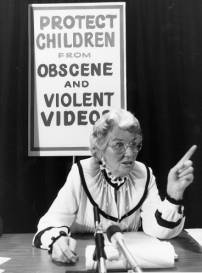 It's a Christian thing, intended to warn parents about the horrors coming out of that modern Gomorrah, Hollywood; or, as they put it themselves, "A service to His little ones (which includes at-home teens) through you, their parents and grandparents, in His name by His Word". Inevitably, the likes of South Park ("vulgar and vile") and The Exorcist come in for stern reproach. But Satan lurks in the unlikeliest nooks. Godfearing parents are beseeched to watch out for "torture of a character (gingerbread man)" in Shrek, for example. And that's before we get to the "lies, several" in, uh, Pinocchio.


