Showing posts with label questionable taste. Show all posts

Wednesday, October 30, 2013

And you thought funeral selfies were bad?

The latest eruption of moral why-oh-whyery to transfix the interwebs has been prompted by the Tumblr Selfies at Funerals, which does pretty much what it says in the title; young people trying to make a solemn occasion all about them. Could there be a more apt symbol of the corruption of modern society?

Once again, plucky Thailand rises to the challenge. On Monday three bomb disposal officers were killed in the restive south of the country and when the bodies were brought into the hospital, a couple of nurses decided to mark the occasion thus:


PS: The nurses have apologised. So that’s OK then.

Wednesday, June 19, 2013

Jezebel and The Guardian and the fine art of taking offence

The problem with any rational discussion of censorship is that it requires the public airing of the material that some might want censored, which rather defeats the purpose. The same paradox applies to the modern, lightweight variant of censorship, which stops short of demanding an outright ban but leaves you in no doubt that the matter in question is a very bad thing indeed and that the people who like it and the people who consume it aren’t much better. And to prove it, here it is.

Two recent examples: a Guardian appeal for photographs of sexualised imagery that readers find offensive; and Jezebel’s piece about why a Vice fashion spread depicting the suicides of female writers was a bit iffy. The latter is particularly delicious because the Vice piece has been taken down while the Jezebel one is still around. It’s today’s variant on ironic quotation marks; you can put the most horrible material in the public domain, provided you make clear the extent to which you disapprove of it. The question is, in the modern media world, is an eyeball still and eyeball if it’s topped by a raised brow?

Monday, January 14, 2013

Sunday, January 13, 2013: The day journalism died, pretty much


Julie Burchill wrote something in The Observer yesterday. (Update: As it’s now been removed by the Observer this link now goes to Toby Young’s Telegraph blog, as he’s reposted the whole thing.) You may have heard about it; you certainly would have done if you were within 500 yards of Twitter, which erupted like a lanced bubo of goopy virtual outrage. The whole thing was a classic case of a banal non-event escalating into something bigger, rather like an urban riot beginning with a spilled pint. Apparently, Burchill’s friend and fellow scribe Suzanne Moore had said something mildly disobliging about a few transsexuals; rather more transsexuals overreacted a bit in Ms Moore’s direction; Moore left Twitter over the treatment she was getting; Burchill then really gave the transsexuals something by which they could be offended, when she – oh, you can read it if you really want. It’s not nice.

The people at The Observer must have known something was liable to kick off, because they turned the comment function off as the article sat there in the early hours of Sunday morning. But of course, rather than simply fume in impotence, people took to the Moore-free space of Twitter, haranguing Burchill, Moore (who, I’m guessing, hadn’t actually had anything to do with Burchill’s piece) and, amusingly, The Guardian. (Because many of the two papers’ online functions are integrated, the link to Burchill’s piece made it look as if it was from The Guardian; the editor of the daily paper seemed to spend much of his Sunday tweeting variants on “nuffink to do wiv me, guv”.) Of course, the argument did get made that all the waving of Twitchforks was simply encouraging more curious traffic to the offending article, which is what Burchill wanted in the first place but by that stage common sense seemed to have sneaked off to the pub. I was particularly aggrieved because the online frenzy interrupted my Twitter-enhanced listen to the omnibus edition of The Archers and I was unable to get Ruth’s mention of a #duffbatchofsemen trending, even though it seemed rather germane to the whole issue of supposedly real and unreal sexual identities.

Of course, Burchill was not the only person to write something ghastly yesterday. The reliably vile Liz Jones was characteristically spiteful about Clare Balding in the Mail, an act that would usually have provoked mob of its own, but rather got lost amidst the anti-Burchill screaming. (Incidentally, how does someone who looks like a Goth version of Gillian McKeith get the right to criticise someone else’s appearance?) Then there was the journalist Patrick Strudwick, who took the popular chanteuse Azealia Banks to task for the use of a nasty word and was then assailed by her dim fans who, for the most part, just proved his point.

Amidst the furore, Matt was changing the bulb in Peggy’s porch light, unaware that Lillian (his partner and Peggy’s daughter) was at that moment enjoying carnal rudeness with Paul (Matt’s brother). But did anybody care by this point? (Note to the uninitiated: he’s still on about The Archers, OK?)

I’m not sure what effect this is going to have on relations between feminists and the trans community, and I don’t think I’m best placed to comment on such matters anyway. I do think, however, it represents something of a tipping point in the way journalism works. Burchill has always hungered for attention, and she genuinely doesn’t care whether it comes in the form of adulation or loathing. And now the fragile eco-system of the media has evolved to meet her. Burchill gets eyeballs and that’s the only kind of currency the likes of The Observer can work on. When it gets to the stage when their rivals at the Telegraph and Independent are commenting on the brouhaha and presumably pushing online readers away from their own offerings, if only for a few minutes, the cash-strapped Obs people must be clapping their hands, even if they’ve lost a few alternatively gendered readers along the way. After years of sneering at the shoddy, superficial sensationalism of the blogosphere, the broadsheets have finally cracked. This is how it’s going to work from now on; as Oscar said (I wonder where his sympathies would have rested in this spat), the worst thing is not being talked about.

But the best comment comes almost by accident. I’m assuming that Charlie Brooker filed his latest Guardian piece some time before he’d have had a chance to see Burchill’s screed, but it neatly skewers those who seek to offend and those who rise to the bait, describing the egregious scourge of environmentalist James Delingpole as “laughing like a naughty boy who has just blown off through the headmaster’s letterbox”. Well, just think of Burchill and Jones and their ilk all dropping their drawers and jostling to get their tired sphincters in the optimum position so as to deliver a cabbagey trump or two to the intellectual life of Britain. And if that isn’t a hideous enough image to make you ignore their inane provocations, I don’t know what is.

Meanwhile, back in Ambridge, Kenton’s trying to cadge some milk churns...

PS: Padraig Reidy at Index on Censorship on the fallout from the Burchill affair.

PPS: The Observer has elected to “withdraw from publication the Julie Burchill comment piece ‘Transsexuals should cut it out’”. Whether this amounts to self-censorship or a retrospective attack of good taste, I’m not sure. What do you think? 

Tuesday, October 25, 2011

If we shadows...


Up to 80 people a night, we are informed, have been walking out of the current RSC production of Marat/Sade, revolted by scenes of torture, masturbation and dwarf/bishop sex. The Daily Telegraph would have us believe that those behind the show will be upset by this, I rather suspect that they’re rubbing their hands with delight, and even more keenly now that hordes of Telegraph readers are spitting thick-cut marmalade over their tweed pyjamas at the very thought of such goings on and yearning for the days when they could go to the theatre secure in the knowledge that the closest they’d come to moral depravity would be Richard Briers almost – but not quite – saying “bloody hell”. In a world where boundaries of taste and morality seem about as solid as Bangkok flood barriers, it takes something special to earn one’s transgressive Brownie points. (And would the notion of a transgressive Brownie provoke similar outrage? I wonder.)

That said, the “up to 80 people” (hmm...) are leaving voluntarily, rather than being carried out. I was lucky enough to see the Deborah Warner version of Titus Andronicus at the RSC, nearly a quarter of a century ago, and chatting to one of the ushers in the interval, I was informed that I’d come on a slow night: nobody fainted; nobody vomited; they hadn’t had a nervous breakdown in the audience for over a week. The dwarf and the bishop will just have to try that little bit harder.

(Image by djailledie, after Jacques-Louis David, from deviantART. Flood update: still dry.)

Wednesday, September 14, 2011

Rhineland’s a fine land once more

There’s been a bit of digital thinking aloud with regard to The Guardian’s abortive @911tenyearsago experiment (although not in The Guardian, oddly enough). Ian Hepburn at False Doorway explained his unease: “We lack neither the immediacy of the events happening now, nor the distance of – say – the World War 2 tweets in a similar vein put out by the National Archive.”

Distance is key it seems, both chronologically and geographically. But as Hepburn suggests, it’s not simply a case that the further away you are (whether in three- or four-dimensional terms) the more you can get away with. I’ve previously discussed the pervasive view of Hitler in Asia, that he was a historical figure who was probably a nasty piece of work, but not really the absolute archetype of evil that he might be in the west. And as such, the idea of dressing up as a Nazi doesn’t seem quite as terrible to Japanese or Indian people as it might to the British (let alone the Germans). Yes,  of course people still do it, but those in the public eye rarely avoid a public flaying, as that amiable halfwit Prince Harry discovered to his cost a few years back.

The odd thing is that as the events of the Second World War grow more distant, the public reaction against this sort of behaviour gets not more indulgent, but less. And then a friend (who happens to be half-British and half-Japanese, which may or may not be significant) reminded me that in 1986 it seemed rather amusing that a cricketing hero should doll up as a Colditz commandant. I doubt his heirs in the current squad would be let off so lightly. Although the Indians might find it moderately amusing.

Sunday, September 11, 2011

How soon is too?

Odd. A Twitter account appears, apparently under the auspices of The Guardian. It is called @911tenyearsago. It describes the events of September 11, 2001, in real time, beginning with “Mohamed Atta and Abdulaziz al-Omari board American Airlines Flight 11 at Boston Logan airport” at 0735 EST. Reaction can best be characterised as surprise, rather than shock; but it picks up nearly 4,000 followers in a couple of hours, so there seems to be a level of interest. Flight 11 hits the North Tower at 0846; President Bush, preparing to enter the Florida classroom, is informed of this nine minutes later. And then... “This account of the events is now ending”. Time freezes at 0905, the South Tower unscathed, Flight 93 still chugging to San Francisco, oblivious to its fate, its role in history and folklore, its forthcoming movie career.

So what went wrong? Were there complaints? Did someone’s bad-taste radar go bleep? And if so, why? Why should an accurate, purely descriptive report of the events of 10 years ago upset people so? No hymns; no prayers; no flags at half-mast; no Paul Simon or James Taylor (baby-boomer sensibilities are more tender than those of mere mortals); no released doves. (Were there doves? There must have been doves at some point.) Feelings are permitted; the facts, suddenly, are verboten. Emotional fascism, Elvis Costello called it. Odd.

PS: The Onion gets it right, but doesn’t it always? And Sam Burnett puts things in their proper context.

Wednesday, July 21, 2010

What’s in the box?

About the only bit of quantum theory I can really get my head around is the idea that observation affects results; that once the box is opened, Schrödinger’s cat is no longer in its dead/undead state, it’s one or the other.

So although we may have a desire to know, sometimes we hold back from investigating in case we affect the result, and thus become the story. In the aftermath of the Raoul Moat saga, there was much harrumphing about the Facebook page set up in his honour by one Siobhan O’Dowd; did tens of thousands of people really think this pink-faced slab of self-pity was really a legend? Well, possibly not. It’s been suggested that a good number – possibly a majority – of those who nominally ‘liked’ the page actually did so to tell the Moat fans what a bunch of idiots they were. And the more people who did that, the higher the number of apparent Moat fans rose. If you just wanted to find out out the relative numbers of pro- and anti-Raoulards, you still had to press the ‘like’ button, skewing the numbers still further.


There was a similar dilemma for those who wanted to find out how well the Times website was doing since it introduced its new paywall. It wasn’t simply a matter of not wanting to drop a few quid into Murdoch’s pocket; it was the knowledge that to take a peek would skew the statistics, making the reader part of the news. Of course, it would be harder in this case to be able to put a number on the readers, or indeed to distinguish between the merely curious and those actually willing to pay because they wanted to read the words and look at the picture. But one could get an idea of how successful the enterprise was by, for example, the number of readers appending comments to the latest Jeremy Clarkson article, presumably along the lines of “ROFL Jeremy Clarkson You Legend”. Incidentally, I’ve always been impressed by Clarkson’s use of metaphors that seem to imply that a car is a beautiful woman, and at the same time his own penis; a paradox that even Schrödinger may have struggled to explain.

And on a slightly different note (but back to Facebook), the tale of the Dr Pepper campaign that referenced the notoriously scatological 2 Girls 1 Cup film clip. The story broke on the tediously ubiquitous Mumsnet (of course it did) and immediately presented professionally disgusted news outlets with a dilemma of their own; how to communicate the depravity of the film under discussion, without actually naming it, or saying why it’s so depraved? The Telegraph had a go with a reference to “a hardcore pornographic film which is notorious for the obscene practices it depicts”, although one wonders what sort of hardcore pornographic film doesn’t depict obscene practices. And of course whether unhygienic but consensual behaviour should be a matter too disgusting to be discussed by the same media outlets that had been covering in forensic detail the activities of a murderous sociopath just a few days previously.

PS: David Hepworth also reflects on whether you can talk about swearing when you’re not allowed to swear.

Saturday, July 10, 2010

Dead president


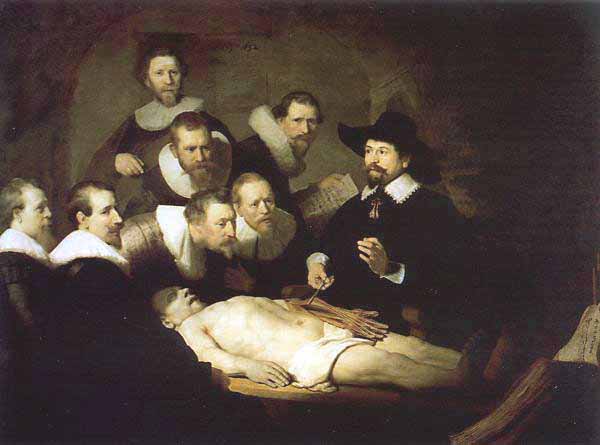
The ANC has expressed its outrage over a painting by Yiull Damaso, depicting Nelson Mandela on the autopsy slab. According to spokesman Jackson Mthembu, the image, based on Rembrandt’s Anatomy Lesson, is reprehensible on a number of counts:
It is in bad taste, disrespectful, and it is an insult and an affront to values of our society... In African society it is a foreign act of ubuthakathi (bewitch) to kill a living person and this so-called work of art … is also racist. It goes further by violating Tat’ uMandela’s dignity by stripping him naked in the glare of curious onlookers, some of whom have seen their apartheid ideals die before them.
It’s not clear exactly how the painting is racist, especially since its depiction of non-white people in positions of authority significantly improves on Rembrandt’s original. But the allegation of ubuthakathi does raise one tricky question: will the painting suddenly become less problematic when Mandela does actually die? Moreover, Mr Mthembu’s vitriol leaves another matter unaddressed: as is so often the case with supposedly shocking works of art (see the Danish Mohammed cartoons), the picture is really a bit rubbish. The dead Mandela looks more like Morgan Freeman.

Tuesday, April 25, 2006

Goo goo g'joob

The organisers of a pay-per-view seance have announced that John Lennon's message to the world is: "Peace."

After 25 years, the man who told us to "give peace a chance," who asked us to believe that "war is over if you want it," who got into bed and a bag for peace, the man for whom, it would appear, peace was quite a big deal... his message to us is, in essence, more of the same.

Well, it's believable, but it ain't exactly news, is it? I mean, if he'd said "Paul was the talented one all along," or maybe "Getting me knob out on the Two Virgins sleeve, that wasn't big and clever was it?" then maybe we might have taken some notice. Or even "'Imagine' is a very cheesy song, and I can't believe so many people like it." But no. "Peace." That's what you get for $10. Next they'll be contacting the hovering shade of John Paul II to clarify his religious affiliations.

And, just when you thought the envelope of taste had been pushed as far as it could go... a horror movie opening in Thailand on Thursday is about a fictional reality game show set in Phnom Penh's S-21 interrogation centre, where the Khmer Rouge murdered about 12,000 people. It stars contestants from Academy Fantasia, the local version of Pop Idol.

For an occidental comparison, imagine a remake of I Know What You Did Last Summer, set in Dachau. Starring Girls Aloud.