Thursday, September 30, 2010

Ceci n’est pas une peinture

Le plagiat est nécessaire. Le progrès l’implique.
—Guy Debord (although Lautréamont said it first)
In an overpriced hotel in the 5th arrondissement, the concierge asks where we’re off to. The Museum of Modern Art, we tell him. “Oh, the Pompidou, you mean,” he says. No, the other one, we insist. He looks baffled.

It feels appropriate that an exhibition challenging our very definitions of art should take place in an art gallery the existence of which is a mystery even to well informed Parisians. Seconde Main (Second Hand) is an exhibition of lookalikes, pastiches and other responses in kind by artists to other artists. Rather than hive it off into a dedicated section of the gallery, the curators have integrated the exhibition into the main collection, putting the second-hand roses alongside the real thing, and making us question the identity and nature of both. In what feels like a loss of nerve, the lookalikes are identified with pink stickers – wouldn’t it have been braver to let us guess? – but the effect is still disconcerting and thought-provoking.


Part of this is due to the nature of the museum’s main collection. Although it contains plenty of big names (Matisse, Chagall, Dufy, Dubuffet, et al) few of the works themselves are instantly recognisable, the sort that you’d find on tea-towels or fridge magnets: this, presumably, is why concierges don’t know about the place. So you see something that looks primitive and jungly, and you just assume it’s a Rousseau, because if you know a bit about modern art, you know that’s that sort of thing that Rousseau did, even though you’ve never seen the painting before. And then you discover it’s not a Rousseau at all; it’s actually by some chancer called Ernest T, who takes the titles and dimensions of Rousseau’s lost works, and has a good guess at what they might have looked like, and paints his guesses.

Many of the works, though, are responses to works that are real and existent and very well known. Richard Baquié takes on Duchamp’s Étant donnés, an installation that requires the viewer to peer through a tiny peephole and immediately become a voyeur to a scene that hints at, but never explicitly announces itself as, the aftermath of sexual violence. Baquié disembowels the original, showing its workings, like Penn and Teller telling you how a magic trick is done. But it doesn’t destroy your respect for the original, because you know that without Duchamp having spent 20 years concocting Étant donnés in the first place, Baquié would have nothing to work with; just as Duchamp himself must have known when he doodled facial hair on the work of a previous artist, nearly a century before.
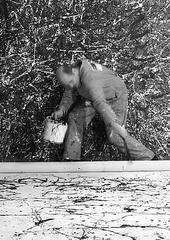
Indeed, many of the subjects (targets? victims?) of the artists here have already been responsible for (guilty of?) appropriating other works, so when Mike Bidlo responds to Warhol’s soap box or Manzoni’s can of shit, we can smile at the cleverness, but the same joke doesn’t bear repeating too often (as it is about Lichtenstein, Jasper Johns, Jeff Koons, Bridget Riley and plenty other Pop-ists and Op-ists). The Art & Language collective do something that could well be a Pollock drip painting; more effective is Gavin Turk becoming Pollock himself, emulating Hans Namuth’s images of Jack the Dripper at work. We can become tired of the art, he seems to hint, long before we tire of the artist. Well, Gavin *was* a YBA, wasn’t he?

The brochure namechecks Borges’ Quixote, and you (OK then, I) sort of expect/hope Baudrillard might get a mention as well, but this isn’t really about pure simulacra. The originals have to be present, indeed, have to be dominant, for the copies to make any sense. When Fayçal Bagriche spirits Yves Klein, Trotsky-like, out of his own Leap into the Void, it only makes sense if you know the original. Otherwise, it’s just a photo of a sidestreet.

Seconde Main demands of the viewer a basic working knowledge of the art of the past 100 years, a knowledge of who Pollock was and what Picasso did, for it to make sense. So not only can this exhibition only work in this museum, it can only work in this country, maybe only in this city, where they don’t worry so much about art being “accessible” and “inclusive”. Art’s just there; deal with it. If you can’t deal with it, here’s a book about it. But preferably not one by Dan Brown, whose baleful presence still hangs over the city.

That said, this is still a learning experience. Towards the end is the only piece that’s an actual fake, intended not just to provoke or confuse or amuse, but to deceive; an ersatz Modigliani by the forger Elmyr de Hory. And somehow, I spot it as a wrong ’un even before I see the pink sticker. I don’t think I’d have been able to do that before I came in.

Tuesday, September 28, 2010

Diabolical liberties

A couple of paintings, new to me, that I saw in the Musée Carnavalet at the weekend:


Jean Touzé (1747-1809), The Jacobins in Hell


Jean Véber (1864-1928), The Parisians Pull the Devil by the Tail

Monday, September 27, 2010

Ruff draft

Possibly an addendum to the post about blogging from a few days ago (from the New Yorker, via M.A. Peel).

Saturday, September 25, 2010

Bof

Suddenly find myself in Paris for 48 hours or so. I won’t tell you how long it’s been since I was last here, but that time we flew from London. I know! The olden days, eh? It’s all the same, and it’s all changed. It’s still a bit shabby round the edges, but the piss-and-tobacco reek is mostly gone. Just as many dogs, but fewer with explosive diarrhoea. Most noticeably, waiters and museum staff seem happy to speak English, which is something a culture shock akin to finding a Bangkok taxi driver with a legitimate licence.

Of course, we stumble on in French, desperate to prove we’re not tourists. To prepare, I pick up a copy of Le Canard enchainé, the French equivalent of Private Eye. My O-level grade B, plus a bit of guesswork, means I understand about 80 or 90 per cent of it; but at the same time, I don’t really understand it at all, in the sense of knowing who all these strange people are. It’s a bit like that time we had to translate an article on French pop music, and my teacher explained who Johnny Hallyday was, but we didn’t really believe him. Checking out the hand-chalked menus at the bistros around the Garde du Nord, I have better luck. Rascasse is fish, I know that. But which fish? My main problem is that I can’t read the writing.

On to the Boulevard Saint-Germain, and in the Café de Flore, haunt of Sartre and Simone, only one person is properly rocking the existentialist look; a young Japanese woman, dining alone, smoking very precisely, exhaling from the furthest corner of her mouth. But no leather-jacketed philosopher sees fit to make a move on her, so she pays up and walks away in the rain.

Wednesday, September 22, 2010

Dream a little dream


One might have thought, after the scene in Living In Oblivion where Peter Dinklage lays down the law, that nobody would dare to put a dwarf in a dream sequence ever again. In fact, the meme still crops up on a regular basis, but if you do indulge in achondroplastic reveries, you’re expected to put big quotation marks around them. When David Lynch cast Michael J Anderson in Mulholland Dr, it wasn’t about dwarfs per se, it was a recognition lollipop to fans of Twin Peaks; and in any case, you weren’t supposed to know whether the whole thing was a dream or not. Similarly, the dwarf in In Bruges was an actor in a film, which is a bit like being in a dream, but not quite (which is the whole point of Living In Oblivion).

On this basis, Werner Herzog presumably thought he could get away with it in his latest, My Son, My Son, What Have Ye Done, because Lynch is one of the 12 (count ’em!) executive producers, so it becomes a cheeky nod to his colleague’s penchant, rather than a tired metaphor for encroaching madness. The fact that what he ended up with was more of a mid-level Coen Brothers effort than anything Lynchian is another matter entirely.

Moving media, David Mitchell (this one, rather than that one or that one) has a go in his most recent novel, The Thousand Autumns of Jacob de Zoet. The central figure falls asleep and dreams he is confronted by a hunchbacked dwarf wielding a leg of pork, although it soon transpires that it’s not a dream; and it’s not a dwarf; and, most disturbingly, it’s not actually pork...

Saturday, September 18, 2010

Carry on specialising

Some time last year, I wrote a piece for LC’s short-lived but fondly remembered Pamphleteer, about the end of that remarkable generation of polymathic raconteurs (your Peter Ustinovs and your John Mortimers) who could be injected into a TV chat show, apparently with no preparation and, more significantly, nothing to sell. Only Stephen Fry carries on the tradition, and even he fails to keep up the second part of the bargain. In the comments box, Boz sensibly pointed out that I’d omitted Kenneth Williams from the list; but it’s only now that I come upon a pertinent remark by Williams himself, made appropriately enough on a chat show in 1987. On the subject of increasing specialisation, he said:

Everyone’s becoming better and better at less and less; eventually someone’s going to be superb at nothing.
Which inevitably makes one think of the likes of Katie Price and Paris Hilton, whose most obvious talent is for being themselves. But, honestly, can’t the same be said for Williams?

Thursday, September 16, 2010

The 2007 revival starts here

The blogging platform Vox is closing at the end of this month. Two or three years ago, such news might have provoked any number of anguished “DEATH OF BLOGGING” editorials, and a few by the likes of Janet Street-Porter, reporting the same thing but with rather fewer tears.

Back then you could barely move for articles in various media pondering where blogging might be heading. Would it supplant mainstream media entirely? Or perish at the hands of Twitter and Facebook, as Paul Boutin argued in 2008? The answer, of course, is neither. The fact that there are fewer outbursts of metablogular chinstrokery these days (present company excepted) need not imply that blogs are dead; it’s just that they’ve become a regular part of the cultural furniture, and there is no more point in thinking and writing about them every minute of the day than there is in constantly offering up one’s opinion on condensed milk, or trombones.

That said, the subject does occasionally crop up (as, I suppose, do meditations on Carnation or Albert Mangelsdorff). Here’s David Hepworth, offering a few thoughts about how his habits have changed since he began blogging in 2007:
Starting a blog is an odd thing. There's a curious early period when there clearly isn't anyone reading it and you feel as if you're miming a pop song in front of the bedroom mirror and you're terrified your mother will burst in. Then a few people drop in, presumably drawn there by the fact that they know you. Either that or the desultory nature of the contents...

But then you start to notice that some things are more popular than others. They attract more traffic and more comments. Then the temptation is to do more of those posts and less of the other kind, to try to anticipate what people might like. You get the same thing with Twitter. Somebody with a lot of followers re-tweets something you've written and the next thing you know you've woken up to fifty new followers. This is nice but then you wonder, what are these new people expecting? I've got a terrible feeling that I'm not going to provide whatever it is that they want.
And, once again, Douglas Coupland in Generation A, dealing with someone whose life has lost its narrative:
“But I can blog my life! I could turn it into story that way!”

“Blogs? Sorry, but all those blogs and vlogs or whatever’s out there—they just make being unique harder. The more truths you spill out, the more generic you become.”