Sunday, August 06, 2006

"Of Man's first disobedience..."

A few days ago, I was rooting through an old pile of unlabelled video tapes. (Incidentally, has anybody yet had to explain to a small child what these bulky, noisy, obsolete slabs of plastic are?) All manner of odds and sods were there, including, for some reason, several hours from the first series of Big Brother, shown in the summer of 2000.

As luck would have it, the recording I found was of the episode that propelled BB from being an interesting media experiment, to a bizarre cultural phenomenon - the downfall of Nasty Nick. In case you don't remember, Nick was the posh City boy who was discovered to have been plotting against his housemates, and was ejected from the house. Following the original broadcast moment by moment, it's difficult to see exactly what he was doing wrong, apart from being friendly to individual housemates, and then bitching behind their backs. In the end, it appears that his mortal sin against the Gods of Endemol was illegal possession of pencil and paper.

In retrospect, what was interesting was his justification for his actions, and the response of his housemates. He said that he saw the whole thing as a game that was to be won, and he was prepared to do anything to win it. Craig and Melanie and the boring Irish one and the others were dumbstruck. They were friends, weren't they? How could he have been so two-faced to friends? When Nick made his final, contrite speech to them, after being told of his imminent expulsion, it was important for him to clarify that he liked them all, and hoped they'd be friends in the outside world.

I'd followed the first BB quite closely, but became pretty bored thereafter. I thought at the time it was because the novelty had worn off. But, looking back to the first series, there's an intrinsic difference. From the second series, housemates know what being on Big Brother is. In the first one, they were just some people, thrown together. They'd never been viewers or voters, so didn't know what emotions could be stirred up by the Channel 4 press office and the silly-season tabloids. Intriguingly, in the post-mortem with Davina McCall, Nick lets slip that he'd seen the original show in the Netherlands, and that's what had made him want to appear. So maybe he knew what was going on.

Moreover, the producers seemed content to suck it and see. They'd selected a bunch of people of varying backgrounds, and let them get on with it. They probably knew that Nick was ambitious and political, but (unless they were playing a very subtle game) his actions caught them by surprise as well.

In subsequent series, everyone knew what the stakes were, even if they weren't all bright enough to acknowledge a game plan. But the producers over-egged the pudding by provoking conflict and encouraging politics. The Nasty Nick story warmed up our water-coolers because he seemed like the devil incarnate by comparison with his contemporaries. Now everyone's a Nick, and the only reason they don't smuggle writing implements into the house is because they wouldn't know what to do with them.

The original Big Brother, all chickens and home-made party costumes and Scout-like assault courses, was a contemporary Eden. But the snake wasn't really Nick, any more than he was Satan. The snake was everyone who watched it, and worked out how to play it, and applied to get onto the next show. Just as in the Bible, the snake represented knowledge and self-awareness. (I know this means Davina is God, and that Geordie bloke is something akin to Milton, but bear with me.) Nick was Adam, cast into the outside world without even the sustenance of an Eve. One of the most extraordinary moments in the episode is when Nick admits to a dumbfounded Anna that the moving story of his wife's death in a car crash had been a complete fiction.

This death of innocence is what turned BB into a vile, manipulative freakshow, where the only seedy pleasure for the viewer is the knowledge that you're not as grotesque and stupid as the drooling peasants on display. The producers selected the nutters and the cretins, and the Heat-friendly self-publicists selected themselves. But by the beginning of the second series, the whole concept had lost something more important than its innocence, or even good taste. Paradoxically, as the competitors became aware, the show lost touch with reality. Which, for a reality TV show, is a bit of a problem.

Friday, August 04, 2006

Telly addicts

Nuzzling gently against Molly's d*mb*ng d*wn comment on the previous post: from a BBC story about mini-motorbikes:

Sheila Lomas, 49, from Cheadle, said reckless mini-moto riders raced across the park near her home. "They are just so noisy and there is no let-up from it," she told BBC News. "When it's hot we cannot have the windows open because we cannot hear the television."

Meanwhile, Filmcritic offers the 50 best movie endings of all time; Seth Godin's 19 tips for promoting your book; Andy Partridge of XTC describes the experience of listening to Beefheart's Trout Mask Replica as "like being trapped in a mad, giant watch"; and the US Treasury Secretary has declared that the main threats to the country's economy are ill people, poor people and ill, poor people. Glad that's sorted out.

Wednesday, August 02, 2006

Signifying nothing

So the Brick Lane protest happens, and there's a bit of shouting and general grumpiness, but it's all a bit pointless really, since the film-makers have pulled out already. Maybe it's because it's the silly season, but some commentators are desperately trying to lump this one together with all that unpleasant Rushdie business back in the olden days; Sikh protests against Gurpreet Kaur Bhatti's Behzti; Hindu protests over MF Husain's paintings; the highly amusing career death of Mel 'Sugar Tits' Gibson; the 40th anniversary of Lennon vs Banjo-Pluckers, Inc; and, for all I know, my late and dearly beloved grandmother's crestfallen face when I announced that I was a vegetarian, and would no longer be partaking of her delicious chicken soup (with or without matzo kleis).

This one is slightly different however, in that it's not a religious protest. The locals are complaining that Bangladeshis - particularly Sylhetis - are being portrayed as unkempt bumpkins. Leave aside the fact that the most damning remarks are made by a character in the novel, and thus to accuse Monica Ali of propagating such slurs is akin to accusing Shakespeare of supporting rape, mutilation and cannibalism for writing Titus Andronicus. Leave aside the fact that I've had the same stereotype related to me over and over again by South Asian acquaintances of all backgrounds. (It's what the English say about the Irish, the Americans about the Poles, the Japanese about the Koreans and the Bangkok Thais about the Isaan [North-eastern] Thais.) Leave aside even the fuckwitted protestor who lived up to the groundless libel by admitting that he'd read bits and pieces of the book and had other bits "explained" to him; or the fact that only two of the 120 protestors were women. ("This event was organised at short notice and obviously our families have children," said a man protesting at the book's allegations that Bangladeshis have a somewhat restrictive view of gender roles. "So who looks after them?")

No, the core of the problem is the protestors' polite request: "If you're going to write certain things then don't upset people."

Have you ever experienced art or media that has "not upsetting people" as its top priority? Think content-free Vegas pap like Cirque du Soleil and Blue Man Group. Think Jack bloody Vettriano. Think Coldplay. Look at the censored films and anodyne music available on international airlines. Next time you're in a hotel, check out the news from CNN or BBC World. In the interests of fairness and balance and sensitivity - all good things, don't get me wrong - we're left with bland banalities, polite evasions, and endless repeats of Larry King, the dullest journalist on the planet. Or maybe just get a job on a magazine in Thailand, where direct criticism is taboo. (I once wrote a book review that was not entirely complimentary about some ghastly you-can-be-a-better-salesperson tome. The managing editor couldn't understand why we would want to draw our readers' attention to books that were not good.)

Or, if you care to cast your mind back that far, consider the Millennium Dome. Because they didn't want to "exclude" anyone, however dim and/or thin-skinned, the whole experience was like an infant school open day. Stephen Bayley (whatever happened to him?) was mocked for suggesting the best thing they could do with it would be to leave the structure empty, and let the punters walk around. But effectively, that's what they did. I actually paid real cash money to get in, and half an hour later I couldn't remember a bloody thing about it.

The bizarre thing is, when I first read Brick Lane, I thought it was a similar, empty, pointless experience: Zadie Smith for daytime TV viewers; second-rate Catherine Cookson with a light dusting of stale garam masala. But no, even this dull, vacuous novel is just too edgy for some people. Now, I'm all for restrictions on expression if they'll really prevent hatred and violence and lynchings and gas chambers and genocide. But restrictions on taking the piss? That's just taking the piss.

Of course, this whole quandary came up earlier this year, with the Danish cartoon saga. I thought all the pictures should have been junked because they were exceedingly poor, but that, apparently wasn't the point. Art Spiegelman, one of our greatest living cartoonists, wrote a superb overview of the whole thing in Harper's a couple of months back. Proving himself to be an equal opportunities offender, he included historical cartoons that were pretty vile about Catholics, black people, capitalists, Boss Tweed (who he?), King Louis-Philippe of France and many more. He also analysed all the Danish cartoons, awarding each a numerical score for offensiveness; and reprinted an Iranian cartoon denying the Holocaust, as well as some cartoons entered into an Israeli competition intended to show the Iranians that however anti-Semitic the goyim can get, Shlomo and Saydie can go one better. It was meaty stuff, some of it downright nasty, but Spiegelman was careful to set the whole thing in context. "As a secular Jewish cartoonist living in New York City, I start out with four strikes against me," he wrote, "but I really don't want any irate Muslims declaring holy war on me. Although I'm not at all religious, I am a devout coward."

However, as Spiegelman and Ali discovered, however careful you are, someone's going to get upset. The cartoonist's most famous work is probably the astonishing graphic novel Maus, which retells the story of Hitler's Germany with the Jews recast as rodents. Apparently, moggie-loving zoologist Desmond Morris complained because the Nazis were represented as cats. Still, at least he bothered to read it. Or at least have it explained to him.

Sunday, July 30, 2006

Ball games

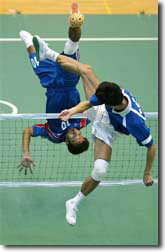
Muay thai (Thai boxing) is, of course, Thailand's most thrilling sport, but takraw runs it a close second. (It was actually invented by the Malays, but don't tell any Thai people that.) It's a bit like keepy-uppy; players have to keep a rattan sphere off the ground, using any part of the body apart from their hands and arms. It has several variations, derived from volleyball and basketball, but the purest form consists of nothing more than a few blokes kicking the takraw to each other on any available patch of flat earth. Often, the acrobatic skills on display make Brazilian footballers look like arthritic Cybermen, and they can keep it going for hours (which is more, it seems, than the Brazilians can manage these days).

I mention this because there's a big building near my house. I don't know what goes on there; people come and go during the day, and trucks occasionally arrive at the gates. But there's a Wonka-esque mystery about what's actually happening inside. The only activity anyone can see or hear is a bunch of blokes playing takraw in the car park, all day, every day. Maybe it's a takraw factory, and they're testing them.

There's less mystery about the goings on in the building a few doors down. It's a sauna. Usually, the clients at Thai saunas can have a beer before, after or even while they, um, do what you do in Thai saunas. For some reason, this one doesn't appear to offer such facilities, although there is a bar directly opposite. As a result, it's not unusual to see an elderly, pot-bellied Asian gentleman, wearing nothing but a skimpy towel about his loins and a post-coital glow, strolling across the road for a Singha or two, and then returning, revived, for another session. At 11 in the morning. Land of Smiles, eh?

Where there's sex, there must be death. There's a good line in Tim Hilton's Guardian obituary of sinophile and art enthusiast Peter Townsend: "Avant-garde magazines sometimes change character when editors move to a new pub." And while we're digging out that black tie, anybody called The Reverend Bevan Wardrobe can claim a Telegraph obit on the basis of his name alone, surely?

Also: Salman Rushdie offers Germaine Greer outside; Chuck Klosterman on blogging, irony, populism and the undeconstructible Snakes On A Plane; patriotic Iranians are exhorted by comedy president Ahmadinejad to refer to pizzas as "elastic loaves"; Rod Liddle almost gets Barthesian on Thorpe Park's ass, but bottles it; and, from the mighty Tangents, news that Bob Stanley of St Etienne is putting together a C86 movie. If you have any video or cine footage of shambling/anorak/twee/indiepop* performance from the era, please send details to blog@tangents.co.uk.

*Select your pejorative of choice.

Thursday, July 27, 2006

What the Cornflake said

Who's the most profound, perceptive analyst of modern culture that we have? Baudrillard, maybe? Habermas? Harold Bloom? Pah! Lightweights.


No, it's Dave Lee Travis. You heard it right, people. Opining on the reasons for the imminent demise of Top Of The Pops, ex-Radio One jock DLT had this to say (after some inevitable zaniness about kids with WiFi aerials in their heads):

"There's just too much stuff out there. Everything's becoming marginalised."

Now, like the best Zen koan, that's a seemingly meaningless, paradoxical statement that packs a powerful pipeful of truth. Everything is marginalised. We have no canon any more, no core cultural identity. You can't assume any knowledge on the part of your audience, which means that at every step you run the risk of patronising half of them, and shooting the conceptual ball way over the heads of the other half.

There's a bit in Ulysses where Deasy, the pompous headmaster, admonishes Stephen to be more prudent, noting that Shakespeare said "Put but money in thy purse." Stephen's response is to mutter the single word "Iago" under his breath.

Now, the joke only works if we know that Iago is a villain, so we shouldn't necessarily be taking advice from him. But how do we deal with this, if we don't know how much the reader knows? Stick with "Iago"? Maybe play safe with "Iago, the villain in Othello"? Or do we have to aim for the lowest common denominator, and explain that it's from "Othello, a play, by the playwright William Shakespeare (1564-1616), who also wrote William Shakespeare's Romeo & Juliet"?

Of course, you can go to the opposite extreme. One thing I love about Eliot's notes for The Waste Land (apart from the fact that he can't remember which Antarctic expedition he's talking about) is that he kindly translates the Sanskrit for us; but assumes we'll be OK with the Latin, Greek, French, German and Italian. That's right. Eliot. He wrote Cats.

So where do you pitch it? The problem is, it's one thing to bemoan the lack of a cultural centre, another to decide what and where that centre should be. I'd be happy with, say, Shakespeare and Eliot and Joyce. (Sorry, make that "the Irish author James Joyce (1882-1941), who wrote Ulysses".) Whereas DLT's vision of what can unite us within a common, unmarginalised, cultural identity would probably be ELO and Snooker On The Radio. But who am I to argue with a mind and beard like that?

Tuesday, July 25, 2006

About some boys

Get the semi-autobiographical Bildungsroman stuff out of your system first, then start to play with the genre. That’s the rule for novelists, although even as I write it, I can hear you bellowing the exceptions. But think of Joyce using A Portrait Of The Artist As A Young Man as a personal catharsis, a professional calling-card and a dry-run for Ulysses.

David Mitchell hasn’t read the rules, it would seem. He kicked off with Ghostwritten, an interlinked series of tales, somewhere in the no-man’s land between a story collection and a novel; paid tribute to Murakami with the Booker-shortlisted Number9Dream; and then followed went back to the intertwined narrative thing with Cloud Atlas, but went one better, moving his multiple narratives to a distant, dystopic future, and then galloping backwards again, linking the stories with such casual elegance that you gasp in admiration.

Mitchell’s Black Swan Green is, on the face of it, a big jump away from structural trickery towards something like a proper story with a beginning, middle and potential for Andrew Davies to do the adaptation. It’s the story of Jason, an awkward, unpopular, stammering 13-year-old who lives in the titular Worcestershire village in 1982. And, really, that’s it.

Of course, Mitchell adds a bit of narrative oomph at the macro (the Falklands War) and micro (Jason’s parents’ marriage woes) levels. And, as a treat for his loyal fans, he also brings in a minor character from Cloud Atlas. But essentially it’s a first-person narrative with all the stuff that fictional teenage boys get worked up about: peer popularity; personal inadequacies; parents; siblings; girls and their breasts.

What literary invention there is, remains rooted in mundanity. Jason has a mature, imaginative vocabulary for a teenager (“Worm casts pitted the bubbling lawn like squeezed blackheads”), but that’s because he’s a poet, under the gloriously 13-year-old pseudonym Eliot Bolivar. There are unspoken struggles with an internal demon called Hangman (very Murakami) but that’s just Jason’s method of personalising and defeating his stammer.

Maybe all this material would have been too painful to write before Mitchell had secured literary credibility for himself. It is, after all, blatantly autobiographical: Mitchell’s the same age as Jason; he comes from the same area; he had a bad stammer when he was a child. The period detail, all bulletins from Goose Green and snogging to the sound of ‘Planet Earth’, feels pretty accurate (I’m about the same age) although some of it seems a bit second-hand, like one of those cheap nostalgia shows that keep Kate Thornton one paycheque away from the shopping channel. Indeed, Mitchell admits “debts of detail” to Andrew Collins’s Where Did It All Go Right?

It’s a brave admission, in that it hints at a genre/marketing shift, from ‘literary’ fiction to the sentimental end of lad lit. Of course, some people are allowed to scamper between the two, not least the crawling king snake of the genre, Nick Hornby.

Hornby’s Arsenal-‘n’-Springsteen persona disguises the fact that, deep down, he only ever wanted to be a literary critic; his first book was not, as the official myth has it, Fever Pitch, but a volume of essays under the clunky title Contemporary American Fiction. In The Polysyllabic Spree, he returns to the bookish leg of his geek tripos (the others, of course, being footy and pop).

It’s a collection of pieces from The Believer magazine, in which Hornby discusses what he’s been reading. The focus is less on the books themselves – although, inevitably, a level of criticism does slide in – but about himself as reader and consumer. The distinction is key – each essay is prefaced by two lists, of the books he’s read, and the books he’s bought in the previous month. There’s crossover, but they’re usually very different. I think we all know where he’s coming from. Bloody 3-for-2’s in Waterstone’s, that mysteriously leave you with two books you didn’t really want...

When he was writing about Liam Brady or Teenage Fanclub, Hornby was faced with the challenge of turning action (a goal, a guitar solo) into prose, to make it come alive for the reader. If you’re writing about writing, the challenge is less pronounced – why tell when you can show? As a result, the best bits of the book are the quotations from other sources. This could just be Hornby demonstrating that he’s a good anthologist with excellent taste (or, as readers of his latest novel might wish to attest, the fact that his own literary ability is going a bit Sunderland). Consider this, from This Is Serbia Calling by Matthew Collin: “The one good thing about no electricity, one cynic remarked during the power failures, is that there’s no television telling us we’ve got electricity.”

There. The insanity of war and politics encapsulated in 24 words. Hornby, to give him credit, just steps back and applauds, and I rather know how he feels: probably the best line in this post is the result of me quoting Hornby quoting Collin quoting some beleaguered Balkan. It’s postmodern correctness gone mad, I tell you.

Of course, Hornby makes no claims to be a war correspondent, although his life hasn’t been all honey for tea. He can combine humour and pain when discussing his son’s profound autism, and touches on a number of books about the subject. It does reinforce the authenticity of the book – this is about what he reads, and what touches him, not what he feels he ought to read. (In that sense, that the only agenda is spontaneous and autonomous, his essays would work very well in blog form.)

Hornby’s immunity to the vagaries of academic fashion is admirable, but he does seem to create a kind of bunker mentality, seeing himself as ringleader of the intelligent populist against the theorists and the literati (he does, after all, still live in Highbury rather than Hampstead.) One ally and friend that he namechecks is Tom Shone, who has distilled the essence of the intelligent movie blockbuster as the ability to combine clever, subtle details (Chief Brody’s son copying his dad’s gestures in Jaws) with big, dumb thrills in just the right proportion: “…you could have finger steepling and scary rubber sharks in the same movie. This seemed like important information. Why had no one told us this before?”

But when Hornby makes an equivalent point about middlebrow fiction, it comes over as the kvetching of a popular author who might make it to the Booker longlist, but that’s as good as it gets: “…after a lifetime of reading I can officially confirm that readers’ writers beat writers’ writers every time…”

Which, if we accept that what he’s really saying is that Hornby is better than Rushdie and Ishiguro and McEwan, et al, because more people read him, it surely means that Hornby is in turn less good than Grisham and Brown and Kinsella or whoever sells more than him. Or that Chelsea are currently better than Arsenal, and Lily Allen is better than Springsteen.

Once again, he has to reach for a quote to redeem himself, and it’s Gabriel Zaid who summarises the whole book, as well as Hornby’s other completist fascinations: “…the truly cultured are capable of owning thousands of unread books without losing their composure or their desire for more.”

Now, if Hornby could come up with one-liners like that – even if he changed the subject matter to Panini stickers or Dylan bootlegs – he’d get the Booker and the sales figures as well. It's the last match of the 1989 season and the ball’s at his feet...

Saturday, July 22, 2006

Is this a blogger I see before me?

I'm developing a morbid fascination with the way old media is stumbling onto the blog bandwagon, especially when legitimate hacks use their blogs to reflect on the way blogs are challenging and changing their working practices. It's all so thrillingly metatextual!

Here's the deputy editor of Newsnight on how they're using Technorati to pick their interviewees, and also the delusions still held by some bloggers that their thoughts are somehow private and privileged; and the news editor of telegraph.co.uk on how last week's stats about how many people have blogs are skewed by commercial definitions of what is and isn't a blog.

Which in turn offers up today's essay question. MySpace: the Sunny Delight of blogging, or what?

Thursday, July 20, 2006

Three quotations...

...that might have gone into that bit where the Spinal Tap one sits, or maybe the Green Wing one, or possibly even the Murakami. Such is the postmodern condition. (A line I tried to shoehorn into the 3,000 words I wrote about Radiohead's 'Fitter Happier' at the weekend, before deciding that references to Baudrillard, Eliot, Joyce, Lou Reed, Nirvana, The Stepford Wives and Leonard Nimoy made it quite pretentious enough, thanks for asking. And on the subject of Radiohead, has anybody listened to Thom Yorke's Eraser album yet? Doesn't it sound a bit like how you'd imagine TY's demos to sound before the other guys have had a chance to work on them? Strange, that.)

Anyway:

"Thus, although the culture industry undeniably speculates on the conscious and unconscious state of the millions towards which it is directed, the masses are not primary, but secondary, they are an object of calculation; an appendage of the machinery. The customer is not king, as the culture industry would have us believe, not its subject but its object."
(Theodor Adorno)

"...and there is a breed of Tuesday in January in which time creeps and no light comes and the air is full of water and nobody really loves anybody..."
(Zadie Smith, from On Beauty)

"Do I get bonus points if I act like I care?"
(Dr Gregory House)