Maybe it's just jetlag, but is blogging the new tamagotchi?
Discuss.
Sunday, June 11, 2006


Friday, June 09, 2006
Beggars, babes and the Bible
 Rembrandt Etchings: Central Chidlom, Bangkok
Thanks to Amazon and iTunes and dodgy DVD stalls, my exile in the place of the olive plums means that I'm doing OK for books and recorded music and movies. Other manifestations of Western culture, however, are somewhat sparse, unless you're into third-rate Noel Coward or (help) The Eagles.
So when I journey back to the Land of Jade and ASBOs, I tend to gorge on gigs and plays and, above all, galleries. Oddly, just before we were due to leave for our latest homeward jaunt, we discovered that Bangkok has suddenly come good on the pretty picture front. The Dutch embassy has organised an exhibition of etchings by the art world's greatest cloggy (Vincent fans may cough discreetly here), Rembrandt van Rijn. The event honours the 60th anniversary of HM the King's accession to the Thai throne, as well as marking 400 years since Rembrandt's birth.
By the nature of the medium, the pictures are small, but there are 88 of them. Some are finished products, intended for clients; some are preliminary studies for paintings; and others are pretty much spontaneous doodles, an arm here, a head there, an old man leaning into the frame at 90 degrees to everything else. Here we see what distinguished Rembrandt from his predecessors; he was one of the first major artists to take on the teachings of the Renaissance and interpret them in a humane, emotional way (as distinct from the intellectual rigour of, say, Leonardo). He's fascinated by light and shade, by the imperfections of skin, by the effect of ageing. His Diana is no glam superhero; this girl's got cellulite you wouldn't believe.
His images of Amsterdam's many beggars and vagabonds demonstrate a wry tenderness that contrasts with the sententious, implied criticism that previous artists had shown. The poor and homeless were widely believed to be responsible for their fate, but Rembrandt's ability to characterise them as flawed but dignified individuals means that his pictures would fit neatly into the works of Dickens, 200-odd years later. Looking at the peg-legged 'captain', head bowed, his arm in a sling, you can't help but muse on the misadventures that might have brought him here.
 Rembrandt works within the boundaries demanded by the artistic tradition of his time, but his buzzing fascination for the real, the fleshy, means that he always seems to be chipping away at the expectations holding him back. All his contemporaries were dutiful chroniclers of scenes from the Bible, but he reminds us that this was stuff that happened. His 'Descent from the Cross' doesn't depict a slim, ethereal presence, elegantly dead. One nail is out, and the released arm hangs useless, broken. A chunky, Dutch labourer, not a non-specifically eastern Mediterranean figure, wields the pliers. This is the muscular, in-your-face Jesus of Dennis Potter, not Robert Powell's blue-eyed pretty boy. This is the work of a man with, his religious faith notwithstanding, a lust for life. Sorry, wrong Dutchman again.
So, Rembrandt hits Bangkok, which is all well and good, with a few buts. The fact that the etchings are on show in a department store rather than a gallery seems, on the face of it, to be a positive, egalitarian move, bringing great art to the masses. But it's probably more an indication of desperation, that Bangkok lacks a gallery space to compete with the likes of Singapore and Shanghai. Moreover, in this city, a store like Central hardly opens its arms to the curious, unwashed masses. In any case, if any member of the hoi-polloi were to slip into the show, the fact that the explanatory captions are only in English renders them pretty useless.
I look at his street people again. His predecessors thought they'd brought their misfortune on themselves. In fact, this is a fairly prevalent view in Thai Buddhist culture, which sees a lowly social position as being the karmic result of bad behaviour in a previous existence. Rembrandt was no anarchist, but there's a sense that exposing the masses to his energetic, inclusive humanism might be, for some people, just that little bit too dangerous.

Monday, June 05, 2006
The Bob Swipe Memorial Post
 In the course of the research for my next book (he says, trying desperately to sound like a proper, grown-up writer), I've been trying to locate the first use of the word 'indie' in reference to a genre of music, rather than the status of the company that releases the music. There have been numerous dead ends, but I've always been fascinated by the haphazard, murky way in which neologisms stagger backwards into the limelight. It's not necessarily the first use that's important; it's the moment at which usage of the word or phrase hits some sort of critical mass. And, in many cases, the event should really be accompanied by a substantial side-order of WHY???
For example, why has the sensible, descriptive 'weblog' been superseded by the ugly 'blog'? Was that extra syllable really such a chore? As Alison Bradley puts it: "Blog is truly an unfortunate word. Far from appetizing, a blog inspires John Carpenter derived images of a blob in the fog, meandering through the web."
See, it could have been worse. We could all have been writing flobs.
Which is silly, of course, but not nearly as daft as this piece by Catherine Bennett in last Thursday's Graun, which suggests that the blogverse is characterised by "a redneck approach to sex and women", including "devil-may-care asides about porn, notes on the ugliness of women commentators, the beauty of young waitresses, or remarks... on the 'totty situation'".
To which the all-too-obvious response is to suggest that Ms Bennett stop worrying her pretty little head about such matters, and make us a cup of tea. On the other hand, if you would like to contribute your euro's worth of vitriol and hearsay to the continuing debate about flobbing, sorry, blogging, you could do worse than to allow Patroclus to delve around in the recesses of your grey matter for a few minutes.
Love-on y'all,
Tim
Friday, June 02, 2006
Tuesday, May 30, 2006
Say what you see
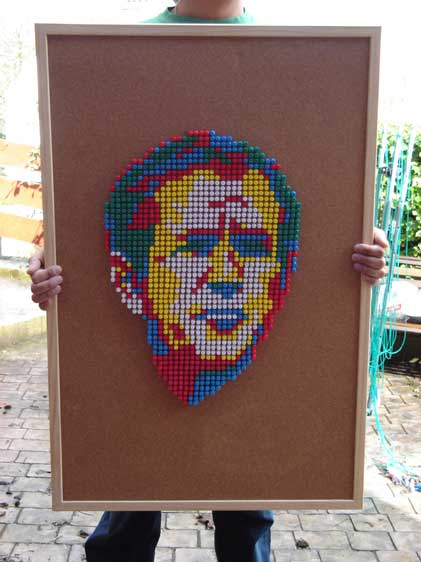 President George W. Bush admitted last week that his notorious "bring 'em on" challenge to any potential insurgents in occupied Iraq was "kind of tough talk, you know, that sent the wrong message to people."
"I learned some lessons about expressing myself maybe in a little more sophisticated manner, you know," continued the most powerful political leader in global history, drawing gasps of admiration for his adroit negotiation of words with more than two syllables. "'Wanted, dead or alive'; that kind of talk. I think in certain parts of the world it was misinterpreted."
I think President Bush is possibly judging himself a bit harshly. The prime role of language should not be to make one look sophisticated; it is to communicate facts and thoughts. So, the president said "bring 'em on". And I don't think that anyone can deny that the insurgents have indeed been brought on, as the slaughter of thousands of Iraqi civilians and hundreds of coalition troops can testify. He said it. It happened. In a world where our politicians are routinely excoriated for saying things that are simply untrue, I think Dubya's adherence to the tried-and-tested concept of cause and effect makes a refreshing change. Osama bin Laden, for example, was wanted, dead or alive. And they still want him, and he is, indeed, dead or alive. More specifically, the latter.
If Bush is still concerned about all the nasty people who mock his blunt talk (some of them even going so far to suggest that he's an abject cretin who'd struggle to wipe his own bottom without Karl Rove giving step-by-step instructions on his Blackberry), he seems to have a kindred spirit in one of our most revered contemporary composers. At around the same time the president was hinting that things might have gone a wee bit pear-shaped in Mesopotamia, Sir Harrison Birtwistle was accepting an Ivor Novello award for his contribution to classical music. Here is his acceptance speech:
"Why is your music so effing loud? You must all be brain-dead. Maybe you are. I didn’t know so many clichés existed until the last half-hour. Have fun. Goodbye."
Magnificent.
Sunday, May 28, 2006
I'm burnin' it
 Man tries to live a brand-free lifestyle, torching his branded possessions en route, and writes a book about it.
Advertising/marketing/branding site accuses him of hypocrisy.
Fair point? Or a sign that he's getting under someone's skin?
Thursday, May 25, 2006
Notes from a dank garret
Various literary pundits and practitioners have been offering their thoughts on first novels in the latest Bookforum.
 "That first novel will be like a rock in Virginia Woolf's pocket," says William H Gass. "Unless it is very bad, the author will never write anything as good again—it will be said. Critics who complained of the first novel will wish the writer would write another like it in order to complain (by comparison) of the sixth." But I don't get his next point: "Though Ulysses is a first novel, it is not a first novel."
Across the page, Craig Seligman also suggests that the true value of a first novel is only revealed in the context of history: "But we don't read in a vacuum, and, however exacting our critical faculties, we don't read the first novels of the writers we care about for their merits alone. There's also the pleasure—one part malice, nine parts love—of seeing our gorgeous friends in their gawky adolescence."
The belief that a substantial number of writers ever grow out of their adolescence is touching, if misguided.
"That first novel will be like a rock in Virginia Woolf's pocket," says William H Gass. "Unless it is very bad, the author will never write anything as good again—it will be said. Critics who complained of the first novel will wish the writer would write another like it in order to complain (by comparison) of the sixth." But I don't get his next point: "Though Ulysses is a first novel, it is not a first novel." Across the page, Craig Seligman also suggests that the true value of a first novel is only revealed in the context of history: "But we don't read in a vacuum, and, however exacting our critical faculties, we don't read the first novels of the writers we care about for their merits alone. There's also the pleasure—one part malice, nine parts love—of seeing our gorgeous friends in their gawky adolescence."
The belief that a substantial number of writers ever grow out of their adolescence is touching, if misguided.
Monday, May 22, 2006
"...the whooshing sound..."
Iraqi TV will shortly begin screening a public information film to dissuade suicide bombers. Maybe they should draw up a sort of Green Crescent Code. "Stop at the kerb, away from parked infidel Humvees..."
And there's an excellent piece by John Patterson in Saturday's Graun on why US TV today is better than US cinema. Apart for the observation that shows such as The Sopranos are essentially "soaps for men", he suggests that those who persist in watching movies on the big screen are like people who buy hardback books. And when was the last time you did that?
Also, Ian Hocking gets his Murakami homework done, beating me to the (affectionate?) punch. Although the reason for my sluggishness is best summed up by the following, from David Freedman.
 And there's a virtual fun-size Milky Way for the first person to explain the post header.
And there's an excellent piece by John Patterson in Saturday's Graun on why US TV today is better than US cinema. Apart for the observation that shows such as The Sopranos are essentially "soaps for men", he suggests that those who persist in watching movies on the big screen are like people who buy hardback books. And when was the last time you did that?
Also, Ian Hocking gets his Murakami homework done, beating me to the (affectionate?) punch. Although the reason for my sluggishness is best summed up by the following, from David Freedman.
And there's a virtual fun-size Milky Way for the first person to explain the post header.
Subscribe to:
Posts (Atom)