You know how Tom Lehrer supposedly claimed to have stopped writing songs when Kissinger was awarded the Nobel Peace Prize, because reality had finally triumphed over satire? And how he subsequently denied he’d said that, probably because subsequent events (George W Bush as President, Ann Widdecombe on Strictly Come Dancing) made the Kissinger thing seem almost sensible?
Well, anyway, here’s Marie Osmond reciting Dada poetry. Hat-tip to my beardy college chum Nick Abrahams.
PS: And on the subject of transgressive art, how about the phantom coat thief?
Monday, October 11, 2010


Sunday, October 10, 2010

Friday, October 08, 2010
When I am an old woman...
I am grateful to the lovely Great She Elephant for nudging Urlai through the back door of my perception. It is a site that claims to be able to analyse the text of a blog and extrapolate the gender, age and general mood of the author.
Close study of the previous 12 posts tells us that Cultural Snow “is probably written by a male [OK, fair enough] somewhere between 26-35 years old. [Thank you!] The writing style is personal and upset most of the time.”
Hmm.
PS: And still on blog-related matters, anyone who happens to be in Bristol on October 22 might find this interesting.
Close study of the previous 12 posts tells us that Cultural Snow “is probably written by a male [OK, fair enough] somewhere between 26-35 years old. [Thank you!] The writing style is personal and upset most of the time.”
Hmm.
PS: And still on blog-related matters, anyone who happens to be in Bristol on October 22 might find this interesting.
Wednesday, October 06, 2010
Society of the spectacles

When Jonathan Franzen’s publishers announced that thousands of copies of his novel Freedom would be pulped after the wrong version was printed, the dials on my cultural bullshit detector immediately flipped into the red. It’s just the sort of story that liberates an author from the high walls of the review sections, and into the news pages, where normal people might go. It’s an amusing cock-up story, but not one that reflects badly on the writer himself; a bit like that time when Jeanette Winterson’s manuscript was left at Balham Tube station.
But the next événement to spice up the drudgery of Franzen’s UK promotional tour was at the same time too banal and too weird to have been dreamed up by some fresh-faced catamite in the Fourth Estate PR department. At Monday’s launch party, someone swiped the poor man’s glasses from his nose, dropping off a ransom note at the same time. The location of the attack (the Serpentine Gallery) and the preposterous demand (£100,000 to you, guv) immediately suggest some sort of neo-Situationist prank, probably carried out by art students.
But no. The spec-snatcher, James Fletcher, is indeed a student, but a student of computational aerospace design. Any aesthetic motivation appears to have been subconscious, as he wrote afterwards in an article for GQ:
Some articles have suggested that the theft was perhaps a display of some kind of art... I’d just like to comment that if art is defined as something which provokes an emotional response, then I suppose it was art.Instead, the attack seems to have been motivated by far more mundane factors:
We sat drinking excessive champagne for a while and talking to some of the guests there until I realised just how dull it all was... I’d mentioned several times to my accomplice how much I admired Franzen’s frames... I remember shouting as I snatched the glasses off the bewildered man's face that I was with Channel 4 doing a comedy stunt. Looking back, I’m not exactly sure what that meant or why I said it.All in all, then, a terribly 2010 manifestation of artistic outrage: a combination of drunkenness, boredom, material avarice and the incoherent, atavistic desire for some kind of fleeting celebrity, however ill-defined. It’s the sort of thing someone should write a big fat novel about. What’s Jonathan Franzen doing these days?
Tuesday, October 05, 2010
Death of Venice
 Venice, in common with many beautiful places, is subject to a terrible paradox: it needs a stream of visitors to fund its upkeep, but those visitors, their feet and fingers, their breath and sweat, are partly to blame for making the upkeep necessary. So it’s little wonder that the city’s inhabitants and elected officials have a somewhat ambivalent attitude to the camera-toting grockles who come to gawp at the loveliness. The mayor, Giorgio Orsini, seems to have decided that, all things considered, the bloody tourists are more trouble than they’re worth, hitting back at those who complain that many of the best bits are hidden by giant billboards. “What difference does it make if the scaffolding shows a picture of the building underneath or an advert,” he asks. “If people want to see the building they should go home and look at a picture of it in a book.”
Maybe he’d rather they went to the Venetian in Las Vegas, that Simulacrum of Sighs, the Likeness of Lagoons in the middle of a bloody desert. Or, better still, the version in Macao, which copies the Vegas Venice rather than the Venice Venice. And doubtless, in the coming years, a succession of Venetians in Rio and Riyadh and Reykjavik, anti-Xeroxes, each one brighter and sharper and more hyperreal than the last. While the real Venice, the first Venice, sinks beneath the water, forsaken and forgotten, the last sound to come from it being a bubbly entreaty from Mayor Orsini, trying to sell you one last overpriced postcard.
Sunday, October 03, 2010
Slip of the tongue
 Still on a vaguely Gallic theme, I do have a degree of sympathy with the MEP Rachida Dati, who managed to confuse inflation with fellatio in a TV interview, something I suspect we’ve all done at some time or other. Her faux pas brings to mind an earlier French icon, France Gall, who in 1966 recorded the Serge Gainsbourg song ‘Les Sucettes’, apparently entirely oblivious to its, um, inflationary subtext; she remained in blissful innocence even after making this promotional clip. When someone (I bet it was Gainsbourg, the cad – I’ll never forgive him for what he said to poor, lovely, pre-crack Whitney Houston) explained what was going on, she hid in her bedroom for weeks, and never made a decent record again.
Next week: Ann Widdecombe attempts to warn us about the possibility of a double-dip recession, but accidentally starts talking about bestiality in the middle of the paso doble.
Thursday, September 30, 2010
Ceci n’est pas une peinture
Le plagiat est nécessaire. Le progrès l’implique.In an overpriced hotel in the 5th arrondissement, the concierge asks where we’re off to. The Museum of Modern Art, we tell him. “Oh, the Pompidou, you mean,” he says. No, the other one, we insist. He looks baffled.
—Guy Debord (although Lautréamont said it first)
It feels appropriate that an exhibition challenging our very definitions of art should take place in an art gallery the existence of which is a mystery even to well informed Parisians. Seconde Main (Second Hand) is an exhibition of lookalikes, pastiches and other responses in kind by artists to other artists. Rather than hive it off into a dedicated section of the gallery, the curators have integrated the exhibition into the main collection, putting the second-hand roses alongside the real thing, and making us question the identity and nature of both. In what feels like a loss of nerve, the lookalikes are identified with pink stickers – wouldn’t it have been braver to let us guess? – but the effect is still disconcerting and thought-provoking.

Part of this is due to the nature of the museum’s main collection. Although it contains plenty of big names (Matisse, Chagall, Dufy, Dubuffet, et al) few of the works themselves are instantly recognisable, the sort that you’d find on tea-towels or fridge magnets: this, presumably, is why concierges don’t know about the place. So you see something that looks primitive and jungly, and you just assume it’s a Rousseau, because if you know a bit about modern art, you know that’s that sort of thing that Rousseau did, even though you’ve never seen the painting before. And then you discover it’s not a Rousseau at all; it’s actually by some chancer called Ernest T, who takes the titles and dimensions of Rousseau’s lost works, and has a good guess at what they might have looked like, and paints his guesses.
Many of the works, though, are responses to works that are real and existent and very well known. Richard Baquié takes on Duchamp’s Étant donnés, an installation that requires the viewer to peer through a tiny peephole and immediately become a voyeur to a scene that hints at, but never explicitly announces itself as, the aftermath of sexual violence. Baquié disembowels the original, showing its workings, like Penn and Teller telling you how a magic trick is done. But it doesn’t destroy your respect for the original, because you know that without Duchamp having spent 20 years concocting Étant donnés in the first place, Baquié would have nothing to work with; just as Duchamp himself must have known when he doodled facial hair on the work of a previous artist, nearly a century before.
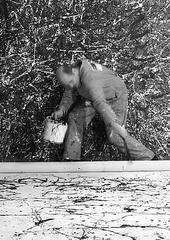 Indeed, many of the subjects (targets? victims?) of the artists here have already been responsible for (guilty of?) appropriating other works, so when Mike Bidlo responds to Warhol’s soap box or Manzoni’s can of shit, we can smile at the cleverness, but the same joke doesn’t bear repeating too often (as it is about Lichtenstein, Jasper Johns, Jeff Koons, Bridget Riley and plenty other Pop-ists and Op-ists). The Art & Language collective do something that could well be a Pollock drip painting; more effective is Gavin Turk becoming Pollock himself, emulating Hans Namuth’s images of Jack the Dripper at work. We can become tired of the art, he seems to hint, long before we tire of the artist. Well, Gavin *was* a YBA, wasn’t he?
The brochure namechecks Borges’ Quixote, and you (OK then, I) sort of expect/hope Baudrillard might get a mention as well, but this isn’t really about pure simulacra. The originals have to be present, indeed, have to be dominant, for the copies to make any sense. When Fayçal Bagriche spirits Yves Klein, Trotsky-like, out of his own Leap into the Void, it only makes sense if you know the original. Otherwise, it’s just a photo of a sidestreet.

Seconde Main demands of the viewer a basic working knowledge of the art of the past 100 years, a knowledge of who Pollock was and what Picasso did, for it to make sense. So not only can this exhibition only work in this museum, it can only work in this country, maybe only in this city, where they don’t worry so much about art being “accessible” and “inclusive”. Art’s just there; deal with it. If you can’t deal with it, here’s a book about it. But preferably not one by Dan Brown, whose baleful presence still hangs over the city.
That said, this is still a learning experience. Towards the end is the only piece that’s an actual fake, intended not just to provoke or confuse or amuse, but to deceive; an ersatz Modigliani by the forger Elmyr de Hory. And somehow, I spot it as a wrong ’un even before I see the pink sticker. I don’t think I’d have been able to do that before I came in.
Tuesday, September 28, 2010
Diabolical liberties
A couple of paintings, new to me, that I saw in the Musée Carnavalet at the weekend:

Jean Touzé (1747-1809), The Jacobins in Hell

Jean Véber (1864-1928), The Parisians Pull the Devil by the Tail
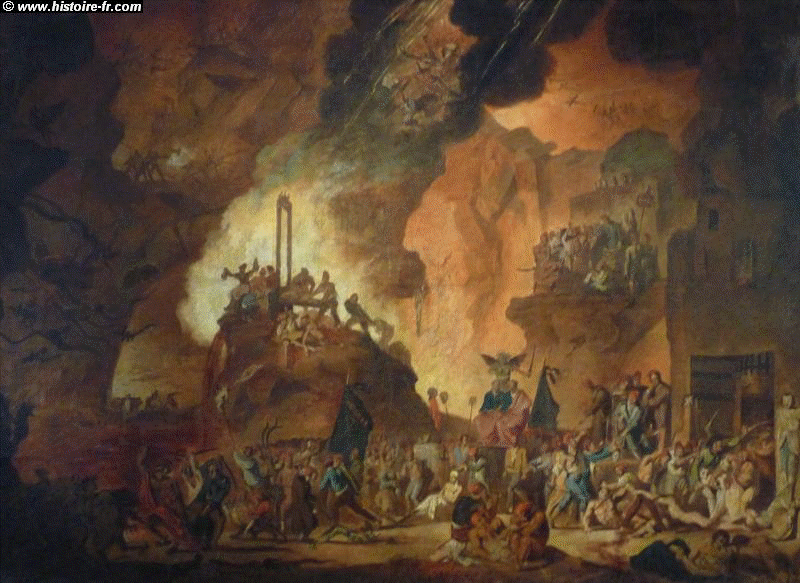
Jean Touzé (1747-1809), The Jacobins in Hell

Jean Véber (1864-1928), The Parisians Pull the Devil by the Tail
Subscribe to:
Posts (Atom)