Sunday, November 20, 2011

Thursday, November 17, 2011

Mad women


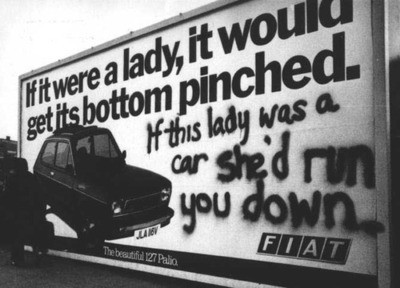
In case anyone needed reminding that the foam-flecked wings of Islam and Christianity don’t hold a duopoly on swivel-eyed witlessness, ultra-orthodox Jews in Jerusalem have taken to ripping down advertising posters that contain images of women. Which is an affront to freedom of expression and insulting to women – until you remember that feminists have had plenty to say about the depiction of women by the advertising industry, and quite a few have taken direct action to express it.

Hmm. Similarly confused thoughts come to mind when watching the following:


Now, according to AdRants, the clip has been “banned”, although I’m sure there was never any intention of using it in mainstream media; it will live and/or die on the web, where it exists as much to sell the reputation of the creative team as it does to shift units of denim (rather like Benetton’s latest attempt to foster intercultural harmony). It’s offensive, in the sense that quite a few people will be offended by it, although different elements will offend different people: the implied lesbianism; the implied necrophilia; the buttocks. I suspect, however, that the big problem comes with the pile of dead women, and the clear suggestion that someone is going round killing them for their jeans. The question is whether it’s less or more reprehensible when we know that the killer is a woman; we can hold onto the notion that killing women is A Bad Thing, but this time we can’t really blame it on the patriarchy, can we? As Camille Paglia said – and she’s a woman, so it’s OK –  “There is no female Mozart because there is no female Jack the Ripper.” But if there were, she’d almost certainly work in advertising.

Monday, November 14, 2011

Paris match

A highlight of my last visit to Paris was Seconde Main, an exhibition of forgeries and pastiches at the Museum of Modern Art. And now we discover that, towards the end of the First World War, the French began building a massive replica of Paris, to confuse the Germans. This can be contrasted with the Americans, who now build massive replicas of Paris and other cities, mainly to confuse Americans; and then in Macao they replicate the replicas, as if anyone cares. But that’s just cheesy postmodernism, and you get quite enough of that here already. If the practical purpose of the decoy Paris was to protect the real city, and to do so the French wanted to create a simulacrum that was identical in all respects, surely there must have come a point at which the builders would have decided the decoy was so beautiful and romantic that it needed protection as well, and so another decoy would need to be built – a replica of the replica – and so on...

Which in turn reminds me of Borges’ story On Exactitude in Science,  in which he discussed the notion of a map that was exactly the same size as the territory it depicted; the question being the extent to which a representation of an object becomes that object. Which almost certainly sounds better in Spanish:

Saturday, November 12, 2011

J’en ai marre

The Smiths, you see, were my band. I was born in 1968, and following the rule that the music that comes into your life during your 15th year is the music that will never leave you, the Smiths have been sitting on my skinny shoulders ever since. They didn’t offer a cure for my teenage ailments – the insecurity, the frustration, the acne – nor were they crass enough to tell me not to worry about them. Instead, they crafted an aesthetic in which all of them, the worry included, were nurtured, even celebrated. Life was indeed a Beckettian mess, but it might be survived, and you might even get to read a few decent books along the way. My flawed, misshapen humanity was as worthy of respect as that of the smooth-skinned, white-toothed hunks who could catch a rugby ball without bursting into tears.

And then the zits and the insecurity faded (although neither really went away) but the Smiths were still my band. I never became a devotee of Morrissey’s or Marr’s solo output, but the material they made between 1983 and 1987 remained, an anchor in bad times, even raising a goofy smile when it caught me unawares.

And then this happened:


Now, I know that in the download age, musicians and composers have to make a living. It’s not as if the Smiths are the first band to have farmed out their back catalogue to the advertisers; the Beatles have flogged running shoes, the Rolling Stones have hawked computers, and I suspect their financial needs are less than those of Morrissey and Marr. And I don’t really mind that it’s a crappy cover version; the song has suffered far worse. It’s not even that it’s John Lewis, a shop that I’ve happily used in the past, although I do wish they’d stop sending me promotional e-mails every few minutes just because I bought a washing machine from them a few years ago.

No. It’s Christmas that’s the problem. The modern, retail-driven Christmas is a festival that might as well have been designed simply to contradict everything the Smiths ever (claimed to?) stand for. It’s about optimism, sentimentality, consumption, warmth, family, hand-knitted comedy jumpers and chocolate liqueurs. It’s about a world in which the anguished yearning expressed in ‘Please, Please, Please Let Me Get What I Want’ can be satisfied with a new pair of football boots or a games console. One can only assume that the person who decided to use the song in this context simply failed to understand it and – far more galling – its composers elected not to disabuse him. I wonder if there might have been a shortlist of other possible songs, if M&M had suffered an attack of scruples; perhaps ‘I Want More’ by Can, or ‘Having It All’ from the Absolute Beginners soundtrack.

It’s as if Morrissey had wandered into my teenaged bedroom, with its postcards of him and Oscar Wilde and Louise Brooks, and offered to do something about my acne, and then proceeded to deposit a huge, steaming, vegeburgery shit all over my face. And then Johnny Marr appeared at his shoulder, volunteering to clear up the mess with a big, fluffy John Lewis towel, which only made things worse. And then I realised they were both wearing Santa hats. And hand-knitted comedy jumpers.

Thursday, November 10, 2011

...but there’s a prize for every one we show

Last week, a cleaner at a gallery in Dortmund scrubbed a stain from a trough, thus ruining – or perhaps enhancing – Marcus Ostwald Martin Kippenberger’s installation When It Starts Dripping From The Ceiling. Much hilarity ensued at the revelation that Ostwald Kippenberger’s piece had been valued at 800,000 euros. It is not real art, we were informed by a phalanx of Sewell manqués. A child of five could do it, harrumphed the people who Know What They Like.


This week, Roy Lichtenstein’s 1961 painting I Can See The Whole Room!... And There’s Nobody In It sold for US$43 million, a record for a work by the artist. In this case, no voices were raised complaining that it’s not real art, although it does have something very significant in common with the Ostwald Kippenberger work; the fact that it relies on a joke. It’s a perfectly good joke (did you hear the one about the people who go to an art gallery to look at some pretty pictures and are forced to think a little bit harder about what they’re doing there?) but it’s not particularly new, and Duchamp and Magritte and Manzoni told it earlier and better.

To be honest, the existence of When It Starts Dripping... would almost certainly have passed me by had the unnamed cleaner not been so zealous in her work, which did make me more than a little suspicious of the whole story; in fact, I’ve long wondered whether such brouhahas as the attacks on Marcus Harvey’s Myra or even the Momart fire that destroyed so many BritArt pieces were not discrete events beyond the artists’ control, but a necessary aspect of the art works themselves. Maybe that’s what the difference is between Lichtenstein and Ostwald Kippenberger: although they tell the same joke, the latter needs someone else to deliver the punchline.

Oops. Ostwald is the name of gallery. 

Tuesday, November 08, 2011

Now we are six


I started this blog six years ago today. My first post mentioned the analogue/digital continuum, Bertie Bucket (RIP), Haruki Murakami (see last post) and vodka. Well, what did you expect? Progress?

Saturday, November 05, 2011

Diacriticism

The first page of the US edition of Haruki Murakami’s 1Q84 is annoying me – well, I say the first page, but 1Q84 is clearly A Publishing Event, with all the bells and whistles and publicity budgets that entails, so you only get to the first page once you’ve negotiated the Chip Kidd cover, with its translucent dust cover that reminds me of New Order’s Low-Life album, and a title page that stretches over eight pages (each character in the title being repeated, with one character per page), and a quotation from the song ‘Paper Moon’, and page that reminds you that this is book one of a trilogy, and that’s not to mention the photographs of the moon and clouds, and the page that just says “HARUKI MURAKAMI”, black on white, in case you’d overlooked the prominent mention on the cover and somehow thought you were buying something by Julian Barnes or Zadie Smith or Malcolm Gladwell or Katie Price – then, only then, do you get to the first page. Although it’s actually page 3. And, on the offchance that you haven’t yet had enough of the cleverness, the “3” is printed backwards. That reverse, I’m guessing, is deliberate. I’m less sure about what happens when we get to discussing Janáček.

The action, you see, begins in a taxi on an expressway in Tokyo in 1984, and Leoš Janáček’s Sinfonietta is playing on the radio. The passenger, Aomame, muses on the circumstances of its composition and first performance, in 1926, which was also the beginning of the Shōwa era, the reign of Emperor Hirohito. The first couple of times the composer’s surname is mentioned, it’s as above, with the correct Czech diacritics in place, including the háček or caron, that upside-down circumflex thingy above the “c”. But then something goes a bit wrong in the typography department, and the next couple of times the háček has slipped sideways, so “Janáček” becomes “Janáˇcek”.

And that annoys me. Now, before anybody points a finger, I’ll admit that I’ve written books that contained mistakes. I’ve attributed a Schopenhauer quote to Nietzsche, allowed in a couple of stray exclamation marks, written “Columbia” when I meant “Colombia” (or was it the other way round?) and confused a Leonard Cohen novel with a Madonna song. On the other hand, my books weren’t quite so keenly awaited, their release didn’t coincide with the author being tipped for the Nobel Prize, and Chip Kidd didn’t do the cover.

On the other other hand, maybe it isn’t a mistake. After all, we are informed that the book is called 1Q84 because the Japanese for “nine” sounds like “Q”, so they carried the pun over into the translation, even though it doesn’t work in English, so maybe it will turn out that the disconnected háček has a meaning that I haven’t yet disinterred. I doubt it though. Incidentally, some people have taken to calling the book IQ84, beginning with a letter rather than a number, which may appear to make more sense, but probably doesn’t.

Fans of Murakami who haven’t yet begun the book may care to note that the first page contains no Miles Davis references, no cooking of spaghetti, no talking cats and no disturbed teenage girls into non-penetrative sex.

That said, regular readers of this blog (who will know that it takes its title from Murakami) must surely be delighted to know that there are another 922 pages to go.

This post is dedicated to the memory of Dr Chris Brooks, who once devoted a two-hour tutorial to the first sentence of Great Expectations. Flood update: watching, waiting. And here’s Janáček, trumpets and diacritics and all:


Wednesday, November 02, 2011

Everyone will become famous for 15 tweets

In The Guardian, Chris Floyd presents photographs of his favourite Twitter users. Forget Stephen Fry and Ashton Kutcher, though: one or two of them, refreshingly, are those mythical beasts, “ordinary people”, not actors or musicians or even, um, Guardian writers (three of whom are on Floyd’s list). Although now that the temp and the civil servant have achieved this random jolt of mainstream media attention, they will of course cease to be ordinary people, and at same time, cease to inhabit a nice little secret corner of social media; perversely, when they stop being ordinary, they also stop being special. Everybody knows them, and they are ruined. “Ignorance is like a delicate, exotic fruit,” said Lady Bracknell, accidentally inventing quantum theory while she was at it. “Touch it and the bloom is gone.”