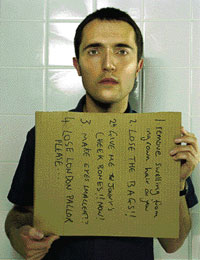
Yeah, right, I said...
Wednesday, March 14, 2007
You're older now and you're a clever swine
Anyway, those nice people who do The Grauniad asked me (and quite a few other people, such as Dave H) what I'd like to happen in the next 12 months. So what did I ask for, from the Santa of Farringdon Road? World peace? Cure for AIDS? End of global warming?

Yeah, right, I said...
Monday, March 12, 2007
Dumb and then some
I come back to her because of a new survey that lists the books that Brits don't finish. All the usual suspects are in place: Ulysses; War and Peace; The Satanic Verses; big, important books that you feel you ought to read, but never quite get around to finishing. Or even start; one of the most disturbing findings from the poll is that 55% of respondents buy books for decoration, with no intention of reading them.
This becomes even more depressing when you realise that one of the unread books is the aforementioned Jade: My Autobiography. Now, I can see all sorts of reasons for not reading the book, and for not buying it in the first place. But, presuming you're the sort of person who might choose to acquire it, you're not likely to cast it aside with disgust, because you suddenly realise what a dreadful woman J.O.O.B.B. is. So there can be only two reasons for not pursuing it to its inevitably gripping conclusion. One is that you find it too intellectually taxing. The other is that you bought it simply as decoration; the implication being that it should be propped up between A Suitable Boy and A Brief History of Time, as a means of impressing the neighbours.
It's then that you remember that the people who purchase Jade: My Autobiography are, to some extent, an elite, in that they buy books at all, even if they only buy them to make other people feel inadequate. Which ties in with another story, about allegations of skulduggery in phone-in quizzes on TV. The big chinstroke for many commentators seems to be about the level of trust between producer and consumer, coupled with the suggestion that you've got to be pretty dumb to keep chucking money at these competitions, despite the production office mantra that the viewer isn't stupid. But wasn't the truth about the aptitudes of the sofa species (or at least the professionals' perception of those aptitudes) already apparent from the questions being asked? As Holy Moly reports, a researcher on This Morning (in its Richard and Judy incarnation) was tasked with setting the teasers for 'Mid-Day Money', and was advised that "What is the capital of France?" might be too challenging a conundrum for the target demographic. His facetious suggestion of "What colour is an orange?", however, was accepted with alacrity.
And before anybody says it, yes, I know. The capital of France is 'F'.
Sunday, March 11, 2007
Sense of hooter
James BC directs us to a project that a) may raise a few quid for the many worthy causes supported by Comic Relief, and yet b) doesn't make more discriminating viewers want to disembowel the leading lights of Light Entertainment. Go here for details.
I might pitch something in, but I don't really think I do funny ha ha particularly well.
Friday, March 09, 2007
Opinions which are of no consequence at all
C'mon, gimme a break. At least my publisher didn't accidentally on purpose leave the manuscript on the platform at Balham Tube station so as to garner a small cough of publicity for a waning career.
Nevertheless, just like the nugatory slivers of news that adorn the advertisements in that free publication that a Slovenian thrusts into your paws when you're trudging to work; or maybe the interview with David Letterman that gives you an excuse to buy Playboy, here are a couple of things that aren't plugs. One is an interesting bit of metablogging from David Cox at CiF (although, as Patroclus rightly insists, CiF isn't a blog).
And the other is from my current bedside read, Sex, Drugs, and Cocoa Puffs, by Chuck Klosterman:
Wednesday, March 07, 2007
This blog did not take place
Jean Baudrillard, philosopher, sociologist and cultural theorist, pioneer of the simulacrum and hyperreality, died yesterday at the age of 77. And yes, as Joel pointed out a few months ago, he does indeed look quite like Stanley Baxter.
PS: CiF piece here.
Tuesday, March 06, 2007
The posh kids win, they always do...
Olav, aka Quiz Blogger, has pointed out an odd lacuna in the US trailer for quiz-show rom-com Starter for 10. (I should point out that I haven't seen the film, because I read the book, and got slightly annoyed at the liberties that the author had taken with the rules of University Challenge. I'm sorry, but these things matter.) It does seem from these clips that they want to turn it into that cheesy but endearing 1989 movie version of Martin Amis's The Rachel Papers, and I can't be the first to notice that James McAvoy is the new Dexter Fletcher, which must not only worry him a little, but makes me feel exceedingly old.
More significantly, isn't it a bit odd that the trailer seems to contain no reference whatever to any kind of TV quiz show? It's a bit like making a trailer for Titanic, but leaving out the boat. Which would have made that particular film rather shorter, but also less amusing.
And what's the title meant to mean if you leave out the quizzy bit? A particularly greedy selection of hors d'oeuvres?
Saturday, March 03, 2007
Race oddity
It might appear that Life On Mars has fallen victim to the same fate as Johnny Speight's Till Death Us Do Part, which set out to satirise racism, then saw its villain become a hero. Tyler hates being stuck in this backwater of bigotry, confronting, whereas the viewers see it as a rather refreshing diversion. But is the tale of the stranded copper really as dangerous as it thinks? Sure, the pre-PC PCs smoke and drink and pinch birds' bums, and Hunt is a marvellously judged tribute to the mighty Jack Regan. But, for the most part, we laugh at them, not with them, and sigh along with the more enlightened Tyler. For example, one recent episode sees a black detective seconded to the squad. Ray Carling, the most Neanderthal member of the team, gets his jabs in, but the worst he can come up with is an anaodyne gag about "spadework". Is that really the nastiest abuse a non-white policeman could expect in the canteen culture of the 1970s? If frustrated blokes think they're getting a vicarious dose of the years when racism and sexism didn't need to come with quotation marks, they're deluding themselves.
Maybe this is the problem with retrospective pastiche: in attempting to achieve a perspective on the past, we lose the essence. But did TV ever really express the racism and sexism of the era? I recently watched the first episode of the 1969 sitcom Curry and Chips, also created by Speight, about a Pakistani starting work in a factory. Clips occasionally show up on cheerful compilations about 'TV Hell', or earnest documentaries about the representation of ethnic minorities in less enlightened times, but otherwise the show might as well be an urban myth.
First off, despite the presence of Eric Sykes and Spike Milligan, it's not very good. The jokes are heavy-handed, the pacing is non-existent, actors (especially Milligan) are visibly corpsing, and the jackal-like studio audience is profoundly annoying. But is it racist? Well, characters use words like 'wog' and 'Paki' a lot, which is disturbing to modern sensibilities. But it's made quite clear that the worst offender, the Powellite Norm, is a moron (as was the case with the similarly taboo Love Thy Neighbour). Sykes, as the manager, is a decent bloke who tries to help the new recruit to feel at home. Not that the moral battle lines are so cut and dried; you could almost call the whole thing nuanced. A black character, played by Kenny Lynch, joins in the abuse of the newcomer, arguing "At least I was born here". A landlady expresses reservations about taking him in, but relents after she decides that he's quite good looking. Could this have been the inspiration for last year's Oscar surprise, the bit-crap-and-muddled-but-its-heart's-in-the-right-place Crash?
Probably the aspect of the show that's hardest to stomach is the presence of Milligan, browned-up to play Kevin O'Grady (his mother was Irish, so the story goes), with an excruciating Gunga Din accent. White actors in minstrel mode make us very uneasy, but Milligan's performance is so stilted and unnatural, that the racial provenance soon becomes irrelevant. The whole point is that he's an outsider and a catalyst, and might have come from anywhere in space (like Mork from Ork) or time (like Sam Tyler). After all, it's hardly a documentary.
Perhaps that's the thing to remember, when pondering what Life On Mars tells us about the frustrations of contemporary masculinity. The past that viewers see, playing out to a glam-rock soundtrack, is a scrubbed-up version of the reality of those years. And the much-maligned 'political correctness' (if that includes the unspoken assumption that racism is a bad thing) was alive and well on TV even then.
Thursday, March 01, 2007
The future's orang
I loathe anthropomorphism, or any kind of wet sentimentality about animals. Not only is it demeaning to the animals, it pushes humans into a sickly, soft-brained second childhood, where they decorate their desks with bad watercolours of kittens, and place obituary notices in pet magazines, pledging that they will meet their deceased mutts "at the Rainbow Bridge".
On the other hand...
aaaaawwwwwwwww....
On the other hand...
aaaaawwwwwwwww....
Subscribe to:
Posts (Atom)